
In the last part of this series I looked at the organisation of Napoleon’s Young Guard at various stages in its development. This time I’m looking at the uniforms of the various regiments that made up the Young Guard infantry (in Part 1 I looked at the Old Guard and in Part 2 I covered the Middle Guard).
The Tirailleurs-Grenadiers (1809-1810)
 The 1er & 2ème Tirailleurs-Grenadiers wore a blue, short-tailed habit-veste coat, cut to light infantry style with pointed bottom-corners to the lapels, which were blue, piped white. The collar was red, piped blue. The pointed cuffs, tail-turnbacks and shoulder-straps were red, piped white. The turnbacks had white eagle badges as turnback-ornaments. Buttons were brass.
 Shakos had white cords and white lace chevrons on the sides, in the same manner as the Fusiliers-Grenadiers. The front of the shako was decorated with the Young Guard eagle-plate in brass, with national cockade above and brass reinforcing to the edge of the brim. There were initially no chin-scales on the shako, though they were soon added. Plumes were officially red-over-white. The proportion of white to red varies from source to source, though the majority view seems to be that the plumes were split half red to half white (some sources show white with just the very tip in red – perhaps the top quarter or so). However, plain red plumes and white-over-red plumes are also recorded for the 2ème Tirailleurs-Grenadiers.
Breeches and waistcoats were white and worn with black gaiters, which were shorter than the usual French pattern, only coming up to just below the knee. White gaiters were also retained for parade dress. The black gaiters were secured with brass buttons down the outside edge, while the white gaiters had white buttons.
Equipment was exactly the same as the Fusiliers-Grenadiers, namely two white cross-belts, one supporting a black cartridge-box decorated with the brass Young Guard eagle badge and the other supporting a short-sword. The sword was decorated with a white sword-know with a red tassel.
Drummers wore the same uniform, though with gold-yellow lace edging to the lapels, collar, cuffs and turnbacks.
NCOs had mixed gold/red shako-lace and cords and mixed god/red fringed epaulettes.
‘Old Hands’ will already have spotted my deliberate mistake in the unit pictured… Officers were seconded from the Fusiliers-Grenadiers and wore the uniform of their old regiment. So the officer shown below should instead have white, square-cornered lapels a plain blue collar and red Brandenburg cuffs with white cuff-flaps, all topped off with a red plume. In my defence, I was led astray by the numerous prints and painted wargames units showing officers wearing the same style of uniform as the rank-and-file… 🙁
Bah! 🙁
As for the the Fusiliers-Grenadiers, the regiments of the ‘New’ Young Guard were not authorised Eagles and instead had to make do with various unofficial fanions or marker-flags. One fanion of the 1er Tirailleurs-Grenadiers is recorded as a sky-blue flag, decorated with red grenade badges, as shown here.
If you want to model these using AB Figures, use the Young Guard Infantry 1809-13 figures and Fusilier-Grenadier Officers. The fanion is by Fighting 15s.
In 1810 the 1er & 2ème Tirailleurs-Grenadiers became the 1er & 2ème Tirailleurs (see below).

The Tirailleurs-Chasseurs (1809-1810)
 The 1er & 2ème Tirailleurs-Chasseurs wore a uniform very similar to that of the Tirailleurs-Grenadiers above. The differences are shown in the figure on the right, namely:
The shako had no lace chevrons and instead of a plume had a green spherical pompom.
The shoulder-straps were green with red piping (one source says white piping).
The sword-knot was plain white.
Tail-turnback ornaments were green eagle and hunting-horn badges.
NCOs wore mixed green/gold shako-cords, lace and fringed epaulettes.
Officers wore the uniform of the Fusiliers-Chasseurs; namely a blue coatee with white lapels, plain blue collar, plain red tail-turnbacks and a red-over-green plume.
I’ve not painted any Tirailleurs-Chasseurs, as my 1809 Young Guard brigade is already represented by the Tirailleurs-Grenadiers above. However, if you want to model these using AB Figures, use the Young Guard Infantry 1809-13 figures and trim the plumes down to make pompoms. Also use Fusilier-Chasseur officer figures, though retaining the shako-plume.
In 1810 the 1er & 2ème Tirailleurs-Chasseurs became the 1er & 2ème Voltigeurs (see below).
The Conscrits-Grenadiers (1809-1810)
 The 1er & 2ème Conscrits-Grenadiers again wore a short-tailed habit-veste, though this time cut in the line infantry style, with square lower corners to the lapels. The lapels and collar were plain blue without piping. The cuffs were like those of the Fusiliers-Grenadiers, being plain red with white, three-pointed cuff-flaps. Shoulder-straps were blue with red piping. Tail-turnbacks were white with red piping and red eagle badge ornaments. Buttons were brass.
The shako had the brass Young guard eagle badge on the front, with national cockade above and brass edging to the peak. Brass chin-scales were also added at some point before their disbandment in 1810. Cords were red. The sides of the shako had the white lace white chevrons that were the mark of Young Guard grenadier regiments. This was topped off with a red spherical pompom, or a red feather plume in full dress.
Waistcoats, breeches, gaiters and equipment were the same as the Tirailleur-Grenadiers.
Drummers had either gold-yellow lace edging to collar, cuffs, lapels and tail-turnbacks OR just lace edging to the collar, with six lace chevrons on each sleeve.
NCOs wore mixed red/gold shako-cords, lace and possibly had fringed epaulettes.
Unlike the Tirailleurs, the officers this time wore the same basic colourings of uniform as the rank-and-file, with the usual officers’ distinctions of gold epaulettes and shako-decoration.
As this was a short-lived regiment, the lack of information has led to a wide variety of uniform variations in paintings and plates, many of which are undoubtedly bogus. These include white piping on the lapels, plain white lapels, white shako-cords, padded red ‘trefoil’ shoulder-straps, white-over-red plumes and drummers’ red shoulder-wings.
I don’t have any information on fanions for the Conscrits-Grenadiers.
I haven’t painted these, as they were short-lived regiments that didn’t fight in the main theatres of war. Though if you want to model these using AB Figures, use the Young Guard Infantry 1809-13 figures. The lapels are the wrong shape, though as it’s all plain blue, this will be invisible. Use Fusilier-Grenadier officer figures.
In 1810 the 1er & 2ème Conscrits-Grenadiers became the 3ème & 4ème Tirailleurs (see below).
The Conscrits-Chasseurs (1809-1810)

Conscrit-Chasseur
The 1er & 2ème Conscrits-Chasseurs again wore a short-tailed habit-veste, though this time cut in the light infantry style, with pointed lower corners to the lapels and pointed cuffs, like the Tirailleur-Chasseurs. The lapels were plain blue without piping, though some prints show white piping. The collar was meant to be plain blue, though all prints show red collars with white piping. The pointed cuffs were red with white piping. Shoulder-straps were green with red piping. Tail-turnbacks were blue with red piping and green eagle badge ornaments. Buttons were brass.
The shako had the brass Young guard eagle badge on the front, with national cockade above and brass edging to the peak. Brass chin-scales were also added at some point before their disbandment in 1810. Cords were white. Pompoms were green and were either spherical or carrot-shaped (both varieties are recorded). Note that white chevrons were NOT worn on the sides of the shako, despite what these pictures show (the chevrons were the mark of Young Guard grenadier regiments).
 Waistcoats and breeches were blue, though white waistcoats are also shown. Gaiters were cut in ‘Hessian’ style like those of the regular light infantry regiments, with green lace edging and green tassels on the front. Equipment was the same as the Tirailleur-Grenadiers, though sword-knots were green with red tassels.
Drummers had basically the same uniform, though with red shoulder-wings, red tail-turnbacks and yellow-gold lace edging to collar, lapels, cuffs and tail-turnbacks. One description also shows NCO-style fringed epaulettes, being green with yellow-gold crescents and red fringe.
 NCOs wore mixed green/gold shako-cords, lace and had fringed green epaulettes with gold crescents and red fringe.
Unlike the Tirailleurs, the officers this time wore the same basic colourings of uniform as the rank-and-file, with the usual officers’ distinctions of gold epaulettes and shako-decoration.
I don’t have any information on fanions for the Conscrits-Chasseurs.
Again, I haven’t painted these, though if you want to model these using AB Figures, use the Young Guard Infantry 1809-13 figures.
In 1810 the 1er & 2ème Conscrits-Chasseurs became the 3ème & 4ème Voltigeurs (see below).
The Tirailleurs (1810-1815)


Tirailleur (1810-1813)
The Tirailleurs continued to wear a uniform almost exactly the same as that worn by the Tirailleurs-Grenadiers, with one or two very minor differences. The most obvious difference was that the shako-cords now changed from white to red.
The shako-plumes were retained for full dress and were still meant to be red-over-white, but the 2ème Tirailleurs is also recorded as wearing white-over-red plumes, while the 3ème Tirailleurs are recorded as having plain red plumes (almost certainly inherited from their days as the 1er Conscrits-Grenadiers). However, pompoms were also adopted for wear in the field and were coloured by regiment. Recorded colours are 1er: red-over-white, 2ème: white-over-red, 3ème: red lentille with white centre, 4ème: white lentille with red centre, 5ème: white lentille with blue centre, 6ème: blue lentille with white centre (N.B. a lentille pompom was a padded cloth disc rather than the typical wool pompom).


Tirailleurs with plain red plume variation 1810-1813 (possibly 3e Tirailleurs?)
While officers were still seconded from the Fusiliers-Grenadiers and wore the uniform of that regiment, the expansion of the Young Guard in 1810-11 meant that officers were commissioned directly into the regiments of the Young Guard to fill the junior posts. These officers would wear a uniform of the same style as the rank-and-file, though with the usual officers’ gold epaulettes and shako-lace and cords (so I’ve got it right this time! Yay!). 🙂
In March 1812, Napoleon decreed that the Middle and Young Guard battalions would carry fanions of a plain pattern. For the Tirailleurs these would be a plain white flag (stop sniggering at the back…). However, somewhat inevitably, the various regiments quickly began creating their own versions with various decorations on the variation of grenades, eagles, wreathed ‘N’s and the like; some of them not even being in the regulation white colour. Only a few of these are positively identified and recorded, such as that of the 5ème Tirailleurs in 1813, which was a crimson flag with a gold star in each corner and a white central disc superimposed with the Young Guard crowned eagle badge in gold and a gold grenade on the reverse.

Aside from the Flanqueurs (see below), the Young Guard didn’t initially adopt the Bardin (commonly known as the ‘1812 Pattern’) uniform, though the re-constitution and massive expansion of the Guard in 1813 meant that manufacturing processes had to be streamlined and the uniform simplified. The Young Guard was therefore ordered to adopt the new Bardin style on 8th April 1813. However, as with the line regiments who had officially adopted the new Bardin uniform in 1812, old-style uniforms continued to be issued from stocks and until manufacturers had changed their manufacturing processes, so the Bardin uniform was probably not common until 1814 or late 1813 at the earliest.
The Tirailleurs‘ new coat was coloured the same as before, with brass buttons, red collar piped blue, red pointed cuffs piped white, blue lapels piped white, red shoulder-straps piped white and red tail-turnbacks piped white with white eagle badge ornaments. The big difference was that the lapels were now very square in appearance and closed all the way down tow the waist, with no waistcoat visible.

Tirailleurs in 1815
Along with the change in coat-style in April 1813, the sabre-briquet (short sword) was removed from Young Guard service and the number of cross-belts was therefore reduced from two to one. This was of the line infantry style, incorporating a ‘frog’ for the bayonet-scabbard. The shako was also simplified from April 1813, with cords being removed and shako-lace (including the distinctive white chevrons) also being removed for all except officers. The pompoms now became spherical and red for all regiments.
When the Tirailleurs were re-formed in 1815 they wore the 1813 Pattern uniform described above, though now with the addition of red fringed epaulettes.
For my Tirailleurs I’ve used the AB Figures Young Guard 1809-1813 figures. These are modelled with full-dress plumes and there isn’t an option for boring pompoms, but why would anyone want them…? 😉 The fanions are by Fighting 15s.
For Tirailleurs in 1813-1814 wearing the 1813 Bardin uniform, use the AB Figures Young Guard 1814 figures.
For Tirailleurs in 1815 you’ll need them with fringed epaulettes [edited Jan 2021 to add that AB Figures do now produce 1815 Young Guard with fringed epaulettes, which are good for Tirailleurs in 1815].
The Voltigeurs (1810-1815)


Voltigeur (left) & Tirailleur (right) 1810-1813
The uniform of the Voltigeurs was essentially the same as that of the Tirailleurs, with the following differences:
The collar was chamois-yellow with blue piping.
Instead of shoulder-straps, the Voltigeurs wore green epaulettes with yellow crescents and a green fringe.
The sword-knot was green with a red tassel.
The tail-turnback ornaments were green hunting-horn badges.
The shako had white cords and a red-over-green plume. Some sources show a green pompom at the base of the plume. The Voltigeur shako lacked the white chevrons worn by the Tirailleurs.
Some sources describe the gaiters as being cut in ‘Hessian’ style, but I’ve not seen this depicted in prints and paintings.
 As in their predecessor regiments of the Tirailleurs-Chasseurs, some officers were seconded to the Voltigeurs from the Fusiliers-Chasseurs of the Middle Guard and would wear the uniform of their original regiment. However, as with the Tirailleurs, a lot of officers were now directly commissioned into the Voltigeurs and would wear the same style of uniform as the rank-and-file, with officer distinctions of gold epaulettes, shako-cords and shako-lace.
 In common with the other regiments of the Young Guard, the Voltigeurs were not authorised Eagles or flags. In March 1812 the Voltigeurs were ordered to carry plain red fanions, without inscription, badge or device. However, this order was once again casually ignored and fanions soon appeared in other colours such as chamois-yellow (the traditional colour of Voltigeurs) and featuring inscriptions and devices such as hunting-horns. The 1er Voltigeurs had a particular ornate example, being a fringed red fanion featuring a wreathed ‘N’, surmounted by a crowned imperial eagle and surrounded by hunting-horn and grenade badges (see below).
 The 13ème Voltigeurs meanwhile had a white fanion emblazoned with a gold hunting-horn and the number ’13’ and surrounded by more hunting-horn badges (see below).


Voltigeurs (1813-1815)
In April 1813 the Voltigeurs were ordered, along with the Tirailleurs, to adopt the simplified Bardin uniform, though again this conversion was probably not fully-realised until 1814.
As with the Tirailleurs, the sabre-briquet was withdrawn from the Voltigeurs at this time, though numerous prints and paintings show them still being used with Bardin uniforms.
The shako was also simplified at this time, with cords, plumes and NCOs’ shako-lace being abolished and replaced with a green spherical pompom.
When re-formed in 1815, the Voltigeurs appear to have worn exactly the same uniform as that prescribed for 1813-1814.
For my Voltigeurs I’ve used the AB Figures Young Guard Voltigeurs 1809-1813 figures. The fanions are by Fighting 15s.
[edited Jan 2021 to add that AB Figures do now produce ‘1815 Young Guard’ with fringed epaulettes, which are perfect for Voltigeurs 1813-1815]
The Flanqueurs & Flanqueurs-Chasseurs (1811-1814)
 When created in 1811, the Flanqueurs were probably the first regiment in the French Army to wear the Bardin style of coat, which was already being worn by various German allies and which featured very square lapels, closed all the way down to the waist and with no visible waistcoat.
The coat had green lapels, collar and shoulder-straps, piped yellow. The cuffs were pointed and were either coloured green or red (the sources differ), with yellow piping. Note that the plate on the right shows solid yellow collar and cuffs; this was apparently a mistake by the person who hand-coloured the print. The tail-turnbacks were red with yellow piping and green hunting-horn badges as ornaments. Buttons were brass.
Breeches were white and short black gaiters were worn, like the other Young Guard regiments. However, some sources show the gaiters as being cut in ‘Hessian’ style and edged in yellow lace, with yellow tassels on the front, as shown in the print on the right.

Flanqueurs-Chasseurs skirmishing in front of a formed body of Flanqueurs-Grenadiers
The shako was of the usual Young Guard pattern, with brass edging to the peak, brass chin-scales and the brass Young Guard eagle badge with national cockade above. Most sources do not show or describe shako-cords, though a few show white cords. White shako-cords certainly seem to have been worn by drummers. The pompom is described variously as a spherical or carrot-shaped pompom, coloured either green-over-yellow or yellow-over-green. Another variant (shown here) was a mushroom-shaped pompom, being mainly green, with a yellow ‘stalk’.
Equipment was much the same as the other Young Guard regiments, namely two white cross-belts; one supporting the cartridge-pouch and the other supporting a sabre-briquet. The badge on the cartridge-pouch is recorded as being a brass hunting-horn rather than the usual Young Guard eagle badge. Information on the sword-knots is scant, though one print shows a white knot with a red tassel.
Drummers had the same uniform as the rank-and-file, though with chevrons of green & yellow ‘Imperial Lace’ running down each sleeve. They also seem to have worn white shako-cords, as mentioned above.
Most officers were seconded from the Fusiliers-Chasseurs of the Middle Guard and wore the blue uniform of that regiment. Only the most junior officers were commissioned directly into the Flanqueurs and these officers wore the green Flanqueur uniform.

Flanqueurs-Chasseurs skirmishing in front of a formed body of Flanqueurs-Grenadiers
As with the other Young Guard regiments, the uniform was simplified during 1813, with the removal of sabre-briquets and shako-cords.
The fanions of the Flanqueurs were ordered to be of plain yellow cloth. However, it is highly likely that once again this order was casually ignored!
I’ve used the AB Figures Young Guard 1814 figures. However, note that these are modelled with overall trousers and lack the sabre-briquet and second cross-belt.
The Flanqueurs-Grenadiers (1813-1814)

 When this regiment was raised in 1813 it wore a uniform essentially identical to that of the Flanqueurs-Chasseurs and the main differences were in terms of headgear and equipment:
The shako had the white lace chevrons on the side that were also worn by the Fusiliers-Grenadiers and Tirailleurs. The pompom is described variously as spherical or carrot-shaped and was coloured either red-over-yellow or yellow-over-red (sources are pretty evenly split). Shako cords were red, though it seems that these were removed at some point, in line with the general attempt to simplify the uniforms. The white chevrons seem to have remained on the shako.
The tail-turnbacks had white eagle badges as ornaments.
The Flanqueurs-Grenadiers were not issued with sabre-briquets and therefore only had one cross-belt, supporting the cartridge-pouch and bayonet frog.
Officers were mostly seconded from the Fusiliers-Grenadiers of the Middle Guard and wore the blue uniforms of that regiment. Only the most junior officers of the regiment wore the green regimental uniform.

I’ve used the AB Figures Young Guard 1814 figures for the Flanqueurs-Grenadiers, with an officer from the Fusiliers-Grenadiers and a fanion by Fighting 15s.

Well that’s it for the Young Guard infantry! I’ve still got the Imperial Guard cavalry and artillery to go…

 In
In 


 Last week I posted
 Above: The scenario map, showing the starting positions for both armies and reinforcement entry-points for the Austrians. Kottulisnky’s 2nd Column had one more infantry brigade (Hohenfeld’s) and some artillery following him at Point C, plus Kienmayer’s II Reserve Korps, which was a couple of hours’ march behind him. One of Kottulinsky’s brigades (Weissenwolff’s) had got lost and would arrive at Point B. Reuss-Plauen’s 1st Column had another infantry brigade (Froehauf’s) due to arrive at Point D. Hoffmeister’s 3rd Column was due to arrive at Point A. Lastly, Radetzky’s Flank Guard was being seriously delayed by Bavarian dragoons, though would eventually arrive in the Franco-Bavarian rear at Point E.
 Above: The Battle of Neumarkt as it appeared on our table (the troops are in their positions at the end of Turn 1). I’d made over 100 trees in the last month and it STILL wasn’t quite enough! The high ground of the Leonberg is in the foreground, the Austrians are on the left, the French are on the right and the Bavarians are hidden amoung the trees along the ridge in the centre. Someone had lost the steeple for my model church, so I used a thatched farmhouse for the Abbey of St Vitus. 🙁


 Above: Back at Neumarkt, Beckers’ Bavarian Brigade, consisting of the 6th Infantry Regiment Herzog Wilhelm (IR #6) and the 7th Infantry Regiment Löwenstein (IR #7), are already marching forward to reinforce Wrede’s forward position along the ridge. Wrede directs these men to support IR #13 at Obserscherm.

 Above: Near the hamlet of Teising, to the west of Neumarkt, Preysing’s Bavarian cavalry brigade, attached to Marulaz, sits patiently waiting for orders. Marulaz initially intended to take his two French brigades across the river and then come back to fetch Preysing, but no plan survives contact with the enemy and Preysing would spend the entire battle in reserve, north of the River Rott.


 Above: Vincent leads the 6th Chevauxlegers along the woodland road and up onto the Leonberg. His aim is to cut the Bavarian left wing off from reinforcement.


 Above: However, Dobl’s Bavarian 12-pounders are taking a steady toll on the Grenzer.
 Above: Another view of Hohenfeld’s arrival.
 Above: Suddenly, Kottulinsky does something rather rash…

 Above: The whole Franco-Bavarian army watches in amazement as Jacquinot remains motionless in the face of the Austrian charge…


 Above: Having weathered the storm of shot from the tree-line, Bianchi’s brigade finally starts to get to grips with their Bavarian tormentors, as Fröhauff’s brigade moves through the woods to envelop the Bavarian left flank.
 Above: But what’s this?! It appears to be a fresh body of troops arriving from the south and emerging from the woods behind the French right flank… Hoffmeister’s 3rd Column has arrived!
 Above: Alarmed by the appearance of enemy cavalry to his rear, Jacquinot frantically turns the 1st Chasseurs around to face the new threat.
 Above: Hoffmeister is already close to linking up with Weissenwolff’s brigade at Strass. Only Jacquinot’s cavalry stands in their way.
 Above: To make matters even worse for Wrede’s Bavarians Kienmayer’s II Reserve Korps has arrived (early)!


 Above: Kienmayer deploys his reserves. Clary’s dragoon brigade stands ready to counter any unexpected attack by Jacquinot’s cavalry, while D’Aspré’s elite grenadier brigade moves up to assault the Bavarian infantry.

 Above: A few minutes later, Reuss-Plauen’s white-coats cheer themselves hoarse as the defeated Bavarians flee for the safety of Neumarkt, leaving Caspers’ guns behind! On the Leonberg, the Rosenberg Chevauxlegers have once again fought the French cavalry to a standstill and again rally back on the peak of the hill.

 Above: Even though the battle for the Leonberg has been won by the Franco-Bavarian army, Bessières has no time to rest on his laurels. Most critically, Preysing advises him that Bavarian dragoon patrols have been fighting a rearguard action against a strong Austrian force that will arrive within the hour at the village of Rott, on the north bank of the River Rott (Point E)! At once, Bessières orders the rallied Bavarian IR #3 to prepare Neumarkt for defence and orders Molitor to likewise withdraw to defend the town against this new threat.
 Above: Even though their cavalry has been beaten off, Hoffmeister’s infantry advance to roll up the enemy flank.
 Above: However, the 2nd Chasseurs, like the 1st Chasseurs before them, now run out of steam and find themselves milling about, right in front of a horde of white-coats… Once again, Jacquinot orders the horsemen to save themselves and make for the bridge at Hundham! Now it’s the 2nd Chasseurs’ turn to endure the jeers and cat-calls of their comrades as they flee for safety… With both his regiments severely depleted, Jacquinot orders a general withdrawal and the 1st Chasseurs also make for the bridge.

 Above: However, forming square to defend against Clary’s dragoons only exposes the Bavarians to assault by D’Aspré’s grenadiers. The Bavarian 6th Regiment is withdrawing in good order and can’t hope to save the 7th Regiment from what is about to happen…

 Of all the pages on this blog, one of the most-viewed is the page on my


 Above: As dawn rises, the ‘Waldo Williams’ Regiment (known generally as ‘The Wallies’), with a company of the Llanfyrnach Armoured Regiment and a squadron of the Preseli Horse, advance on the isolated farm of Dyffryn-Conin. The farm is to be used as a firm base for a further assault on the railway near Clunderwen.
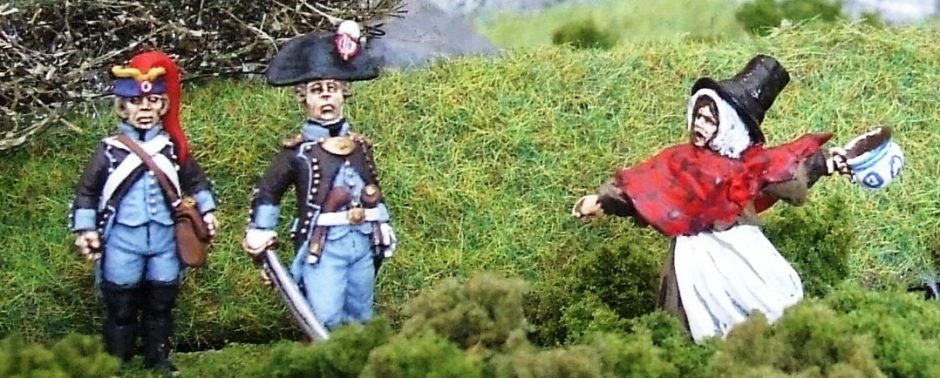
 Above: The locals enjoy the morning air, oblivious of the impending battle. As is customary, the ladies wear traditional Welsh dress in case some tourists come past.
 However, the Royalist garrison of Clunderwen Junction has been tipped off and is advancing to meet the enemy at Dyffryn-Conin!


 Above: Suddenly, the thundering of hooves and the revving of engines announces a charge by the Preseli Horse! Resplendent in their buff coats and steel helmets, the Welsh cavalrymen draw sabres and charge the hedgerow, screaming their war-cries; “Shwmae Mam!”, “Beth ydym ni’n ei wneud yma?!”, “Peint i mi!”, “Rhedeg i ffwrdd!”…


 Above: Back at the farm, the Wallies’ Llanfyrnach Company has occupied the stable-block and is raking the farmhouse with fire. Colonel Lewis-Jones senses that his moment of glory has come… Dragging me and his personal standard-bearer along by the scruffs of the neck, he personally leads the Hermon Company through the farmyard gate and across the yard to assault the farm house! Thankfully his grip on my collar eases off and I manage to take cover in the corner of the yard, behind the civilians (that’s me at the top-left of the picture above)!
 Above: Veterans of the Great War will recognise the scene in the farmyard as the Cadets open up on the Hermon Company at point-blank range with pistols, rifles and heavy machine gun… The Colonel manages to reach the farmhouse with two men, but they are quickly cut down at the front door and the Colonel is forced to fall back, dragging his wounded standard-bearer with him.


 Regular readers of this idiocy will probably remember that I’ve created a Welsh Nationalist faction for the ‘Very British Civil War’ in Pembrokeshire; namely the
 The most powerful Welsh Nationalist faction in West Wales is the Free Wales Army (FWA)’s Pembrokeshire Division, centred on the port of Fishguard. Prior to the civil war, Fishguard was something of a hotbed of Welsh Nationalist academia, mainly drawing on the non-conformist and pacifist Welsh chapel tradition. However, with the departure of most of the pacifist Nationalists to the new Senedd (Parliament) at Machynlleth, the FWA has rapidly filled the vacuum, aided by public revulsion at Royalist/BUF methods in the Landsker. The FWA therefore emerged as a pro-war, militaristic backlash against the failed policies of the traditional, pacifist Welsh Nationalist intelligentsia. Some observers ascribe fascistic elements to the FWA movement; they certainly love their bottle-green uniforms, public rallies and oaths to the cause and there are echoes of Italian and German fascism in the title of Yr Arweinydd (‘The Leader’) for their senior member. The current Arweinydd is a shadowy figure only known as Martin Bach (‘Small Martin’).
 asterisk with downward-turning ‘arms’). Those without uniforms typically wear a green armband with the eagle symbol in white. Flags again are bottle-green with the white eagle in its stylised form or sometimes in a more realistic form, typically inscribed with the motto ‘FE GODWN NI ETO’ (‘We will rise again’). The naval ensign is similar but in sea-grey.
 After some debate, the capital of the new Republic was established at Machynlleth, site of Prince of Wales Owain Glyndŵr’s short-lived Senedd (‘Parliament’). A new Senedd has been created and despite the war, the Republic has even managed to hold local elections, to provide the Senedd with Representatives. However, not all Welsh Nationalist territories are willing to suborn themselves to the Republic, though many of these (such as the Republic of Cantref Cemaes and the Kingdom of Dyfed) do send non-voting Representatives to the Senedd, which to its credit, allows these dissenting voices to be heard.
 The ‘Knights of the Grey Mare’ are a shadowy and terrifying guerrilla group operating in the Gwaun Valley, which is a deep, narrow and thickly-wooded gorge, nestling in the mountains east of Fishguard. They resist ALL attempts to move into the Gwaun with ruthless and terrifying acts, backed up by wild rumours of druidic practices and the Dark Arts. They are never seen and never heard, though they most definitely exist; patrols and sentries will simply disappear, only to reappear at dawn, minus everything below the neck.
 This move was a massive gamble for Lord Rhys, but through sheer force of personality and undoubted popularity, he has managed to maintain his social position within Carmarthenshire and to largely preserve his power and estates, while simultaneously opposing the government and English hegemony over Wales. Of course, he’s got a lot of cash and that buys influence, men and weapons. A string of early victories against Loyalist forces in Carmarthenshire, as well as against the Reds in the coal-mining districts of the upper Amman, Loughor and Gwendraeth Valleys also helped to secure his Welsh Nationalist credentials.
 The flag of the Kingdom of Dyfed is a bright green & white flag, split vertically, with green at the hoist and white at the fly. In the centre are the Arms of Dyfed, being a royal blue shield displaying a gold lion rampant, surrounded by four gold roses. The personal banner of Lord Dryslwyn was originally a black, upward-pointing black chevron on a white field, with three standing black ravens (two above and one below the chevron). Since elevation to become Lord Rhys, this is now quartered with the arms of Dyfed described above.

 They certainly do look like cracking figures – I just wish they’d been available 10 years ago! 🙁


 The uniform of the Fusiliers-Grenadiers was largely modelled on that of Grenadiers à Pied of the Old Guard; namely a long-tailed blue ‘cutaway’ coatee cut in the line infantry style, with brass/gold buttons, blue collar, white lapels, red tail-turnbacks with white eagle ornaments and red Brandenburg cuffs. However, from 1806 to 1808 the uniform had some slight differences; the collar and lapels were edged with red piping and the cuff-flaps were red, piped white with more white piping around the edge of the cuffs. On the shoulders were blue pointed shoulder-straps, edged with red piping.


 Although I haven’t painted these units, they formed part of the Middle Guard and wore very similar uniforms, so are worth mentioning here. Both battalions were raised in March 1809 from a cadre of Imperial Guardsmen and volunteers (most of them Italian). The Vélites of Turin were specifically raised to be the bodyguard for Napoleon’s brother-in-law, Prince Borghese, who lavished money and expensive Parisian tailoring on his beloved regiment.
 A specific request by Prince Borgehese for the Vélites of Turin to be issued with an Eagle was refused by Napoleon, but there is a surviving flag of the standard 1804 ‘lozenge’ Pattern (pictured here). This may have been a private purchase by Prince Borghese, but if officially issued, it seems likely that the Vélites of Florence would also have been issued with such a flag. These flags were probably carried on light-blue poles with gilt spearhead finials. I can’t find any other details of fanions for the Vélites.
 I doubt that there’s a single Napoleonic wargamer who doesn’t have at least one Imperial Guard unit in their collection and I’m certainly no exception… And having recently painted my very LAST Imperial Guard infantryman (for the two Young Guard Corps at Leipzig in 1813), I thought I may as well post the pics here, starting with the Old Guard (which appropriately enough, are the oldest figures in my Imperial Guard infantry).
 Back in the mists of time, I had a single unit of 16x 15mm Old Guard Grenadiers à Pied by Battle Honours. They got a lot of mileage and by the mid-1990s were looking rather battered. By then we’d started doing demo-games at wargames shows and I was wanting some new models, so asked Mike Hickling at AB Figures if they had any imminent plans for Old Guard infantry models. By sheer luck, he had just cast the very first of the new AB Figures Old Guard and he put them straight in the post to me on approval! I had it on good authority therefore that these AB Figures Old Guard figures were the first to appear anywhere – they were in our Bautzen 1813 game at ‘Warcon’ (1995 I think?) before they even appeared in the AB Figures catalogue! 🙂
 Above: French 15mm Old Guard Grenadiers à Pied by AB Figures. When I first saw these, I was totally blown away by the quality of sculpting and the accuracy of the depiction. They look just as though they have stepped out of a Detaille or Gerard painting. Even today, nearly 25 years later, I still think that they’re the best figures ever to have been produced in this scale (or indeed any scale). They’ve even got their customary earrings sculpted on…
 Above: Regular readers of this blog will note that my painting was a fair bit better in those days… 🙁 Eyesight and cramping hands now get the better of me. I also had a lot more patience and would routinely paint my own flags…


 Above: The Chasseurs à Pied had some subtle uniform differences to the Grenadiers à Pied; their coat was cut in ‘light infantry’ style, with pointed lapels and pointed cuffs, edged in white piping. Epaulettes were green with red fringes and crescents. The bearskin this time had no front-plate and no cul de singe and plumes were now red-over-green.

 Above: The Old Guard on parade, with Général de Division Dorsenne, the Colonel-General of the Grenadiers à Pied at their head in full ceremonial uniform.