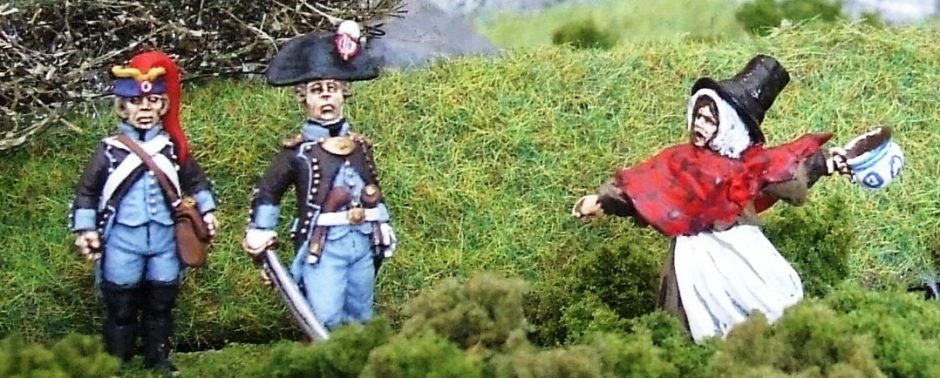

 Like many others, I originally started wargaming because I wanted to refight the Great Battles of History, as in the epic wargame scene in the film Callan. It is therefore, very satisfying when you finally manage to tick one off the list! 🙂
One such Great Battle was ticked off the list on Platinum Jubilee Thursday (2nd June), when we refought the Battle of Leuthen (albeit without the snow) at the Carmarthen Old Guard. As we only had a single available day to play the game, we played it in one day (six hours), but it could easily have gone on for longer, had it not been for some disastrous dice-rolling and an ‘early bath’ for one side! This was fortunate, as we’d run out of club-time anyway. This scenario is probably therefore, best played over two days (of if you have the stamina, over a longer period in one day). I’ll post the after-action report next time, but here’s the scenario, designed for Tricorn rules (our unofficial 18th Century conversion for Shako Napoleonic rules).
It does have to be said that Leuthen, like Rossbach, is one of those battles where it is VERY unlikely to result in anything other than a historical result, but some wargaming itches just beg to be scratched…
 Historical Background

Frederick after Kolin
1757 had not started well for King Frederick II of Prussia. His invasion of Bohemia had resulted first in a pyrrhic victory at Prague and then complete defeat at Kolin, followed by a hasty retreat back to his own borders. To add to his problems, the Russians were also invading in the east, while the French, together with the Imperial Reichsarmee were poised to invade from the west.
Thankfully for Frederick, Prince Charles of Lorraine squandered Daun’s victory at Kolin by vacillating when he should have been invading Prussian territory. This Austrian failure gave Frederick the breathing-space he needed to march west and blunt the Franco-Imperial advance. This he did in spectacular style on 5th November, by utterly crushing the Franco-Imperial army at Rossbach. Frederick’s army was soon re-tracing its steps, marching hard to once again meet the Austrians, who had finally managed to force Bevern’s Prussian army back into Silesia.
However, Frederick was too late to save Bevern’s army. Fighting at odds of almost 2:1, Bevern was defeated on 22nd November at Breslau. Leaving 5,000 men to garrison Breslau, the rest of Bevern’s demoralised army retreated north to the fortress of Glogau. However, the Breslau garrison, demoralised and under-provisioned, surrendered after only two days, on 24th November. Upon hearing the news of Bevern’s defeat, Frederick sent General Zieten with his hussars to gather up the surviving units of Bevern’s army and bring them to Parchwitz, some 25 miles west of Breslau. Frederick himself arrived at Parchwitz on 28th November and after allowing a few days to absorb as many of Bevern’s survivors as could be gathered, set out again on 4th December to meet the Austrians in battle.
 Early on the following morning, at the snow-dusted village of Borne, the Prussian advance guard under the Prince of Württemberg surprised and defeated the Austrian advance guard, commanded by the Saxon General Nostitz. Frederick, right up with the advance guard, immediately galloped forward to the high ground beyond the village and was greeted by the incredible sight of a huge army of whitecoats, stretched out over three miles, from the hamlet of Sagschütz in the south, through the villages of Leuthen and Frobelwitz, to Nippern in the north. Frederick had seen a very similar sight nearly six months earlier, at Kolin. However, this time his army was completely hidden from observation by the gently rolling landscape and Lorraine’s main reconnaissance asset had just been swept from the field, leaving the Austrians completely blind. Frederick also had an ace up his sleeve; he knew the ground intimately, thanks to exercising his army on this very ground during peacetime.
Frederick quickly formulated his plan. Ordering Württemberg’s advance guard, along with three Frei-Battalions and the Feldjäger zu Fuss to continue on the original axis of advance and demonstrate against the Austrian right wing at Nippern, Frederick ordered the rest of his army to turn south from Borne, using the terrain and patchy fog to mask their movement as far as Striegwitz.
 This manoeuvre worked brilliantly as Lucchese, commanding the Austrian cavalry of the right wing, became convinced that he was about to become the focus of the Prussian attack and begged Lorraine for reinforcements. Lorraine agreed and ordered all the reserve cavalry, including Serbelloni’s division on the left wing, to march north, while the bulk of the Grenzer and grenadiers were ordered to skirmish out in front of Nippern, in search of the phantom Prussian army. Marschall Daun, Lorraine’s 2ic and the victor of Kolin, disagreed with this decision (he believed the Prussians to be retiring), but accompanied the troops northward, in order to gain a better appreciation of the situation at Nippern.
Having fixed the Austrian attention to the north, Württemberg’s cavalry now withdrew to join the rear of Frederick’s column, leaving only the small light infantry contingent to maintain a presence in the north. Driesen now took over responsibility for securing the Prussian left flank; he concealed his cavalry in dead ground behind Radaxdorf, ready to counter any southward Austrian move.
It was now approaching noon and at the front of the column, Bevern’s infantry flank-guard and Ziethen’s large cavalry division had appeared near Sagchütz, followed by the two long columns of Prussian infantry. The Hungarian General Nadásdy, commanding the Austro-Allied left wing corps, could clearly see what was going to happen and sent appeal after appeal for Serbelloni’s cavalry to return and for Lorraine to see what was happening, but to no avail. The only general to respond was Feldmarschallieutenant Buccow, commanding one of Serbelloni’s cavalry divisions, who disobeyed his orders and turned back to face the new threat. Having been left to fend for himself, Nadásdy ordered Spiznass’ Württemberg Corps to refuse the flank to the left and ordered O’Donnell’s cavalry to move to the left flank and form up with Nostitz’s hussars and Saxon chevauxlegers.
While Nadásdy was frantically realigning his command, the Prussian infantry had executed a parade-perfect wheel to the left, forming two lines facing north. They then performed another wheel by battalions; a three-quarter turn to the right, thereby aligning every battalion in line, arranged one behind the other in two columns aimed at the Württemberg left flank. As the lead battalions came within musket-shot of the enemy, the entire Prussian infantry contingent executed a perfect quarter-wheel to the left, so that they were once again facing north, but were now arranged in echelon, with the right flank (heavily reinforced with elite battalions) advanced toward the enemy and the vulnerable left flank refused away from any possible Austrian response. Frederick’s ‘Oblique Advance’ had been executed perfectly and his infantry were now poised to roll up the Austrian-Allied left flank.

However, Zieten’s cavalry were struggling to deploy effectively among the tangle of villages, ponds, woods and the bank of the Schweidnitz River and he was therefore having to attack through the Sagschütz woods at 45 degrees. It was at this point that Nadásdy managed to strike the first blow, surprising Zieten and routing the Normann Dragoons, even managing to get hussars around and into Zieten’s rear! However, Bevern’s infantry were deployed against just such an eventuality and their fire halted the Austrian and Saxon horsemen, giving Zieten’s cavalry a chance to rally and finally drive back the enemy.
In the meantime, Frederick had deployed heavy 12pdr and 24pdr guns dangerously close to Austrian lines, on the Butter-Berg and Juden-Berg. As these began to pour a heavy fire onto Austrian lines, at 1pm the Prussian vanguard smashed into the Württembergers, closely followed by some of the best regiments in Frederick’s army. The Austro-Allied left flank quickly began to crumble; first the Württembergers and then the Bavarians broke and fled. Forgàch’s Austrian infantry tried to make a stand on the Kirch-Berg, north of Sagschütz, but now came under fire from heavy guns newly-positioned on the Glanz-Berg and too were broken. Less than 30 minutes had passed since the initial assault.

Grenadier Battalion ‘Kremzow’ (17/22), on the right flank of the Prussian first line, comes under fire at Sagschütz.
However, Lorraine had finally begun to grasp the enormity of the crisis and was beginning to send formations south to meet the Prussians. Part of Arenberg’s reserve infantry division had already gone north to Nippern, but his remaining five battalions were now ordered south, to hold the line at Leuthen.
Seeing the disaster unfolding in front of him, Buccow knew that he had to win time for a new line to establish itself at Leuthen. With only two regiments of cuirassiers, one regiment of dragoons and six elite squadrons, he bravely held off the Prussians for over an hour, until heavy losses finally forced him to withdraw. The Austrian gunners had also held off Retzow’s Prussian left wing and these sacrifices allowed the new line to begin to crystalise around Leuthen.
At around 3.30pm, the Prussians had finally re-ordered their lines and moved to assault Leuthen village. Thanks to Buccow’s sacrifice, Arenberg’s infantry were in place, but the toll from the great mass of close-range Prussian heavy artillery was appalling and three battalions were quickly shredded by fire. Arenberg’s two remaining battalions held on heroically, buying time for Colloredo’s right wing to move up, but they too were eventually forced back. Nevertheless, their sacrifice had allowed time for the Austrians to stuff thousands of troops into the village and the church, surrounded by thick, almost fortress-like walls, was turned into a strongpoint by the Imperial ‘Rot’ (‘Red’) Würzburg Regiment.

The III. Battalion of the Garde-Regiment (IR 15) storm a breach in the southern wall of the church. Note that this entire battalion wore grenadier mitre caps.
The ‘Pannwitz’ Regiment (IR 10) was initially given the task of assaulting the church, but after numerous fruitless attempts and 710 casualties, the task was passed to the Garde-Regiment (IR 15), which had its II. & III. Battalions present. For a full half-hour, the Prussian guardsmen were repulsed time and time again by the heroic Würzburgers, until at last III./Garde stormed a breach in the southern wall (above) while II./Garde simultaneously managed to force their way in via the eastern gate (below). The magnificent Würzburgers simply couldn’t hold out any more and at last a small group of only five officers and 33 men broke out of the churchyard, saving their four colours. The Prussian Garde-Regiment had lost 510 men in their assault.

The II. Battalion of Regiment-Garde (IR 15) storm the eastern gate of Leuthen Church. Note that this battalion actually wore hats. The red grenadier caps shown were only worn by the regiment’s detached companies of ‘flank-grenadiers’, who formed half of Grenadier Battalion ‘Kleist’ (15/18).
However, the collapse of Leuthen had not yet brought about a collapse of the Austrian army. As the Prussians exited the northern edge of the village, they came under heavy musketry and canister fire from Colloredo’s infantry and artillery, positioned on the Windmill hill beyond. More Austrian troops were streaming south through Frobelwitz from Kheul’s right wing. It was now 4pm, night was falling and Frederick still needed to win the battle. As so often happened in Frederick’s battles, fate now played a hand…
General of Cavalry Lucchese, who had earlier demanded that reinforcements be sent north to meet the phantom threat, now came south. At around 4.30pm his great mass of cavalry appeared at the crest of the Schönberg and swept south, intending to roll up what he supposed to be the the Prussian left flank, starting with the juicy target of the Prussian battery on the Butter-Berg. However, he remained completely unaware of Driesen’s large cavalry wing, which was still hidden behind the ridge of the Sophienberg!
Observing the appearance of Lucchese’s cavalry, Driesen immediately ordered his 50 squadrons forward against Lucchese’s 54 squadrons. On paper these were a close match, but Driesen had surprise and a flanking position on his side! The initial clash was catastrophic for the Austrians as Lucchese was killed and the Prussian hussars worked their way round to attack them from the rear, but the Austrian second line somehow managed to check the Prussian attack. as night began to fall, the pendulum of battle briefly swung back in the Austrians’ favour, but it was at this moment that Prince Eugene of Württemberg struck with his 30 squadrons of hussars and dragoons!
The Austrian cavalry collapsed! Fugitives swept over the Windmill Hill, closely pursued by Prussian horsemen. The result was a slaughter as Austrian batteries and battalions, outflanked and overrun by Prussian cavalry, simply dissolved.
Frederick had his victory.

Exhausted and relieved at having survived the battle, Prussian troops sang the hymn ‘Now Thank We All Our God’ amid the carnage of Leuthen.
The Scenario
Note that this scenario does not include large chunks of the Austrian right wing, as with a few exceptions, they didn’t get involved in the battle and by the time they moved south of Frobelwitz and the Prussians reached them, the army was broken. Their presence is however, reflected in the Austrian army morale level (they receive an additional 100 morale points for the off-table formations). This also means that we could (just) fit the battle onto a 10 x 6-foot table instead of a 16 x 6-foot table.

 The Prussian Army – King Frederick II
(Excellent – 3 ADCs)
Advance Guard – Generallieutenant Prinz von Württemberg (Average)
I. Bn (5 sqns), ‘Werner’ (‘Capuchin’) Hussars (HR 6) [4/1]
II. Bn (5 sqns), ‘Werner’ (‘Capuchin’) Hussars (HR 6) [4/1]
6 Sqns, ‘Warnery’ Hussars (HR 3) (elite) (Large Unit) [5/2]
I. Bn (5 Sqns), ‘Seydlitz’ (‘Red’) Hussars (HR 8) [4/1]
II. Bn (4 Sqns), ‘Seydlitz’ (‘Red’) Hussars (HR 8) [4/1]
5 Sqns, ‘Württemberg’ Dragoons (DR 12) (Large Unit) [5/2]
5 Sqns, ‘Székely’ (‘Green’) Hussars (HR 1) (elite) [5/2]
Flank Guard – Generallieutenant Prinz von Braunschweig-Bevern (Good)
Grenadier Battalion ‘Wedell’ (1/23) [5/2]
Grenadier Battalion ‘Manteuffel’ (37/40) [5/2]
Grenadier Battalion ‘Ramin’ (19/25) [5/2]
Grenadier Battalion ‘Bornstedt’ (13/26) [5/2]
I. Bn, ‘Asseburg’ Infantry Regiment (IR 27) (elite) [5/2]
II. Bn, ‘Itzenplitz’ Infantry Regiment (IR 13) (elite) [5/2]
Battalion Guns [2/0]
Cavalry of the Right Wing – Generallieutenant von Zieten (Excellent)
3 Sqns, ‘Garde du Corps’ Cuirassiers (CR 13) [6/2]
5 Sqns, ‘Gensd’armes’ Cuirassiers (CR 10) (Large Unit) [6/2]
5 Sqns, ‘Seydlitz’ Cuirassiers (CR 8) (Large Unit) [6/2]
5 Sqns, ‘Markgraf Friedrich’ Cuirassiers (CR 5) (Large Unit) [6/2]
5 Sqns, ‘Jung-Schönaich’ Cuirassiers (CR 6) (Large Unit) [6/2]
5 Sqns, ‘Normann’ Dragoons (DR 1) (Large Unit) [5/2]
5 Sqns, ‘Czetteritz’ Dragoons (DR 4) (Large Unit) [5/2]
5 Sqns, ‘Jung-Krockow’ Dragoons (DR 2) (Large Unit) [5/2]
5 Sqns, ‘Stechow’ Dragoons (DR 11) (Large Unit) [5/2]
I. Bn (5 Sqns), ‘Zieten’ (‘Leib’) Hussars (HR 2) (elite) [5/2]
II. Bn (5 Sqns), ‘Zieten’ (‘Leib’) Hussars (HR 2) (elite) [5/2]
Infantry of the Right Wing – Generallieutenant Prinz Ferdinand von Preussen (Good)
I. Bn, ‘Meyerinck’ Infantry Regiment (IR 26) (elite) [5/2]
II. Bn, ‘Meyerinck’ Infantry Regiment (IR 26) (elite) [5/2]
I. Bn, ‘Itzenplitz’ Infantry Regiment (IR 13) (elite) [5/2]
Grenadier Battalion ‘Kleist’ (4/16) [5/2]
Grenadier Battalion ‘Unruh’ (Standing Grenadier Battalion 2) [5/2]
Grenadier Battalion ‘Kremzow’ (17/22) [5/2]
I. Bn, ‘Markgraf Karl’ Infantry Regiment (IR 19) (elite) [5/2]
II. Bn, ‘Markgraf Karl’ Infantry Regiment (IR 19) (elite) [5/2]
II. Bn, ‘Garde’ Infantry Regiment (IR 15) (guard) [6/2]
III. Bn, ‘Garde’ Infantry Regiment (IR 15) (guard) [6/2]
‘Grenadiergarde’ Infantry Regiment (IR 6) (guard) [6/2]
I. Bn, ‘Kannacher’ Infantry Regiment (IR 30) [4/1]
II. Bn, ‘Kannacher’ Infantry Regiment (IR 30) [4/1]
I. Bn, ‘Pannwitz’ Infantry Regiment (IR 10) [4/1]
II. Bn, ‘Pannwitz’ Infantry Regiment (IR 10) [4/1]
Battalion Guns [2/0]
Battalion Guns [2/0]
Battalion Guns [2/0]
Heavy Battery [3/0]
Heavy Battery [3/0]
Heavy Battery [3/0]
Heavy Battery [3/0]
Infantry of the Left Wing – Generallieutenant von Retzow (Average)
I. Bn, ‘Geist’ Infantry Regiment (IR 8) [4/1]
II. Bn, ‘Geist’ Infantry Regiment (IR 8) [4/1]
I. Bn, ‘Winterfeldt’ Infantry Regiment (IR 1) [4/1]
II. Bn, ‘Winterfeldt’ Infantry Regiment (IR 1) [4/1]
I. Bn, ‘Forcade’ Infantry Regiment (IR 23) [4/1]
II. Bn, ‘Forcade’ Infantry Regiment (IR 23) [4/1]
I. Bn, ‘Alt-Braunschweig’ Infantry Regiment (IR 5) (elite) [5/2]
II. Bn, ‘Alt-Braunschweig’ Infantry Regiment (IR 5) (elite) [5/2]
Grenadier Battalion ‘Hacke’ (3/6) [5/2]
Grenadier Battalion ‘Schenckendorf’ (35/36) [5/2]
Grenadier Battalion ‘Dieringshofen’ (21/27) [5/2]
I. Bn, ‘Kurszell’ Füsilier Regiment (IR 37) [4/1]
Battalion Guns [2/0]
Battalion Guns [2/0]
Heavy Battery [3/0]
Heavy Battery [3/0]
Infantry of the Second Line – Generallieutenant von Forcade * (Average)
I. Bn, ‘Prinz von Preussen’ Infantry Regiment (IR 18) (elite) [5/2]
I. Bn, ‘Münchow’ Füsilier Regiment (IR 36) [4/1]
I. Bn, ‘Jung-Braunschweig’ Füsilier Regiment (IR 39) [4/1]
I. Bn, ‘Alt-Württemberg’ Füsilier Regiment (IR 46) [4/1]
Grenadier Battalion ‘Östenreich’ (29/31) [5/2]
Grenadier Battalion ‘Plötz’ (Standing Grenadier Battalion 6) [5/2]
I. Bn, ‘Prinz Ferdinand’ Infantry Regiment (IR 34) (elite) [5/2]
Grenadier Battalion ‘Kahlden’ (Standing Grenadier Battalion 1) [5/2]
I. Bn, ‘Prinz Heinrich’ Füsilier Regiment (IR 35) (elite) [5/2]
I. Bn, ‘Kalckstein’ Infantry Regiment (IR 25) [4/1]
II. Bn, ‘Kalckstein’ Infantry Regiment (IR 25) [4/1]
Battalion Guns [2/0]
Battalion Guns [2/0]
Cavalry of the Left Wing – Generallieutenant von Driesen (Good)
5 Sqns, ‘Krockow’ Cuirassiers (CR 1) (Large Unit) [6/2]
5 Sqns, ‘Leib-Carabiniers’ Cuirassiers (CR 11) (Large Unit) [6/2]
5 Sqns, ‘Driesen’ Cuirassiers (CR 7) (Large Unit) [6/2]
I. Bn (5 Sqns), ‘Bayreuth’ Dragoons (DR 5) (Large Unit) [5/2]
II. Bn (5 Sqns), ‘Bayreuth’ Dragoons (DR 5) (Large Unit) [5/2]
5 Sqns, ‘Kyau’ Cuirassiers (CR 12) (Large Unit) [6/2]
5 Sqns, ‘Schönaich’ Cuirassiers (CR 9) (Large Unit) [6/2]
5 Sqns, ‘Gessler’ Cuirassiers (CR 4) (Large Unit) [6/2]
I. Bn (5 Sqns), ‘Puttkamer’ Hussars (HR 4) (elite) [5/2]
II. Bn (5 Sqns), ‘Puttkamer’ Hussars (HR 4) (elite) [5/2]
Artillery Reserve
Butter-Berg Battery
Heavy Battery [3/0]
Heavy Battery [3/0]
Juden-Berg Battery
Heavy Battery [3/0]
Heavy Battery [3/0]
 Prussian Notes
* Forcade’s 2nd Line covers a massive frontage and it might be easier for game-play purposes if it were split into two wings; Generalmajor von Oldenburg’s Brigade on the left of the 2nd Line had the Kalckstein Musketeers (2 bns), Prince Ferdinand Musketeers (1 bn), Kahlden Grenadier Bn, the Prince Henry Fusiliers (1 bn) and a battery of battalion guns, for a total FMR of 25. On the right of the line, Generalmajor von Bülow’s Brigade had the Plötz Grenadiers, Östenreich Grenadiers, Alt-Württemberg Fusiliers, Jung-Braunschweig Fusiliers, Münchow Fusiliers, Prince von Preussen Musketeers (1 bn each) and the remaining battalion guns, with a total FMR of 29. Class both Brigadiers as Average.
Note that I’ve reduced the number of Battalion Guns on both sides in order to speed up play and to reduce the likelihood of the game bogging down into an artillery-duel. The ratio would normally be one battery of battalion guns for every four Prussian battalions or for every four Austrian battalions (not including grenadiers), but I’ve increased the ratio here to 1:6.
Only the Heavy Position Batteries are marked on the map. The Butter-Berg and Juden-Berg Batteries start the game unlimbered at Effective Range (i.e. within the 12″-20″ range-band) from the nearest enemy unit. All other Prussian artillery starts the game limbered. Battalion Guns should be dispersed equally among the infantry battalions; either deployed in front or in the intervals between battalions. The 2nd Line should also have its appropriate share of Battalion Guns.
 Prussian Formation Breakpoints
Division FMR ⅓ ½ ¾
Württemberg 31 11 16 24
Bevern 32 11 16 24
Zieten 60 20 30 45
Ferdinand 92 31 46 69
Retzow 63 21 32 48
Forcade 54 18 27 41
Driesen 56 19 28 42
Artillery Reserve* 12 – – –
Army FMR ¼ ⅓ ½
Prussian Army 390 98 130 195
* The MR value of any broken Artillery Reserve Batteries are added when assessing overall Army losses.
Prussian Orders
All Prussian infantry divisions except Bevern must start the game on Attack orders.
Zieten’s and Bevern’s Divisions may start the game on Attack or Defend orders.
Württemberg’s Division must start the game on Reserve orders.
Driesen’s Division starts the game off-table and may be ordered to ride to the battle, though may intervene without orders (see below).
No orders may be changed until the Orders Phase of Turn 2.
Prussian Reinforcements
Due to limited table size, the left flank of the Prussian infantry and Württemberg’s cavalry may be brought on to table, adjacent to the left flank of their parent formations, at any time.
Driesen’s cavalry is off-table to the west, concealed by the high ground of the Sophien-Berg, just to the west of Radaxdorf. Driesen is tasked with countering any move by Austrian cavalry against the Prussian left flank. His division MAY appear (at the Prussian player’s choice) two turns (or later) after the arrival of any new Austrian cavalry formations OR if any Austrian cavalry units push west of the main Austrian line. They may arrive anywhere between Lobetinz and the Briegwasser stream. The division arrives in three lines: CR 1, CR 7, CR 11 & DR 5 (from right to left) in the first line, CR 12, CR 9 & CR 4 in the second line and HR 4 forming the third line. Driesen will arrive under Attack orders (mark command arrow on map).
Frederick may alternatively give Attack orders to Driesen’s cavalry at any time from the Orders Phase of Turn 2 onward. Driesen is classed as being one ADC move from Frederick and if successful, Driesen will arrive two turns later (arrival locations and formation as above).
If you want to maintain the fog of war, use this briefing map for the Prussians:

 The Austrian Army – Feldmarschall Prince Charles of Lorraine
(Poor – 1 ADC)*
Infantry of the Left Wing (Left) – Feldzeugmeister Graf Colloredo** (Average)
I. Bn, ‘Moltke’ Infantry Regiment (IR 13) (Large Unit) [4/1]
I. Bn, ‘Hildburghausen’ Infantry Regiment (IR 8) (Large Unit) [4/1]
II. Bn, ‘Hildburghausen’ Infantry Regiment (IR 8) (Large Unit) [4/1]
I. Bn, ‘Carl Lothringen’ Infantry Regiment (IR 3) (Large Unit) [4/1]
II. Bn, ‘Carl Lothringen’ Infantry Regiment (IR 3) (Large Unit) [4/1]
I. Bn, ‘Baden-Baden’ Infantry Regiment (IR 23) (Large Unit) [4/1]
I. Bn, ‘Gaisruck’ Infantry Regiment (IR 32) (Large Unit) [4/1]
I. Bn, ‘L. (Jung-) Wolfenbüttel’ Infantry Regiment (IR 10) (Large Unit) [4/1]
II. Bn, ‘L. (Jung-) Wolfenbüttel’ Infantry Regiment (IR 10) (Large Unit) [4/1]
I. Bn, ‘Harrach’ Infantry Regiment (IR 47) (Large Unit) [4/1]
II. Bn, ‘Harrach’ Infantry Regiment (IR 47) (Large Unit) [4/1]
Grenadier Battalion [5/2]
Battalion Guns [2/0]
Battalion Guns [2/0]
Heavy Battery [3/0]
Light Battery [3/0]
Infantry of the Left Wing (Right) – Feldzeugmeister Graf Colloredo** (Average)
I. Bn, ‘Alt-Wolfenbüttel’ Infantry Regiment (IR 29) (Large Unit) [4/1]
II. Bn, ‘Alt-Wolfenbüttel’ Infantry Regiment (IR 29) (Large Unit) [4/1]
I. Bn, ‘Joseph Esterházy’ Hungarian Infantry Regiment (IR 37) (Large Unit) [4/1]
II. Bn, ‘Joseph Esterházy’ Hungarian Infantry Regiment (IR 37) (Large Unit) [4/1]
I. Bn, ‘Nicholas Esterházy’ Hungarian’ Infantry Regiment (IR 33) (Large Unit) [4/1]
II. Bn, ‘Nicholas Esterházy’ Hungarian’ Infantry Regiment (IR 33) (Large Unit) [4/1]
I. Bn, ‘Thurheim’ Infantry Regiment (IR 25) (Large Unit) [4/1]
I. Bn, ‘Kheul’ Infantry Regiment (IR 49) (Large Unit) [4/1]
II. Bn, ‘Kheul’ Infantry Regiment (IR 49) (Large Unit) [4/1]
I. Bn, ‘Deutschmeister’ Infantry Regiment (IR 4) (Large Unit) [4/1]
I. Bn, Imperial ‘Rot-Würzburg’ Infantry Regiment (Large Unit) [4/1]
I. Bn, ‘Browne’ Infantry Regiment (IR 36) (Large Unit) [4/1]
I. Bn, ‘Bethlen’ Hungarian Infantry Regiment (IR 52) (Large Unit) [4/1]
I. Bn, ‘Harsch’ Infantry Regiment (IR 50) (Large Unit) [4/1]
II. Bn, ‘Harsch’ Infantry Regiment (IR 50) (Large Unit) [4/1]
Grenadier Battalion [5/2]
Battalion Guns [2/0]
Battalion Guns [2/0]
Battalion Guns [2/0]
Heavy Battery [3/0]
Light Battery [3/0]
Reserve Infantry of the Left Wing – Feldmarschallieutenant Forgách (Good)
I. Bn, ‘Heinrich Daun’ Infantry Regiment (IR 45) (Large Unit) [4/1]
II. Bn, ‘Heinrich Daun’ Infantry Regiment (IR 45) (Large Unit) [4/1]
I. Bn, ‘Leopold Pálffy’ Hungarian Infantry Regiment (IR 19) (Large Unit) [4/1]
I. Bn, ‘Haller’ Hungarian Infantry Regiment (IR 31) (Large Unit) [4/1]
I. Bn, ‘Macquire’ Infantry Regiment (IR 46) (Large Unit) [4/1]
I. Bn, ‘Luzan’ Infantry Regiment (IR 48) (Large Unit) [4/1]
I. Bn, ‘Clerici’ Infantry Regiment (IR 44) (Large Unit) [4/1]
I. Bn, ‘Forgách’ Hungarian Infantry Regiment (IR 32) (Large Unit) [4/1]
I. Bn, ‘A. Batthiány’ Hungarian Infantry Regiment (IR 34) (Large Unit) [4/1]
I. Bn, ‘Joseph Pálffy’ Hungarian Infantry Regiment (IR 39) (Large Unit) [4/1]
Battalion Guns [2/0]
Battalion Guns [2/0]
Light Battery [3/0]
Light Battery [3/0]
Slavonisch-Gradiskaner Grenzer [Skirmishers]
Württemberg Auxiliary Corps – Feldmarschallieutenant Graf Spiznass (Poor)
I. Bn, ‘Truchsess’ Fusilier Regiment (poor) [3/0]
II. Bn, ‘Truchsess’ Fusilier Regiment (poor) [3/0]
I. Bn, ‘Röder’ Infantry Regiment (poor) [3/0]
II. Bn, ‘Röder’ Infantry Regiment (poor) [3/0]
I. Bn, ‘Prinz Louis’ Infantry Regiment (poor) [3/0]
II. Bn, ‘Prinz Louis’ Infantry Regiment (poor) [3/0]
I. Bn, ‘Leib’ Infantry Regiment (poor) [3/0]
II. Bn, ‘Leib’ Infantry Regiment (poor) [3/0]
I. ‘Klettenberg’ Grenadier Battalion [4/1]
II. ‘Pless’ Grenadier Battalion [4/1]
III. ‘Georgi’ Grenadier Battalion [4/1]
I. Bn, ‘Spiznass’ Infantry Regiment (poor) [3/0]
II. Bn, ‘Spiznass’ Infantry Regiment (poor) [3/0]
Battalion Guns [2/0]
Slavonisch-Gradiskaner Grenzer [Skirmishers]
Bavarian Auxiliary Corps – Generalfeldwachtmeister Graf Seyssel d’Aix (Poor)
II. Bn, ‘Kurprinz’ Infantry Regiment (poor) [3/0]
I. Bn, ‘Preysing’ Infantry Regiment (poor) [3/0]
I. Bn, ‘Erzherzog Clemens’ Infantry Regiment (poor) [3/0]
II. Bn, ‘Erzherzog Clemens’ Infantry Regiment (poor) [3/0]
II. Bn, ‘Leib’ Infantry Regiment [4/1]
III. Bn, ‘Leib’ Infantry Regiment [4/1]
I. Bn, ‘Morawitzky’ Infantry Regiment (poor) [3/0]
II. Bn, ‘Morawitzky’ Infantry Regiment (poor) [3/0]
I. Bn, ‘Minucci’ Infantry Regiment (poor) [3/0]
II. Bn, ‘Minucci’ Infantry Regiment (poor) [3/0]
Battalion Guns [2/0]
Reserve Cavalry of the Left Wing – General der Cavallerie Nadásdy (Good)
6 Sqns, ‘Hessen-Darmstädt’ Dragoons (D19) (Large Unit) [5/2]
6 Sqns, ‘Zweibrücken’ Dragoons (D39) (Large Unit) [5/2]
6 Sqns, ‘Jung-Modena’ Dragoons (D13) (Large Unit) [5/2]
4 Sqns, Saxon ‘Prinz Carl’ Chevaulegers† [5/2]
4 Sqns, Saxon ‘Prinz Albrecht’ Chevaulegers† [5/2]
4 Sqns, Saxon ‘Graf Brühl’ Chevaulegers† [5/2]
6 Sqns, Sachsen-Gotha’ Dragoons (D28) (Large Unit) [5/2]
5 Sqns, ‘Nadásdy’ Hussars (H11)† [4/1]
5 Sqns, ‘Dessewffy’ Hussars (H34)† [4/1]
Elements, Cavalry of the Left Wing – Feldmarschallieutenant Graf Buccow‡ (Excellent)
6 Sqns, ‘Kalckreuth’ Cuirassiers (C22) (Large Unit) [6/2]
6 Sqns, ‘Erzherzog Ferdinand’ Cuirassiers (C4) (Large Unit) [6/2]
6 Sqns, ‘Batthiány’ Dragoons (D7) (Large Unit) [5/2]
5 Sqns, Massed Carabinier Companies (Large Unit) [6/2]
Reserve Infantry of the Right Wing (-) – Feldmarschallieutenant Herzog von Arenberg (Average)
I. Bn, ‘Mercy-Argentau’ Infantry Regiment (IR 56) (Large Unit) [4/1]
I. Bn, ‘Haller’ Hungarian Infantry Regiment (IR 31) (Large Unit) [4/1]
I. Bn, ‘De Ligne’ Infantry Regiment (IR 38) (Large Unit) [4/1]
I. Bn, ‘D’Arberg’ Infantry Regiment (IR 55) (Large Unit) [4/1]
I. Bn, ‘Andlau’ Infantry Regiment (IR 57) (Large Unit) [4/1]
Battalion Guns [2/0]
Cavalry of the Right Wing – General der Cavallerie Graf Lucchese§ (Average)
6 Sqns, ‘Erzherzog Joseph’ Dragoons (D1) (Large Unit) [5/2]
6 Sqns, ‘Erzherzog Leopold’ Cuirassiers (C3) (Large Unit) [6/2]
6 Sqns, ‘Lucchese’ Cuirassiers (Cii) (Large Unit) [6/2]
6 Sqns, ‘Stampach’ Cuirassiers (C10) (Large Unit) [6/2]
6 Sqns, ‘Löwenstein’ Cuirassiers (C27) (Large Unit) [6/2]
6 Sqns, ‘Benedict Daun’ Dragoons (D31) (Large Unit) [5/2]
6 Sqns, ‘Herzog Württemberg’ Dragoons (D38) (Large Unit) [5/2]
6 Sqns, ‘Serbelloni’ Cuirassiers (C12) (Large Unit) [6/2]
6 Sqns, ‘Anhalt-Zerbst’ Cuirassiers (C25) (Large Unit) [6/2]
 Austrian Notes
* Starting on Turn 2: At the start of each Initiative Phase, roll 1 d6 for Prince Charles of Lorraine. On a roll of 6, Feldmarschall Daun takes command for that turn: increase C-C Quality to Good (rolls 2 d6 command dice) and an extra ADC can be deployed this turn. At the end of the turn command reverts to Lorraine and the extra ADC is removed if he wasn’t used. NB The extra ADC can be used first, leaving the ‘regular’ ADC at headquarters. Daun will then add an ADC every time he appears, even if his previous additional ADC is still in play, galloping toward his destination.
** I’ve arbitrarily split Colloredo’s massive command into two wings (Left & Right) for game flexibility. The Left consists of the brigades of Puebla (1st Line) and Wied (2nd Line), while the Right comprises the brigades of D’Arberg & Angern (1st Line) and Haller (2nd Line).
† The Saxon Generallieutenant Nostitz was seriously wounded during the initial cavalry combat at Borne. Nevertheless, he carried on fighting hard at Sagschütz, though would die from his wounds twelve days later, after being captured by the Prussians. His division (consisting of the three Saxon-Polish Chevauxleger regiments and two Austrian Hussar regiments) is grouped with O’Donnell’s Austrian cavalry, under Nadásdy’s command. I did consider marking each of Nostitz’s regiments with a single casualty at the start of the game, to account for losses suffered at Borne, but they did remarkably well doing the clash at Sagschütz, so decided to leave them as they are.
‡ Feldmarschallieutenant Buccow was ordered to move north with the rest of Serbelloni’s Left Wing Cavalry Division, in response to a perceived Prussian attack on the Austrian right flank. However, when the Prussian attack appeared on the LEFT flank, Buccow disobeyed orders, halted his division and then mounted a counter-attack (along with five amalgamated elite squadrons described as Carabiniers, but possibly also including Horse Grenadiers) against the Prussian infantry advancing from Sagschütz.
§ The Austrian Right Wing under Kheul, the cavalry of the Left Wing under Serbelloni (with the exception of Buccow’s Division), the massed light troops and grenadiers (who were skirmishing in front of the right flank near Nippern) and part of Arenberg’s Reserve Division played no significant part in the battle and aren’t therefore represented here. However, the strength of the missing right wing is counted for army morale purposes with an arbitrary extra 100 army morale points (below).
Note that I’ve reduced the number of Battalion Guns on both sides in order to speed up play and to reduce the likelihood of the game bogging down into an artillery-duel. The ratio would normally be one battery of battalion guns for every four Prussian battalions or for every four Austrian battalions (not including grenadiers), but I’ve increased the ratio here to 1:6.
All Austrian & allied artillery starts the game unlimbered. Only the Position Batteries are shown on the map. Battalion Guns should be dispersed equally among the infantry battalions; either deployed in front or in the intervals between battalions. The 2nd Line should also have its appropriate share of Battalion Guns.
 Austrian Formation Breakpoints
Division FMR ⅓ ½ ¾
Colloredo (Left) 59 20 30 45
Colloredo (Right) 77 26 39 58
Forgách 50 17 25 38
Spiznass 44 15 22 33
Seyssel d’Aix 34 11 17 26
Nadásdy 43 15 22 33
Buccow 23 8 12 18
Arenberg 22 8 11 17
Lucchese 45 15 23 34
Right Wing§ 100 – – –
Army FMR ¼ ⅓ ½
Austrian Army 497 125 166 249
Austrian Orders
All Austrian, Bavarian and Württemberg infantry formations must start the game on Defend orders.
Nadásdy’s Division may start the game on Attack or Defend orders.
Buccow’s Division must start the game on Reserve orders.
Arenberg’s and Lucchese’s Divisions start the game off-table and will arrive as reinforcements (see below).
No orders may be changed until the Orders Phase of Turn 2.
Austrian Reinforcements
Turn 4 – Arenberg’s Infantry Division arrives on the north table edge, east of Frobelwitz. The division is formed in a column of five battalions and is on Attack orders (mark command arrow on map).
Turn 12 – Lucchese’s Cavalry Division arrives on the north table edge, up to 24 inches west of the Briegwasser stream and is on Attack orders (mark command arrow on map). The division is formed in two lines, with the dragoon regiments on the right flank (D1, C3, Cii, C10 & C27 in the first line and D31, D38, C12 & C25 in the second line).
If you want to maintain the fog of war, use this briefing map for the Austrians:

 Terrain
The terrain is frozen, with a light covering of snow, so the terrain is easily traversable by all troop-types.
The streams are frozen and are insignificant obstacles, for decorative purposes only. They do not affect movement.
The woodland areas are just sparse, open winter scrub with a few scattered trees. In game terms they are treated as ‘Orchards/Vineyards’: 2/3 speed for infantry, 1/3 speed for cavalry and impassable to artillery. They do not impede line of sight and do not act as cover.
The hills are just low, rolling rises. They serve to block lines of sight and allow artillery units placed on them to fire overhead, but do not give a +1 melee benefit to the defender.
The villages are very open, straggling settlements, consisting mostly of gardens with a few houses. Therefore class as ‘Woods’: 1/2 speed for infantry and only passable to other troops if they remain in column/limbered. Villages provide a -1 cover modifier from fire for defending infantry, but no melee modifier (Flank and Rear Support modifiers are applied as normal). Any cavalry or artillery charged while passing through a village will be automatically broken. Villages will block line of sight, though fire will penetrate up to 2 inches.
The western ends of Leuthen and Frobelwitz are barricaded and will provide one battalion with a +1 melee modifier against attacks from the west (the game starts with an Austrian grenadier battalion defending each barricade).
The only Built-Up Sector on the map is Leuthen Church, which may hold one battalion and may not be passed through by cavalry or artillery. This is surrounded by very strong walls and fills the centre of the village. It may be targeted by artillery fire from the north or south, provided that the line of fire does not pass through the village. It provides a +2 melee modifier to defending infantry. Infantry defending Leuthen Church may not receive Flank or Rear Support, but if occupied by friendly troops, the position will provide neighbouring troops with Flank or Rear Support.
The three Württemberg Grenadier Battalions on Spiznass’ left flank are deployed behind an abatis. This gives them a +1 melee modifier against frontal attacks. Sadly, I only discovered this little nugget AFTER we’d played the game, but with Andy’s dice-rolling it made absolutely no difference whatsoever… 🙂
 Game Length & Victory Conditi0ns
The game will last until the end of Turn 16 or until one army breaks, whichever comes first.
The Prussians MUST break the Austrian army to claim Victory (which will automatically be a Historic Victory). If they fail to break the Austrians by the end of the game, the Austrians will be awarded Victory.
If the Austrians by some miracle, manage to break the Prussian army they may claim a Historic Victory.
Bugger…
Anyway, that’s all from me for now… Possibly terminally… 🙁
Yes, after managing to avoid the Flu-Manchu for over two years, Chairman Mao has finally got his revenge on me and Mrs Fawr! We’re presently sweating like a Para in a spelling test, coughing like a veteran BBC presenter in a kindergarten and feeling sicker than Marshal Murat’s tailor. 🙁
Cash donations to the Jemima Fawr Recovery Fund may be paid here.
If I’m spared I’ll be back soon with the Leuthen AAR.

 In
In  As previously discussed, I’m using the order of battle for the Battle of Minden as a ‘to do’ list for my collecting and painting. At Minden the cavalry regiments of the Allied Right Wing were commanded by
  As with
 Above: The
  Above: These figures, as with all my British, Hanoverian and French cavalry thus far, are by
  Above: The Scots Greys had blue facings, small-clothes and horse-furniture, with white ‘metal’ (i.e. buttons and lace) and yellow lace edging to the horse furniture, with a central blue stripe. Drummers wore a shorter version of the mitre-cap with a loose ‘bag’ and wore Royal Livery. The Light Dragoon Troop wore the same uniform with a shorter version of the mitre cap, though I haven’t modelled these, as they were detached on coastal raiding duties around the French coast.
 Above: The
  Above: Regiments of Dragoons and Dragoon Guards during this period always had drummers, not trumpeters, though Dragoon Guards also had oboists and kettle-drummers. Regiments of Light Horse had drummers and hunting-hornists, while Regiments of Horse had trumpeters and kettle-drummers. Musicians usually rode grey horses and wore very heavily-laced ‘livery coats’ that were normally in the facing colour (as here), though Royal Regiments wore Royal Livery. Drummers wore a short mitre-cap much like those of the infantry drummers, but with a tasseled bag hanging at the rear.
 Above: The
  Above: For the 10th Dragoons I’ve again gone for a yellow Regimental Guidon (by Maverick Models), rather than the crimson King’s Guidon. Note that the fringed edge was of mixed silver and green cords, again reflecting the central stripe colour of the lace edging.
 Above: The
 As it happens, Eureka don’t do Dragoon Guards’ figures, so I had to choose between Dragoons or Horse. Due to the lapels, I foolishly opted for Horse, completely forgetting that Horse had two broad cross-belts, instead of the single Dragoon-style buckled cross-belt worn by Dragoon Guards. I SHOULD have gone for Dragoon figures and then just painted in the lapels… Ah, well… As with the Scots Greys, I just painted in the aiguillettes.
 Above: I’ve used a white Regimental Guidon for the 3rd Dragoon Guards, again by Maverick Models. The fringe this time was mixed gold and silver. While they used Dragoon-style swallow-tailed Regimental Guidons, the Dragoon Guards had square King’s Standards, reflecting their origins as Regiments of Horse. In the British Army, a Guidon was always swallow-tailed, while a Standard was always square; the Horse and Royal Horse Guards had only Standards, the Dragoons and Light Horse had only Guidons and the Dragoon Guards and Household Cavalry had both styles.
 Above: The
  Above: The 1st (King’s) Dragoon Guards had blue facings, though had red horse-furniture. The ‘metal’ was yellow and the horse-furniture was edged with yellow lace with a blue stripe. Drummers wore Royal Livery.
 Above: The 1st (King’s) Dragoon Guards are known to have ridden black horses. For black horses I mix a small amount of red-brown with the black to produce a very dark brown highlight colour. The manes and tails then get a light dry-brush of dark grey. I tend to find that just using plain black makes them look too ‘flat’.
 Above: As they’re a full ‘unit’, I decided to give the 1st (King’s) Dragoon Guards both the King’s Standard (the square crimson flag) and a Regimental Guidon (swallow-tailed blue flag). Again, these are by Maverick Models.
 Above:
 Above: Uniquely among the British cavalry of the era, the Royal Horse Guards wore blue coats. The facings, small-clothes and horse-furniture were red, including the full-length lapels that were a distinctive feature of the uniforms of Regiments of Horse (not that they’re really visible at this scale). ‘Metal’ was yellow, though the other ranks’ coats were very plain, being devoid of lace or aiguillettes. Officers’ coats by contrast, were heavily laced with gold, as can be seen in this portrait of General Ligonier, Colonel of the regiment, circa 1754 (note the full-length lapels).
 Above: The King’s and Regimental Standards of the Royal Horse Guards were all square, crimson in colour and fringed in gold. All three were very similar, having a prominent crown, flanked by the letters G & R. Each standard then had a different heraldic device in the centre. Again, I’ve gone with Maverick Models’ offerings.
 Above: I do like the Eureka figures, as the quality of sculpting and casting is exceptional. However, in the interests of journalistic balance, I do have a couple of issues with them:
 Anyway, that’s it from me for now. I’m now off on my hols for a week, but when I get back I’ll start writing the after-action report for last week’s epic Leuthen refight. Here’s a taster…
 It’s taken me a whole year due to various other ongoing projects, but this month I’ve finally finished enough British and Hanoverian troops to put on the table opposite the French army I completed last year! 🙂
 Sackville was in fact the overall commander of British troops in Germany, though at Minden was only in direct command of the British-Hanoverian cavalry of the right wing. However, Sackville disgraced himself during this battle, repeatedly ignoring orders from the Commander-in-Chief, Prince Ferdinand of Brunswick to charge the enemy. As a consequence, Sackville was sacked and returned to Britain, where he continued to protest his innocence, demanding trial by Courts Martial. In 1760 he got his wish… and was found guilty, expelled from the Privy Council and cashiered from the Army…
 By 1763, Sackville had quietly wheedled himself back into good odour, winning favour with the new King George III and being re-admitted to the Privy Council. This portrait (right) was painted in 1766 and he is clearly wearing Army uniform, but it isn’t clear which regiment (if any) he was re-commissioned into. In 1769 he inherited the fortune, estate and title of Lady Elizabeth Germain, widow of the 7th Duke of Norfolk and thereafter used the title Lord George Germain, presumably in an attempt to distance himself from the disgrace he had brought to the Sackville name. His new-found wealth and power saw him rise in 1775 to the post of Secretary of State for the American Department and therefore having overall responsibility for the suppression and defeat of the American Rebellion. Somewhat inevitably, his mishandling of the war led directly to the catastrophic defeats at Saratoga and Yorktown and the ultimate loss of the American colonies. After the war and suffering from ill health, he was quietly ‘promoted out of the way’ to the House of Lords, though died soon afterwards in 1785.
 There was no stipulated uniform for General Officers in the British or Hanoverian Armies at this time, so generals usually wore versions of their own regimental dress. Sackville was Colonel of the
 At the
  Known to be a gallant, humane and charitable officer (as depicted in this painting of him giving charity to a wounded soldier of the 61st Foot), Granby’s popularity with the British public was enormous and it has often been said that more British pubs are named for him than for any other person. This was partly due to his habit of setting up retired soldiers from his regiment with an inn as a form of pension, but also probably due to his undoubtedly popularity. However, following various political intrigues and poor choices, Granby died in 1770 penniless and pursued by creditors, though greatly mourned.
 The Marquess of Granby was Colonel of the
  The RHG (and two regiments of Horse) were issued with cuirasses upon arrival in Germany and these were normally worn under the coat, as depicted in the Reynolds portrait (and in the Sackville portrait above), though its worth mentioning that armour was a frequent and fanciful ‘knightly’ affectation added to officers’ portraits and was not typically worn by generals in the field. Nevertheless, Granby is here depicted with the steely ‘pigeon breast’ of a cuirass under his coat.
 At Minden the Royal Regiment of Artillery (RA) had two ‘brigades’ (batteries) of artillery; one of six 12pdrs and one of nine 6pdrs. In
  In terms of crew figures I started with Eureka figures, but wasn’t very happy with the lack of pose-variation, so as an experiment, I bought a pack of twelve Blue Moon crew figures to man the battalion guns. By happy circumstance, the Blue Moon and Eureka figures are an almost perfect match in terms of size and sculpting-style, so I’ve totally mixed them up.
 The RA uniform of the period is clearly shown in this extract from the David Morier painting of the RA on campaign in the Low Countries in 1748 (shown in full at the top of this page). The rank-and-file had dark blue coats and smallclothes, with brass buttons, red lapels, cuffs and linings, all heavily laced in yellow. Officers had basically the same uniform, except with red smallclothes, gold buttons & lace and crimson sashes. Belts were buff, while the belly-box and scabbard were black with brass fittings.
 Almost all British infantry battalions were issued with a pair of battalion guns. These would be crewed by RA personnel, but could use infantrymen for muscle-power when required. From 1760 the two British combined grenadier battalions in Germany, who had not previously had battalion guns, were issued with one or two guns. Highland battalions were only issued with 1pdr ‘Amusettes’, which were like very heavy muskets (akin to the ‘punt-gun’ used by wildfowlers), being usually mounted on light, manhandled wheeled carriages.
 Prior to the Seven Years War, battalion guns had typically been 3pdrs, but like the Prussian Army, the RA had largely upgraded them to Light 6pdrs by the start of the Seven Years War. Being blissfully unaware of this, I ordered some 3pdr guns from Blue Moon and was quite surprised to discover that the models are absolutely TINY! Ah well, at least they’re easily identifiable on the table as being battalion guns… 🙂
 Here are a few random bits and pieces that I’ve painted for my SYW Prussian army over the last 18 months or so. The artillery were painted only last week, but the grenadiers and adjutant were painted in January of last year and I simply forgot to post them at the time.
 Firstly, Fred and his friends are looking a lot better than they did in
  Frederick needed an extra ADC on his staff, so here’s a cavalry Flügeladjutant of the Prussian Royal Staff. I think I must have been having a bad day when I painted this chap, as he’s more than a bit slapdash…
 The uniforms, as with most Prussian füsilier regiments, were fairly plain and lacked lapels and buttonhole-lace. The ‘Kursell’ Füsiliers had red collar, cuffs and linings with yellow ‘metal’ and white smallclothes. The ‘Kreytzen’ Füsiliers meanwhile, had white ‘metal’ and rose-pink collar, cuffs, smallclothes and (most unusually) linings. Almost all other Prussian regiments had red linings, but those of the ‘Kreytzen’ Regiment matched the facing colour. Another unusual feature of the ‘Kreytzen’ Regiment’s uniform was that the officers had lapels and silver Brandenburg buttonhole-lace. Neck-stocks were black and cuffs were of Swedish style for both regiments.
 The grenadier cap front-plates matched the ‘metal’ colour for both regiments and the backs, including the head-band, matched the facing colour, with white piping for both regiments. Pompoms were white-over-red for the ‘Kursell’ Regiment and plain white for the ‘Kreytzen’ Regiment.
 I needed some Prussian Jäger for our
  The Feldjäger zu Fuss and Jäger zu Pferde wore an almost identical uniform, consisting of an olive-green coat, with red collar, linings and Swedish cuffs, yellow ‘metal’ and a yellow aiguillette on the right shoulder. The waistcoat was also olive green, while breeches and gloves were buff leather. There was no cross-belt. The waist-belt was white, but was largely hidden by a natural leather cartridge-box. Neck-stocks were black and boots were of tall, cavalry style. The hat had a black cockade secured by a yellow strap and green-within-white corner-rosettes. Officers had gold scalloped hat-lace, gold aiguillettes and gold buttonhole-lace on the waistcoat.
 Here’s a rear view of the Feldjäger zu Fuss, showing the yellow aiguillette. The uniform of the Feldjäger zu Fuss is very similar to that of a number of Frei-Corps Jäger detachments, so will do extra duty as stand-ins for those units (in the
  These are Eureka figures with Blue Moon 3pdr guns. I went for the Blue Moon guns, as the Eureka guns are rather ‘meaty’ and are akin to my Old Glory 12pdrs! I needed guns that would be recognisable as light battalion guns, without the need for a label.
 There is a popular misconception that battalion guns were manned by the infantry. While the infantry may have provided some extra muscle-power when necessary, Prussian battalion guns were in fact manned by detachments from the Prussian
  Above: Prussian artillery uniforms were relatively plain, being a blue coat without collar or lapels. The cuffs were Brandenburg-style and were blue, as was the shoulder-strap. The neck-stocks, coat-linings and the piping on pockets and cuff-flaps were red. ‘Metal’ was yellow. Smallclothes were straw. Belts were white and the circular powder-flask was black, bound in brass with a brass central plate. Hats had white lace and pompoms coloured (from top to bottom) yellow, black, red and white. Guns were brass and had light blue carriages with ironwork painted black.
 That’s it for now. There’s lots more SYW stuff to come, including the British-Hanoverian cavalry, artillery and generals, the ongoing Bohemia Campaign, a French v British-Hanoverian battle, a scenario and battle report for the Combat of Pretzsch and I’m presently painting a load of Austrian artillery and yet more Prussians in preparation for a forthcoming Leuthen game…
 In my recent account of our refight of the
  The
The  The uniforms of the
  The
The  Here’s another view of the
  The
The  The uniforms of the
  As only one battalion of the
  The
The 
 The uniforms of the
  The Colonel’s Colour of the
  Upper Saxon District (Obersachsischen-Kreis)
 The Pfalz
  The Pfalz
  That’s it for now! Lots more SYW stuff to come, as in addition to the Reichsarmee I’ve been painting a lot of Prussians, Austrians, British and Hanoverians. The
 Thanks to Maurizio’s efforts, we’ve found an error in the

 In
In 


 Having generated the potential battlefields, Königsegg chose 09, 17 and 58 as his final three maps. A d3 was then rolled to decide which of these would be the final battlefield, resulting in map 58 being the final map.
 During secret deployment, both sides opted to place their infantry on the eastern side of the field, where the spring crops would make going difficult for the cavalry. The cavalry were all massed in the more open ground on the western flank.
 Above: The view of the battlefield from behind Austrian lines as the troops start moving. Königsegg has grouped all his dragoons and hussars on the left under Maquire, while the cuirassiers are all massed in reserve behind the left flank. His two leading infantry divisions have six battalions apiece (one also having a battalion of Grenzer deployed in skirmish order).
 Above: The third division consists of five infantry battalions and two grenadier battalions and remains on the Fickmühlenberg, along with the bulk of the artillery (two heavy batteries and three light batteries), who are content to fire long-range over the heads of the leading divisions.
 Above: To everyone’s surprise, the Austrian line abandons its lovely defensive position and advances under the barrage… As the Whitecoats close with the Prussian line, the Holy Roman Umpire spots a flaw in Königsegg’s Cunning Plan…
  Above: The dragoons and hussars of the Austrian left wing.
  Above: The Prussian left wing, its flanks secured by the villages of Gross-Fahrtgasse and Klein-Fahrtgasse, contains all the ‘regular’ infantry and grenadier battalions, plus an additional artillery battery.
  Above: The Prussian centre contains all of Frederick’s Guard infantry battalions (three battalions of the Garde Regiment (IR 15) and the solitary battalion of the Grenadiergarde Regiment (IR 6), as well as the reserve heavy artillery batteries.
 Above: The Prussian right wing consists of all Frederick’s cavalry in a single formation; two regiments of cuirassiers, two regiments of dragoons and an elite battalion (half-regiment) of hussars, plus the reserve regiment of Guard cuirassiers (the Gensd’Armes (CR 10), incorporating the Garde du Corps (CR 13).
  Above: The overall view of the battlefield from the Prussian side.
 Above: The Prussian cavalry move quickly to secure the gap between the villages of Fickmühlen and Poppenweiler.
 Above: The Austrian cuirassiers seem content for the time being, to watch the cavalry battle from their hilltop. On their right, the Austrian light artillery, finding itself out of range of the Prussian lines, limbers up and moves forward.
 Above: The Austrian right wing advances on Klein-Fahrtgasse. However, as the Austrian heavy guns fall silent, it’s now Gesichts-Handflächen all round at Königsegg’s headquarters as they realise that the infantry have now masked their own guns!
 Above: The Prussians breathe a sigh of relief, as a few battalions were really starting to suffer from the Austrian bombardment!
 Above: At Grosse-Fahrtgasse, Frederick and his staff observe as the heavy guns tear lumps out of the Austrian centre.
 Above: Grenzer work their way forward through the Fahrtgasse-Holz and start sniping at gunners on the Prussian left wing.
 Above: At Fickmühlen, the cavalry clash! The leading two regiments of Prussian cuirassiers, with the Gensd’Armes and hussars in support, charge the two regiments of Austrian dragoons. A regiment of Austrian hussars, with the second regiment in support, attempts to intervene.
 Above: The odds are not in the Austrians’ favour. Just to go all ‘gamey for a second; the baseline numbers are shown on the dice; 6 for the cuirassiers, 5 for the dragoons and 4 for the hussars. The Prussian cuirassiers and the Austrian hussars get +1 for having rear support, while the central Austrian dragoon regiment gets +1 for secured flanks. Nobody has casualties and nobody is staggered, so no negative modifiers.
 Above: On the left, the Prussians win by 4, so the Austrian dragoons take 4 casualties and retreat. The Prussians elect to rally in place. On the right, the best Austrian result still means that the Prussians win by 1, so the Austrian dragoons and hussars both take 1 casualty and retreat, while the Prussian cuirassiers retire to rally behind their hussars. With no more mêlées to fight, both Prussian cuirassier regiments now take a single casualty for cavalry fatigue.
 Above: Both Austrian dragoon regiments managed to rally from their retreat, but sadly for the Austrians the hussars couldn’t be persuaded to hang around! However, the great mass of Austrian cuirassiers has now moved down off the Fickmühlenberg and looks set to intervene…
 Above: In the centre, the Austrian infantry have been taking a pasting from the Prussian heavy guns and have now attracted the attention of two regiments of Prussian dragoons.
 Above: On the Austrian right, the advance has slowed in order to allow their battalion guns to keep up with the advance through the fields of spring crops.
 Above: Frederick watches as his dragoons advance on the Whitecoats!
 Above: As the Prussian dragoons charge, the surviving Austrian hussar regiment attempts to intervene… and is utterly smashed! The dragoons ride on into the infantry, but the Whitecoats stand their ground and the dragoons are sent packing! However, the second regiment of Prussian dragoons don’t seem bothered by the flight of their comrades and advance on the Austrian infantry…
 Above: At last, the Austrian cuirassiers engage the Prussians.
 Above: As the cavalry clash for the second time, the Austrians generally gain the upper hand: Near Fickmühlen the Prussian hussars are swept from the field and the Austrian cuirassiers (with the blue standard) charge on, also defeating the supporting Prussian cuirassiers. On their left, the next Austrian cuirassier regiment (with the red standard) throws back the first line and breaks through, but is in turn thrown back by the Prussian Gensd’Armes.
 Above: However, although things are suddenly going well for the Austrians on the left flank, Königsegg had suffered a crisis of confidence and had already ordered the right wing to withdraw (while reinforcing them with the reserve).
 Above: Another view from behind the Austrian right flank.
 Above: And another view from the Austrian right flank…
 Above: The view from behind the Prussian right flank. No expense was spent in the making of this report…
 Above: The second wave of Prussian dragoons charges the Austrian infantry!
 Above: Once again, the heroic Austrian infantry repel the Prussian dragoons! However, this Austrian division has already lost one battalion to the intense Prussian gunnery.
 Above: The Prussian cavalry very much got the worst of the last round of combat, with one hussar regiment broken outright. To make matters worse, one regiment each of dragoons and cuirassiers fail to rally and also flee, leaving only the Gensd’Armes, a cuirassier regiment and a dragoon regiment on the field. Nevertheless, they are still game for a fight, despite losing over a third of their starting strength.
 Above: Opposing them are four largely-intact regiments of Austrian cuirassiers (two of them completely fresh) and two regiments of dragoons, though the dragoon division is still demoralised due to losing the two hussar regiments earlier.
 Above: As the Austrian infantry tries to withdraw (covered by their battalion guns), the Prussian left wing advances!
 Above: King Frederick decided to retreat only one ‘dot’, to Niemes. The Austrians now had the option to pursue…
 According to Da Roolz, both participants in a battle must remain stationary to reorganise for the turn following a battle, so Frederick remains at Niemes, while Königsegg remains at Münchengrätz. Bevern meanwhile, has finally obeyed his orders and has marched from Kratzau to Liebenau, in a belated pursuit of Königsegg!

 Here’s my version of the campaign map:
 Austrian Army List:


 The only change I’ve made to the procedure is that a defender in mountainous terrain can add or subtract 1 from his roll. You may wonder why he’d want to subtract 1… If he can force a draw in the first round, he can defend behind pre-prepared defences.
 Turn 1:


 In my last post I presented
  Above: The Austro-Imperial forces are shown in white and the Prussians in blue. Only the Trautmannsdorff Cuirassiers and the Grenzer were Austrian Army units. The rest of the army was made up of units from the Imperial Reichsarmee of dubious value. The Imperial cavalry were particularly bad, though the Pfalz Garde zu Fuss Regiment and the Hessen-Darmstädt Regiment were reliable troops. On the Prussian side, this bunch of Frei-Battalions and high-numbered Fusilier Regiments would normally be assumed to be the worst of the Prussian Army, but in fact, these units repeatedly proved themselves to be the equals of the better-regarded Prussian regiments.
 Above: The Reichsarmee deploy as per the map. They are essentially in their camp positions and have just formed up from their tents, so if you’re planning on refighting the battle, I wouldn’t allow any form of flexible deployment for the Reichsarmee.
 Above: The Reichsarmee are also limited in that they have enforced Defend orders. Under the standard rules, ADCs cannot be sent with fresh orders until the end of Turn 2, so they can’t do much except passively react to the Prussian attack until Turn 4 at the earliest. They can however re-deploy within their allotted sectors of the line once the Prussians come within 12 inches.
 Above: A close-up of the Reichsarmee cavalry. The Austrian Trautmansdorff Cuirassiers (on the right of the first line) are the best regiment on the table, in either army (Morale 6 and a large unit, meaning that they can take an extra hit). The rest of the cavalry is awful (Morale 3).
 Above: The view of the Reichsarmee from Zinna. There is only a single cavalry regiment, the bloody awful Kurpfalz Cuirassiers, posted on this flank. The remnants of the Grenzer skirmish out in front, haven fallen back from the Ratsweinberg.
 Above: The painfully-thin line of Wunsch’s Prussian army deploys on the forward slopes of the Ratsweinberg. Lossberg’s combined unit of hussar and dragoon squadrons is hidden beyond the Zinna Ridge, formed up in column and preparing to ride around the enemy’s left flank. While I did have the option to completely change Wunsch’s historical deployment, it seemed perfectly good as it was, so I went with the historical line-up.
 Above: Unlike the Reichsarmee, I had hardly any of the necessary Prussian units for this battle; just the Willemy Grenadier Battalion (4/16) and the Hoffmann Füsiliers (IR 41), plus a couple of Lossberg’s hussar squadrons. However, the Wunsch Frei-Regiment wore very similar uniforms to my two recently-painted Frei-Battalions and the rose-pink saddlery of the Meinicke Dragoons (DR 3) in my collection looks very similar to that of the Plettenberg Dragoons (DR 7), although the Plettenberg Dragoons had coats with red facings. I just used random Füsilier and Grenadier Battalions for the remaining units.
  Above: Wunsch’s Jäger Detachment moves forward to engage the Grenzer. I actually had some very similarly-uniformed regular Fuss-Jäger waiting to be painted, so quickly knocked these up before the game.
 Above: Wunsch’s 12pdrs deploy on the Ratsweinberg and prepare to fire. The enemy are only just in range, but the 12pdrs should be able to shake the nerves of the inexperienced Reichsarmee troops.
 Above: As the Prussians move forward, Major Lossberg’s cavalry move quickly to outflank the enemy.
 Above: The Prussian right wing moves forward to engage the Reichsarmee left.
  Above: Wolfersdorff’s left wing has delayed its march by a turn, in an effort to refuse the left wing. Pogrell’s Dragoons wait to see what the Imperial cavalry do.
 Above: An overview of the battlefield at the end of Turn 2.
 Above: The 12pdrs have started to do their work, causing casualties and disruption among the Kurmainz Regiment.
  Above: Lossberg makes his move and charges over the ridge!
  Above: Historically, Lossberg’s attack came as a complete surprise and fell upon the flanks and rear of the Reichsarmee. However, I was feeling generous as Andy hasn’t played since the 90s and allowed him to turn the Kurpfalz Cuirassiers to face when Lossberg came within 12 inches (a fleeing Grenzer must have shouted a warning as he came sprinting past…). I was going to attack with Lossberg in column to maximise speed and surprise, but as this was going to be a frontal mêlée, I formed Lossberg’s lads into line before charging.
 Above: Not that it mattered, as the Dice Gods were with the Kurpfalz Cuirassiers… (The small dice show the starting factors (5 v 3) and the large dice show the subsequent roll (3 v 6), making a total of 8 v 9 to the Kurpfalz Cuirassiers! With a difference of 1, Lossberg takes the casualty and retreats… Bah!
 Above: A Breakthrough charge takes the victorious Kurpfalz Cuirassiers to the top of the ridge, where they will have a +1 defensive advantage when/if Lossberg charges again. However, they now take 1 casualty for cavalry fatigue, so Lossberg won’t have the -1 disadvantage for having more casualties. It could have all gone horribly wrong if Lossberg failed to rally his cavalry, but he thankfully manages to halt the retreat (by rolling less than their MR of 5). The cavalry of both sides now mill about rallying for a turn, shouting insults. Even if Lossberg finally wins, the taunting afterwards is going to be intolerable…
 Above: Near Zinna, skirmisher fire also starts to find its mark as both the Jäger and the Grenzer suffer casualties. The battalion guns are also now starting to do damage. In the Imperial 2nd line, Ernestinisch-Sachsen Regiment refuses its flank, in case the Prussian cavalry reappears.
 Above: By the end of Turn 5, the Imperial cavalry are on the move! One ADC carrying the order had failed to arrive, but Saint-André had wisely sent two ADCs with the same message. The Prussian 12pdrs slew their guns around and open fire from the Ratsweinberg, but only do very minor damage to the Trautmansdorff Cuirassiers.
 Above: Having seen the ADCs galloping toward the enemy cavalry, Wolfersdorff wisely decided to refuse his left flank with the 2nd Battalion of the Wunsch Frei-Regiment, the Burgsdorf Grenadier Battalion and the battalion guns. Expecting the Imperial cavalry to attack the flank of the infantry, Wunsch sends an ADC to Oberst Pogrel, ordering him and his Dragoons t0 attack!
 Above: However, the Imperial cavalry don’t seem interested in Wolfersdorff’s infantry and are instead making a bee-line for the Plettenberg Dragoons. The arrival of the ADC with his packet of orders now seems somewhat superfluous…
 Above: At last, the Prussian line closes to within musketry range…
 Above: As the two lines open fire on each other, the field is suddenly wreathed in strangely-fibrous powder-smoke… The 2nd Battalion of the Kurmainz Regiment take the worst of it and are already close to breaking.
 Above: Anticipating the forthcoming assault, Saint-André shifts his second line over to the left and brings the Alt-Wurttemberg Regiment (in their funky little yellow hats that they decided to wear against all historical advice) across the river.
 Above: The Kurmainz Regiment might be getting hammered, but they’re also dishing it out to the Hessen-Kassel Füsiliers.
 Above: On the Prussian left flank, the 2nd Battalion of Frei-Regiment Wunsch fires a volley at the Imperial cuirassiers, but to no effect.
 Above: Having shaken the Kurmainz Regiment with firepower, the Prussian infantry launch their first charge, as the Willemy Grenadier Battalion and both battalions of the Hessen-Kassel Füsiliers charge into the 1st & 2nd Battalions of the Kurmainz Regiment. At Zinna, Frei-Regiment Wunsch has cleared away the last of the Grenzer, so the Jäger switch to harassing the Ernestinisch-Sachsen Regiment in the Imperial second line.
 Above: Assisted by battalion guns, the Kurmainz Regiment halt the 1st Battalion of the Hessen-Kassel Füsiliers, but the 2nd Battalion charges home, as does the Willemy Grenadier Battalion.
 Above: Although one battalion didn’t make it into contact, the remaining two Prussian battalions smash the Kurmainz Regiment; the 2nd Battalion is destroyed outright, while the 1st Battalion flees with heavy casualties, disordering the Ernestinisch-Sachsen Regiment as they do so. The 1st Battalion then fails to rally from its retreat and the survivors flee into the forest to the rear. Some very startled regimental gunners also take to their heels!
 Above: Back at Zinna, Lossberg has issued a tot of brandy to his cavalrymen (he rolled a 6 on his initiative die and was able to restore the lost casualty) and charges back up the ridge against the Kurpfalz Cuirassiers! Again, the basic MR odds are 5 versus 3, but the cuirassiers are now defending the ridge, so bump their number up to 4. However, as the Prussians have made good their losses, the Imperials suffer -1 for greater losses, so the odds go back to 5 v 3.
 Above: On the opposite flank, Pogrell and the Plettenburg Dragoons, full of confidence in the Superiority of Prussian Arms (except in the Artillery Arm, who can’t hit a verdammt barn door, it seems!), charge into the Trautmansdorff Cuirassiers, who remain largely untroubled by the Prussian 12pdrs… In a show of solidarity, the Reichsarmee’s Bayreuth Cuirassiers also throw themselves into the fight.
  Above: It might have been an even fight between the Prussian Dragoons and Austrian Cuirassiers, but the Dice Gods inflict a crushing defeat on Pogrell and his dragoons flee with four hits (one more hit before they break)! Having defeated the Prussian dragoons, the Imperial cuirassiers decide to make breakthrough charges in order to get out of the 12pdrs’ arc of fire.
 Above: The right wing of the Reichsarmee infantry waits for the battle to come to them.
 Above: As the Prussian infantry begin breaking through on the Reichsarmee left, the rest of the Reichsarmee infantry slowly start wheeling back away from the breakthrough, in an attempt to prevent them from being rolled up.
 Above: Another view of the same action: On the left, the 2nd Battalion of the Ernestisnich-Sachsen Regiment is utterly smashed by the combined weight of the Willemy Grenadiers and the 1st Battalion of the Hessen-Kassel Füsiliers.
 Above: On the right flank of the Reichsarmee infantry, the 1st Battalion of the Franconian Hohenlohe Regiment crosses over the stream to more closely support the rest of the first line.
 Above: Spurred on by the success of the first line of cavalry, the second line now has a crack at Wolfendorff’s left-flanking battalions. Carefuly staying out of the line of fire of the Burgsdorf Grenadiers, the Hohenzollern Cuirassiers (manfully ignoring the fact that they’ve already taken long-range hits from the Prussian 12pdrs) charge the 2nd Battalion of the Wunsch Frei-Regiment… and are slaughtered…
 Above: The Prussian right wing charges again, this time victimising the 1st Battalion of the Ernestinisch-Sachsen Regiment and their supporting battalion guns. The other three Füsilier battalions move forward to engage in a sharp firefight with the 3rd & 4th Battalions of the Kurmainz Regiment. The Jäger and Lossberg’s cavalry meanwhile move down from the ridge to assist with rolling up the Imperial flank
 Above: The Ernestinisch-Sachsen Regiment is overwhelmed by the assault, but on the left of the Prussian line, the Hoffmann Füsiliers are being shredded by fire from the Kurmainz Regiment, the Pfalz Garde zu Fuss and their supporting battalion guns.
 Above: Wolfersdorf could really use his two remaining battalions about now, but they’re busy fending off the Ansbach Dragoons, who have wisely decided not to attack the angry Prussian infantry! Wolfersdorff’s battalion guns are busy banging away at the threatening Imperial right wing, but are most surprised to see a pair of Austrian ADCs galloping through their position (note to self: add a rule, stating that ADCs must stay at least 6 inches away from enemy units)!
 Above: The ADCs are on their way to the commander of the Imperial cavalry, who is now once again engaging the rallied remnants of the Plettenberg Dragoons at the foot of the Ratsweinberg. Saint-André has realised that the cavalry orders only told them to attack the enemy dragoons and then the Ratsweinberg battery. He needs them to come back urgently and attack the rear of the Prussian infantry!
 Above: The Prussian 12pdrs try to save the Plettenberg Dragoons, but to little effect. The Dice Gods are not with the Prussian gunners today.
 Above: The Imperial left wing has now been completely destroyed by the Prussian assault. However, the Prussian Hoffmann Füsiliers, on the left of the Prussian line, have been broken by Imperial fire. And the next two battalions are also being heavily damaged by the surprising weight of fire from the two surviving battalions of the Kurmainz Regiment!
 Above: Both Imperial infantry commands are now demoralised, which means that all units get a -1 mêlée modifier and will automatically break if they are forced to retreat from combat. The Imperial infantry are split into 1st Line and 2nd Line commands, so have both suffered roughly equal casualties (3 battalions plus guns from the 1st Line and 2 battalions plus guns from the 2nd Line). If they had been split like the Prussians, into Left & Right Wings, the Left Wing would now be completely broken, while the Right Wing would be completely intact. The best Imperial troops, namely the Pfalz Garde zu Fuss and the Hessen-Darmstädt Regiments, have yet to be seriously engaged, though the Garde have suffered casualties from artillery.
 Above: The Ansbach Dragoons retire from the threat of Prussian musketry (not really in the spirit of ‘Attack’ orders! 🙂 ). This gives Wolfersdorff the opportunity to get those two battalions moving and attack the Imperial infantry.
 Above: Sadly it wasn’t to be Oberst Pogrell’s day, as his dragoons were finished off in short order by the Trautmansdorff Cuirassiers. A slightly panicking General Wunsch orders his artillery commander to start slewing his 12pdrs around!
 Above: Lossberg’s cavalry now re-enter the battle, launching a charge deep into the Imperial flank. The 2nd Battalion of the Baden-Baden Regiment stands no chance as the vengeful Prussian horsemen hit their open flank. The Alt-Württemberg Regiment fires a volley in support, but to no effect and the Badeners are annihilated!
 Above: Having broken the Badeners, Lossberg launches an immediate breakthrough charge against the Alt-Württemberg Regiment. The Württembergers have already fired a volley, so present bayonets to receive the charge.
  The Württembergers are clearly made of sterner stuff and repulse Lossberg’s cavalry with ease!
 Above: Near the bridge, Wolfersdorff has cunningly used his infantry’s superior abilities at foot-drill to insert a column behind the Imperial infantry’s right flank (note the use of MDF arrow markers to show that the Prussian infantry are in column). However, the Ansbach Dragoons aren’t going to let them off the hook that easily!
 Above: Back at the Ratsweinberg meanwhile, the Imperial Bayreuth Cuirassiers have a rush of blood to the pallasch and charge the guns! Wunsch has a spectacular view of the action as the Prussian gunners pick up rammers, buckets and worm-screws to comprehensively defeat the Imperial horsemen!
 Above: “MARIA THERESA ON A VELOCIPEDE!” What’s happened here?!
 Above: The Prussian centre has completely collapsed in a single charge by the Reichsarmee infantry! The 1st Battalion of the Baden-Baden Regiment took revenge for the loss of their 2nd Battalion by routing the 1st Battalion of the Hessen-Kassel Füsiliers, while the Kurmainz Regiment routed the Hessen-Kassel 2nd Battalion and completely destroyed the Salmuth Füsiliers!
 Above: Obviously, this was all part of Wunsch’s plan… Inspired by Hannibal at Cannae, he’s planned for his centre to give ground, allowing his elites to then crush the enemy flanks inward… Obviously…
 Above: We might be demoralised, but we’re determined to give those uppity Imperials a damned-good taste of our Prussian spunk! With that in mind, the Burgsdorf Grenadiers insert themselves into the Hohenlohes’ rear!
 Above: Meanwhile, the 2nd Battalion of the Wunsch Frei-Regiment successfully fend off the unwanted attentions of the Ansbach Dragoons!
  Above: I’m not sure what they are worried about, but the Alt-Württemberg Regiment and Pfalz Garde zu Fuss back away to the riverbank, along with the last remaining battalion guns.
 Above: The two surviving battalions of the Kurmainz Regiment advance and deliver a crushing volley into the surviving Prussian battalion guns. The gunners flee, taking with them two more morale points… With a sinking feeling in the pit of his stomach, Wunsch checks his roster and realises that his right wing has now reached exactly 50% losses… 🙁
 Above: Back at the Ratsweinberg, the Trautmansdorff Cuirassiers might be demoralised, but they’re more than a match for those Prussian gunners!
  Above: Which of course they do… Then followed up by a breakthrough charge, which destroys the second 12pdr battery, right in front of the horrified Wunsch!
 Above: Lossberg has taken casualties, but his men are still keen for a scrap. However, there’s nothing he can do to save the situation.
 Above: The Wunsch Jäger continue to take pot-shots at the Württembergers. While not exactly battle-winners, this tiny group of skirmishers has been a constant pain in the arse to the Imperial left flank throughout the day, rolling a remarkable number of sixes!
 Above: However, with the 50% casualty threshold having been reached (two elite battalions with MR 5 and the battalion guns with MR 2 = 12. The remaining units are the grenadiers with MR 5, the Frei-Battalion with MR 4 and the Jäger with MR 3 = 12), the Prussian right wing requires a morale-check. We roll a 2 and the right wing disintegrates! 🙁
 Above: The gleeful Reichsarmee jeers the fleeing Prussians on their way… We’re never going to hear the bloody end of this… 🙁
 I knew it wouldn’t take long for people to find the flaws in