Last time I posted my scenario for the Battle of Leuthen, arguably one of the greatest battles of the 18th Century. Following much delay caused by holiday and subsequent Covid infection, here’s my report of our refight, which was played at the Carmarthen Old Guard on Platinum Jubilee Thursday (2nd June). As always, the rules used were Tricorn, which is my own conversion of Shako Napoleonic rules. This game was the ultimate playtest of the system (which I’ve been working on since late 2019 since resurrecting it from 1997) and I’m pleased to report that it worked magnificently! 🙂
So to the game… We’re using my own collection of 15mm models. The Austrian army is almost all Lancashire Games figures, painted by Gareth Beamish for the collection of our late friend Doug Weatherall, though the Bavarians, Württembergers and Saxons are Old Glory 15s figures, painted by me and covered in previous articles. The Prussians are all painted by me and are a mixture of Lancashire Games, Old Glory 15s and Eureka figures. The scenery is a mixture of items from Phil Portway’s collection and my own.
The Prussians were played by Phil Portway, Peter Williams and Sid (whose surname I didn’t catch, sorry). The Austrians were played by Andy James and Rob Pritchard. I was Holy Roman Umpire. Regular readers of this blog will understand that volunteering to umpire games is a tactic I’ve started using in order to avoid losing! 😉
 I’m not going to cover the historical background, orbats or scenario details again, so go back to the scenario for that information. However, here’s the scenario map again for reference:

 Above: Having outflanked the Austrian army, the Prussians close with the Austrian left flank.
 Above: Away to the north, Prince Charles of Lorraine (bottom-left), his attention fixed by a phantom Prussian threat on his right, is blissfully unaware of the very real threat on his left.
 Above: A closer view of the Austrian army. Frobelwitz village is in the foregrount, with Leuthen itself in the middle-distance. Although Frobelwitz is on the Austrian left flank of our scenario, it is actually in the centre of the Austrian position. Behind the camera, Kheul’s infantry and Lucchese’s cavalry extend northward to Nippern and Serbelloni’s cavalry are marching north to join them (historically, Serbelloni would actually still be in the picture at this point, marching past Frobelwitz on the left.)
 Above: The view from the Prussian left flank. The left-most four battalions are actually just off-table and will arrive as the Prussian line advances. Württemberg’s advance guard cavalry (mostly hussars, though including a regiment of dragoons), job done, has formed up to the rear of the infantry as Frederick’s cavalry reserve. Driesen’s cavalry is off table to the left.
The observant might have spotted that I’ve used a regiment of Swedish Horse to stand in for the Prussian dragoons. I’ve only got four painted Prussian dragoon regiments and they’re already in use under Zieten’s command. Later in the game these were replaced with one of Zieten’s routed dragoon regiments.
 Above: A view of the Prussian right flank. Bevern’s six elite battalions form a ‘half square’, protecting the flank of Zieten’s cavalry. One battalion is actually off-table at the very corner of the position. I changed this after our game, shifting the map 6 inches southward, to ensure that Bevern’s command was all on table at the start (see the map above). This does mean that a couple of Colloredo’s Austrian battalions drop off the north edge of the map, but that won’t remotely affect the game.
 Above: The Prussian infantry emerges from dead ground in front of Spiznass’ Württembergers; already-reluctant Austrian allies, who have the misfortune to be holding the left flank.
 Above: Prince Ferdinand of Prussia commands the right wing of the Prussian first line, which has the honour of spearheading the attack. His division is led by Wedel’s Brigade of three superb battalions (I. Bn ‘Itzenplitz’ Regiment (IR 13) and the two battalions of the ‘Meyerinck’ Regiment (IR 26) with the blue & yellow flags). Immediately backing them up are three flanking grenadier battalions, the superb ‘Markgraf Karl’ Regiment (IR 19 – Maltese Cross flags), two battalions of the ‘Garde‘ Regiment (IR 15) and the single-battalion ‘Grenadiergarde‘ Regiment (IR 6). These units, having been lucky enough to avoid Kolin, represent the cream of Prussia’s infantry arm. In front of them is the cheese of the Austro-Imperial infantry…
 Above: Another view of the Prussian left wing, the first line of which is commanded by General von Retzow. The second line of the army is a single command, led by General von Forceade. The second line is much weaker than the first, being only half the strength of the first line and made up of the remnants of Bevern’s beaten army.
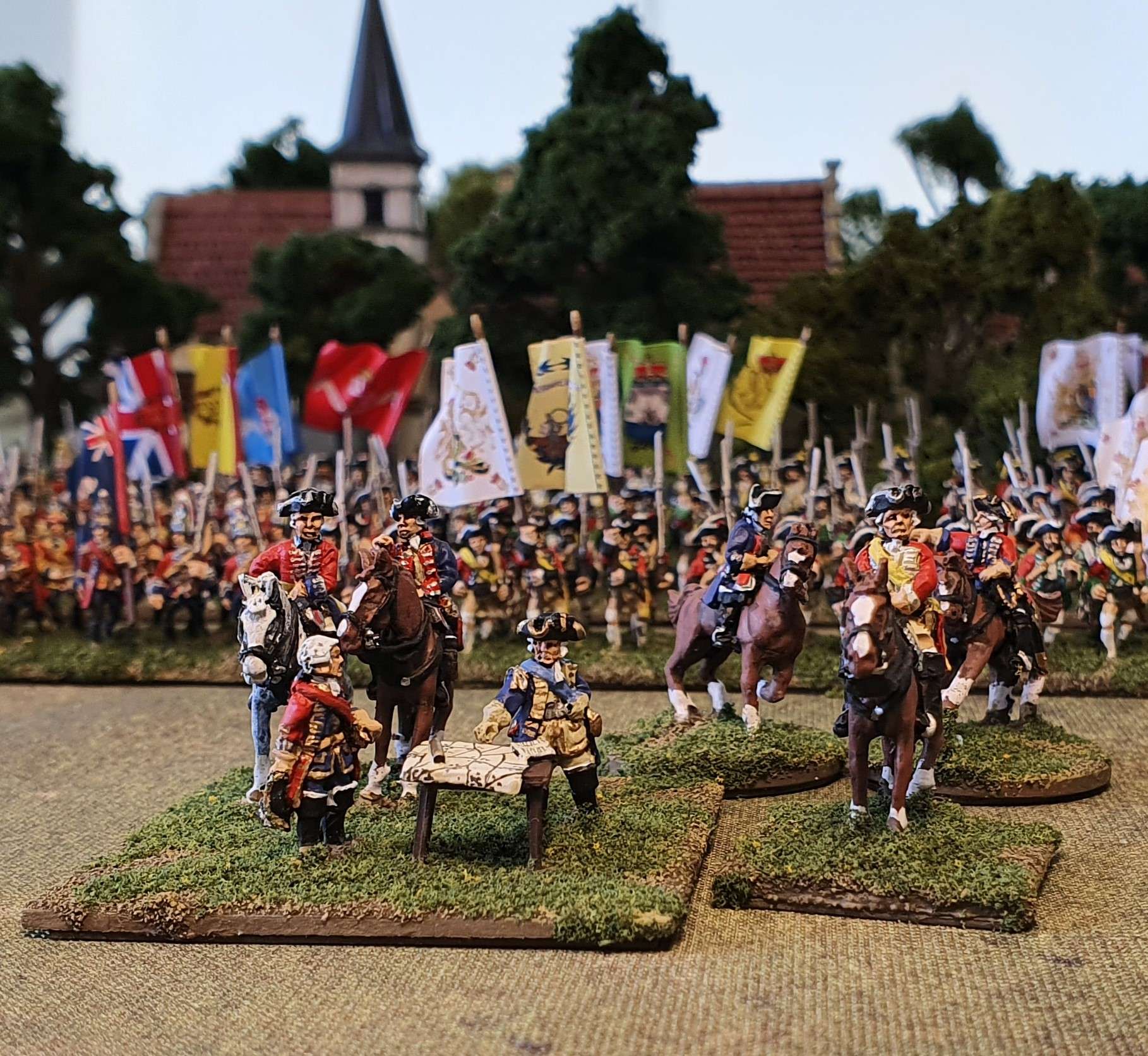
 Above: Frederick and his staff observe the attack from the high ground of the Wach-Berg. Mounted nearby in a grey coat is the veteran British correspondent, Sir Aiden Catey of the Times of London. Frederick tolerates him at present, but will probably have to have him executed when he ceases to be amusing…
 Above: Prussian heavy guns, having deployed perilously close to the enemy, open fire from the Juden-Berg.
 Above: On the extreme Austrian left flank, Nadásdy has grouped the three Saxon chevauxleger regiments and Hungarian hussar regiments of Nostitz’s division (on the left) with the four Austrian dragoon regiments of O’Donnell’s division (on the right) and prepares to counter the Prussian attack.
 Above: Near Leuthen, Feldmarschallieutenant von Buccow has disobeyed orders, halting his march northward in response to the new Prussian attack. He has two regiments of cuirassiers, one of dragoons and a combined regiment consisting of five squadrons of carabiniers (cuirassier elite companies).
 Above: At Frobelwitz, a combined battalion of Austrian grenadiers barricades the western end of the village. Another battalion has similarly barricaded Leuthen and another further north at Nippern. All the other detached Austrian grenadier companies are busy guarding baggage or away to the north, hunting the Phantom Menace. The Württembergers however, have three Prussian-style semi-permanent grenadier battalions and have posted them behind abatis defences in the woodland on the left flank.
 Above: The battle begins.
 Above: Marching forward as if on parade, the Prussian infantry goes straight for the throat. Behind them, two of Ferdniand’s four heavy batteries deploy on the Glanz-Berg, ready to put some fire down onto the Austrian reserve areas behind Sagschütz hamlet.
 Above: The Prussians waste no time in getting stuck in! The Bavarians also waste no time in wheeling back to face the threat.
 Above: Württemberger artillery and musketry proves to be remarkably ineffective against the Prussian assault. [Of seven dice rolled, Andy rolled no fewer than five ones!]
 Above: Not wishing to fight the Prussian cavalry while they have close infantry support, Nadásdy decides to withdraw, hoping to draw Zieten’s cavalry out, beyond the protection of Bevern’s supporting infantry.
 Above: Another view of the assault on Sagschütz. The Austrian and Württemberg artillery at this end of the line proves no more effective than the Württemberg musketry. They inflict some light damage on one of the Prussian heavy batteries as it deploys, but little else.
Sorry about the wandering houses! We used ‘cobbled’ tiles to mark the location of the villages and then placed buildings on/around them, but people do like to move the buildings and then just plonk them down in random places, as here! 🙁
 Above: Boring mêlée gameplay stuff (for the benefit of those who are trying out Tricorn):
Each unit starts with a baseline Frontal Morale Rating (FMR) which then gets modified by its situation. A d6 is then added for the total result. The enemy does the same and the difference in the resultant number is the number of losses suffered by the loser. Once a unit has taken losses equal to its FMR it is ‘broken’ (removed from the table). The FMR for the Württemberg infantry is 3, with the three grenadier battalions at the bottom of the picture having 4. Almost all the Prussian units here have 5, with three Guard battalions at the top of the picture having 6 and a few of the supporting battalions having 4.
To make things simple (especially in large mêlés like this), we start by placing a d6 behind each unit, showing its baseline FMR. The dice is then turned over as modifiers are added subtracted (for high numbers a second d6 is placed). All of the Württemberg battalions suffered a -1 for Failed Volley and the grenadier battalion on the left of the line suffered -1 for being Staggered and -1 for having Greater Losses. Most battalions on both sides had +1 for Secure Flanks and +1 for rear Support. Once that’s done, a d6 is rolled for each unit and placed next to the FMR dice to show the total. The totals are then compared and results applied.
Looking at the dice above, you can see that the Württemberg line was utterly destroyed in the first assault. The results starting from the bottom; 1: 6 v 2 – grenadiers have already suffered 2 casualties from artillery fire, so take 2 more and break. 2: 13 v 6 – grenadiers take 4 casualties and break. 3: 12 v 10 – grenadiers take 2 casualties and retreat. 4: 9 v 6 – infantry take 3 casualties and break. 5: 11 v 9 – infantry take 2 casualties and retreat. 6: 14 v 9 – infantry take 3 casualties and break. 7: 8 v 7 – infantry take 1 casualty and retreat. So that’s three battalions retreated and four destroyed outright.
 Above: As units break or retreat from combat, units within 6 inches to their rear have to make a morale check (roll less than their MR). If they fail they become Staggered. At the end of the turn the retreating units then try to rally (by rolling less than their MR); two of the three fail and become broken, so at the end of Turn 1 that’s six Württemberg battalions gone (I./Leib Regiment, all three grenadier battalions and I./Prinz Louis Regiment) out of a starting 13!
 Above: Having already lost more than 1/3rd of his starting MR strength, Von Spiznass rolls to hold his division together and succeeds! His second line now becomes the next target of the Prussian assault…
 Above: The Prussians come on in the same old way… The hamlet of Sagschütz offers scant cover to the Spiznass Regiment, whose 1st battalion is destroyed and 2nd battalion is forced to retreat to the Kirch-Berg. East of the hamlet, I./Prinz Louis Regiment is also forced to retreat, while II./Leib Regiment is destroyed outright. However, the Württembergers manage to restore a little honour at this moment, as on the right of their line, the II./Truchsess Regiment, along with the Bavarian Leib Regiment, manage to halt the charge of the Prussian Garde and Itzenplitz Regiments by fire, while on the left of the line the II./Prinz Louis Regiment manages by the skin of their teeth to beat off the Kremzow Grenadier Battalion. The Kremzow Grenadiers then fail to rally and scurry off to the rear!
 Above: However, these small successes are all academic, as the Württemberger losses have been catastrophic and what’s left of the corps breaks and flees the field.
 Above: A short time later, the Prussian infantry have taken Sagschütz and their reletless advance has destroyed half of the Bavarian Corps. The surviving Bavarians fall back to make a stand at the Kirch-Berg. Behind them, Forgách’s Austrian and Hungarian battalions similarly fall back, hoping to establish a new line facing south.
 Above: At Leuthen meanwhile, Prussian heavy guns have been conducting an artillery-duel with Colloredo’s position batteries. Although being lightly damaged by return-fire, the Prussians are steadily gaining the upper hand. Note that had to use Swedish gunners for this battery, as I’d run out of Prussian artillery!
 Above: Colloredo’s infantry seem to be catching the worst of the artillery duel, as the round-shot bounces through their ranks.
 Above: At last the Austrians catch a break as Daun returns to the headquarters and manages to slap some sense into Lorraine! Two ADCs are soon galloping south toward Buccow’s cavalry.
 Above: Up at Frobelwitz, the whitecoats wonder what all that noise is to the south…
 Above: At Leuthen, the defenders have a much better idea of what is heading their way, but can only stand and watch, while nervously waiting for orders.
 Above: The Prussians advance much faster than the Bavarians can possibly retire and the Bavarians are soon caught in a hail of lead.
 Above: For once, the Prussians don’t even need to charge as several Bavarian battalions are completely broken up by fire. The remaining battalions follow the Württembergers in fleeing the field. It’s now the end of Turn 4 and Lorraine has lost 23 battalions and four batteries for Frederick’s loss of one grenadier battalion… Nevertheless, the Bavarian sacrifice has bought time for the Austrians; Forgách has almost completed his withdrawal to the line of the frozen Radaxdorfer-Bach.
 Above: Nadásdy has now completed his withdrawal, only just beating the allied infantry fugitives to the Radaxdorfer-Bach! Although Zieten’s Prussian cavalry have left their infantry support far behind, they still have a significant qualitative and numerical advantage over Nadásdy’s Austrians, Hungarians and Saxons; Zieten has five cuirassier regiments (MR 6), three dragoon regiments (MR 5) and a large elite hussar regiment 0f two battalions (MR 5), versus Nadásdy’s four dragoon regiments (MR 5), two hussar regiments (MR 4) and three Saxon chevauleger regiments (MR 5).
 Above: Having cleared away the Württembergers and Bavarians, Prince Ferdinand re-orders his ranks north of Sagschütz before continuing the assault.
 Above: On the Prussian left, Retzow’s division passes through the Juden-Berg battery position.
 Above: Forgách desperately attempts to order his lines before the Prussian infantry reach him. However, his troops are already suffering casualties from long-range artillery fire and one battalion has already been broken by the sheer volume of fire. The Prussian gunners are certainly earning their pay this day and the Austrian artillery seems incapable of responding in kind.
 Above: Nadásdy’s men draw swords and prepare to charge…
 Above: To Nadásdy’s rear, Buccow’s cavalry are on the move. However, to everypne’s surprise, they aren’t going to reinforce Nadásdy against Zieten! Instead, they move forward, aiming for the gap between Forgách and Colloredo, with orders to remove the troublesome battery from the Butter-Berg and then to engage what they presume to be the Prussian left flank (they don’t know yet about Driesen’s massive cavalry wing lurking in the dead ground, just beyond the Butter-Berg and who is waiting for just such a move).
 Above: At Frobelwitz, some Austrian reinforcements arrive, in the form of part of Arenberg’s Reserve Division of the Right Wing.
 Above: Having drawn Zieten out onto ground of his choosing, Nadásdy finally orders tyhe charge! Two Austrian dragoon and three Saxon chevauleger regiments smash into four Prussian cuirassier regiments.
 Above: Concerned by the cavalry battle on his flank, Prince Ferdinand turns the I./Markgraf Frederick Regiment, II. Standing Grenadier Battalion and a detachment of battalion guns to protect the flank.
 Above: The ‘scores on the doors’ once again! For the Prussians (on the left) the red dice are the modified mêlée modifiers, while the blue dice is the rolled d6. The Austrians are using white dice for the mêlée modifiers and are rolling blue d6 (except for one red d6 at the top).
At the bottom of the picture, the Prussian Garde du Corps get 8 against the Graf Brühl Chevauxlegers’ 10, so suffer 2 casualties and retreat (both sides had rear support but had one open flank, so no secure flanks). Next, the Gensd’Armes get 9, but are fighting both the Prinz Albrecht and Prinz Carl Chevaulegers, so the Saxons roll for both and pick the best result (the supporting hussar regiment can only support one unit, so the Prinz Albrecht Regt gets the Rear Support +1); they get 13 & 10, so the best result of 13 wins and the Gensd’Armes take 5 casualties and retreat. Next, the Seydlitz Cuirassiers get 14 against the Jung-Modena Dragoons’ 12, so the dragoons suffer 2 and retreat. Lastly, the Schönaich Cuirassiers, lacking rear support, get 7 against the Zweibrücken Dragoons’ 8, so retreat with 1 casualty.
 Above: At the end of the combat, the Prussians have astonishingly, lost three combats and won only one! However, the Prussians have a significant advantage in numbers.
 Above: Neither side sees advantage in launching breakthrough charges with their winning regiments, so opt to rally back behind their supporting lines. A breakthrough charge would have been especially unwise for the Austrians, as even if successful, it would have left them milling around in front of the Prussian third line. Combats done, both sides successfully rally all their retreating cavalry regiments. It’s now the end of Turn 6.
 Above: In Turn 7 the cavalry charge again! The Austrians have the initiative, so get their charge in first (units blown from combat cannot provide rear support and are easy meat, so despite his regiments’ quality disadvantage, Nadásdy needs to put distance between the Prussians and his rallying regiments.
 Above: On the flank, the Austrian Hessen-Darmstädt Dragoons charge over the Kirch-Berg to hit the supported line of the Markfraf Karl Infantry. In response, Zieten throws in the Markgraf Friedrich Cuirassiers! Fighting both units at a significant disadvantage, it doesn’t appear as though the Hessen-Darmstädt Dragoons have a chance!
 Above: In the main cavalry battle the two sides are evenly matched in terms of numbers, but the two Austrian hussar regiments have only MR 4 and are faced by Prussian dragoons with MR 5 and rear support. The Desewffy Hussars (on the left) face the the Normann Dragoons and are destroyed outright. In the centre, the Nadásdy Hussars are beaten by the Czetteritz Dragoons and are forced to retreat with 2 casualties. On the right the Austrian Sachsen-Gotha Dragoons are evenly-matched against the Prussian Stechow Dragoons and fight them to a draw. However, as the Austrians charged first, they have the advantage and the Stechow Dragoons are forced to retreat.
 Above: On the Kirch-Berg, the Hessen-Darmstädt Dragoons win against astonishing odds! As mentioned above, they were fighting against two units; the elite I./Markgraf Karl Regiment (MR 5 with +1 for rear support provided by the II. Standing Grenadier Battalion) and the Markgraf Friedrich Cuirassiers (MR 6 though not quite a flanking charge). Tragically for the Prussians, neither the battalion guns or the infantry manage to do any damage and the dragoons charge home completely fresh! The dice gods are with the Austrians on this occasion, as neither the infantry or the cuirassiers manage to beat the dragoons! The cuirassiers are able to retreat, but infantry beaten by cavalry are automatically broken.
The dragoons now have the option to conduct a breakthrough charge and with only the unsupported grenadier battalion in front of them, they take that option and put the Prussian grenadiers to the sword!
 Above: To add insult to injury, the Prussian Markgraf Friedrich Cuirassiers and Czetteritz Dragoons both fail to rally from retreat and go back into the box!
 Above: By contrast, the Nadásdy Hussars manage to rally, though are still ‘blown’ and are now parked in front of the already-rallied Saxon Prinz Carl Chevaulegers. The victorious Hessen-Darmstädt Dragoons meanwhile are rallying and blown on the Kirch-Berg and right in front of some Prussian battalion guns. They have also now drawn the attention of the heavy artillery positioned on the Glanz-Berg… The sudden storm of shot soon wipes the jubilation from Austrian faces as the dragoons are broken and sent packing!
 Above: Nadásdy is pleased with his men’s performance thus far, but the destruction of the Hessen-Darmstädt Dragoons has sharply reminded him that he is still at a significant disadvantage and his luck can’t hold forever.
 Above: Turn 7 brings a slight ‘operational pause’ as the Prussian infantry closes to musketry range with Forgách and the two cavalry wings re-order their lines. On the Prussian left, Prince Eugene of Württemberg receives orders from Frederick to move to the left flank and counter Buccow’s cavalry with his hussars (note that the Swedish horse have now been replaced with zombie dragoons from the right flank).
 Above: Buccow, having been forced to contract his frontage to squeeze between Colloredo and Forgách, charges into Retzow’s infantry! Retzow’s command has become somewhat disordered during the advance (the King will have to have a word with him later). Nevertheless, the Kalckreuth Cuirassiers are subjected to a devastating volley from the two battalions of the Winterfeldt Infantry Regiment, but that doesn’t stop the cuirassiers from sabering a battery before retiring to lick their wounds.
 Above: In the meantime, Nadásdy’s cavalry have charged again, but this time it ends in disaster, with the Nadásdy Hussars broken and the Sachsen-Gotha Dragoons, Prinz Carl Chevaulegers and Graf Brühl Chevaulegers thrown back to the Radaxdorfer-Bach!
 Above: Zieten orders the Jung-Krockow Dragoons and his own hussar regiment to continue the charge on into the sparse second line of Austrian cavalry! The Austrian Jung-Modena Dragoons are utterly broken and the Prinz Albrecht Chevaulegers are thrown back to join their compatriots.
 Above: The heroic Saxon horsemen rally once again, but Nadásdy knows that they cannot do much more. With losses nearing catastrophic levels, his men are now demoralised [in game terms this inflicts a permanent -1 on their mêlée rolls and any unit being forced to retreat will automatically break].
 Above: The Prussian cavalry rally following their decisive charge. However, on their left the Austrian Zweibrücken Dragoons fight on! Nevertheless, the Seydlitz Cuirassiers have returned and are thirsty for revenge…
 Above: The Prussian infantry continue their relentless march through Lorraine’s army. Although the Austrian Macquire Regiment (on the left flank), manages to halt the charge of the Prussian Meyerinck Regiment, the rest of Forgåch’s first line is completely smashed. One battalion of the Heinrich Daun Regiment manages to rally, but the other three battalions (from the Heinrich Daun, Leopold Pálffy & Haller Regiments) are broken by the Prussian Garde and Grenadiergarde.
 Above: With four of his original ten battalions broken, Forgách has now suffered 1/3rd losses, but his remaining battalions stand!
 Above: At the start of Turn 9, most of Zieten’s and Nadásdy’s cavalry are blown following the previous combat. However, the Seydlitz Cuirassiers charge over the Kirch-Berg to contact the Zweibrücken Dragoons. The result is a draw, but the Prussian cuirassiers have the qualitative edge and force the Austrian dragoons to retreat.
 Above: Somewhat astonishingly, Forgách has decided to go down fighting and launches a charge on the Prussian infantry! This is unlikely to end well…
 Above: Buccow is also in an aggressive mood, as he throws his cavalry once again against Retzow’s left flank. The massed Carabiniers are on the left and the Erzherzog Ferdinand Cuirassiers are on the right, with the Batthiány Dragoons in support. The Carabiniers suffer heavy casualties from the muskets of the I./Winterfeldt Regiment and are beaten off in mêlée, though manage to rally. The cuirassiers fare better however and despite being staggered by earlier artillery fire, manage to break the II./Winterfeldt Regiment before retiring back behind the dragoons.
 Above: At long last, Colloredo’s infantry are on the move! One of the left-flanking battalions has already been broken by fire from the Butter-Berg and their comrades now fall back to defend Leuthen. The rest of the division is ordered to form a new line facing south and a few battalions push out to remove the Prussian guns and establish the new right flank on the Butter-Berg (they are still unaware of the lurking presence of Driesen’s cavalry and somewhat remarkably, Driesen has decided not to move forward in response to Buccow’s attack on Retzow).
 Above: Arenberg’s division finally reaches Leuthen and not a moment too soon!
 Above: On the Prussian side, Forcade has gathered in his second line of infantry to establish a more concentrated infantry reserve in the centre.
 Above: Württemberg’s hussars stand ready to counter the unlikely possibility of any breakthrough by Buccow.
 Above: As expected, Forgách’s desperate counter-attack does not go well and his division is destroyed! The only obstacle between them and Leuthen is Buccow’s battered cavalry division.
 Above: On the eastern flank of the battle, the Austrian Zweibrücken Dragoons failed to rally after retreating from their combat with the Seydlitz Cuirassiers, so now its all down to the three Saxon Chevauleger regiments to hold the flank.
 Above: Another view of the Prussian advance. There are remarkably few casualty-markers behind Prince Ferdinand’s divisions. Most of the leading battalions have suffered a casualty and the II./Meyerinck (second from right with the blue flag) has suffered three, but that’s it, apart from the three battalions lost earlier on the right flank. Retzow’s left-hand division has suffered higher casualties due to being faced by larger numbers of Austrian guns and by Buccow’s cavalry (oddly enough, in the actual battle, Retzow also suffered heavily from artillery fire, being more visible to the main Austrian line).
 Above: Serbelloni’s right wing is also now moving south toward Leuthen. Note that as most units are based in line on a single base, we used MDF arrow markers to indicate direction of travel when in column. It’s not to everyone’s taste, but it’s FAR easier than fiddling with individual four-figure bases, especially in games of this size.
 Above: Buccow charges again! Now it’s the turn of the Batthiány Dragoons, who smash into the II./Alt-Braunschweig Regiment, who have just moved forward to plug the gap left by the II./Winterfeldt Regiment, who were broken by the previous charge.
 Above: Astonishingly, the Batthiyáni Dragoons smash the II./Alt-Braunschweig and charge on through the gap! The Kurszell Fusiliers have the misfortune to be in the way and have just become staggered thanks to the broken infantry in front. The dragoons ride them down without mercy, taking some small revenge for the disaster that is unfolding on their left!
 Above: Württemberg knows that Austrian cavalry are causing havoc to his front, but his path is blocked by thousands of friendly infantry!
 Above: On the Prussian right flank, Zieten’s cavalry FINALLY secure the flank of the infantry.
 Above: Concerned by Serbelloni’s move toward the Butter-Berg, Frederick finally orders Driesen’s cavalry to advance. As if things weren’t already bad enough for the whitecoats…
 Above: However, the cavalry are riding to the rescue! Lucchese’s Austrian right wing cavalry appear on the crest of the Schön-Berg and move to intercept Driesen! However, I must confess that I brought these on two turns early for the ‘look of the thing’ as we were running out of time and they wouldn’t see combat. It’s now Turn 10 and Lucchese isn’t scheduled to turn up until Turn 12.
 Above: As mentioned above, we were sadly running out of club-time for the game. We’d played for six hours and 10 turns (good going for such a large game and fairly inexperienced players). However, that suddenly became academic, as the Austrians suffered a thunderbolt from the Dice Gods!
Once again, Nadásdy had been left with no option but to charge. In front of him were the Prussian Jung-Krockow Dragoons and the two battalions of the elite Zieten Hussars. So three units versus three, all with MR 5… However, the Saxon regiments all had greater casualties and the division was still demoralised, while the Prussians all had rear support, so now it was more like 6 v 3. These heroic regiments had been very lucky in the initial stages of the battle, but now their luck finally ran out…
Although none were defeated outright in combat, the fact that Nadásdy’s division was demoralised meant that any Retreat result would immediately become Broken. Consequently, Nadásdy’s heroic cavalry division ceased to exist.
Lorraine’s army had already passed through the 1/4 casualties threshhold on the previous turn, when Forgách’s division disintegrated, but the loss of Nadásdy meant that he now had to test again for passing through 1/3rd losses.
Lorraine rolled a 1…
So that was the end of our Leuthen refight. A resounding victory for the Prussians, marked by some astonishingly bad Austrian dice-rolling during key moments (the sole exception being the initial cavalry combat). Had there been more time, we’d have casually ignored the bad army morale roll and carried on to fight for Leuthen Church, but this time it wasn’t to be.
Thanks to all who played and best wishes to our mate Trevor, who missed the game due to illness. Trevor will have the pick of commands when we do our Kolin refight soon.

King Frederick II Likes This
 Prior to our June refight of the Battle of Leuthen, I was working my way through the Prussian order of battle, painting units to fill it out as best I could so we didn’t have to rely too heavily upon proxies. To start with, I needed twelve grenadier battalions, but only had eleven painted. One of the missing units was Grenadier Battalion ‘Wedell’ (1/23), so that was soon under the brush.
 Above: Grenadier Battalion ‘Wedell’ (1/23) was formed from the combined grenadier companies of the ‘Winterfeldt’/’Lattorff’/’Zeuner’ Infantry Regiment (IR 1) and the ‘Forcade’ Infantry Regiment (IR 23). The battalion went through a succession of commanders (and therefore titles), being known initially as ‘Bandemer’. When Bandemer died in March 1757, the unit became ‘Wedell’ until he was killed at Zorndorff in August 1758. The unit then became ‘Rathenow’ until finally being given the title ‘Poseck’ in March 1762.
 Above: Both constituent regiments had red, Brandenburg-style cuffs, linings and neck-stocks, with white small-clothes, white ‘metal’ and a blue shoulder-strap. The men of IR 1 also had red lapels and collar. Both regiments had simple white lace buttonholes, with three pairs on each side of the breast/lapels and one pair below, with another pair above each cuff. IR 1 also had a pair of lace buttonholes on each tail-pocket. The officers of IR 1 had silver lace edging to the lapels and cuffs, while the officers of IR 23 had silver lace buttonholes.
 Above: Both regiments had silver-fronted caps with a blue back and white band. Those of IR 1 had white piping with a white pompom. Those of IR 23 had red piping and a white pompom with a speckled red top (appearing pink at a distance).
 Above: The Garde Infantry Regiment (IR 15) was one of only two Prussian line infantry regiments with three battalions (the other being the ‘Anhalt-Dessau’/’Kahlden’/’Anhalt-Bernburg’ Infantry Regiment (IR 3)). The I. Battalion of the Garde was also known as the Leibgarde, being Frederick’s personal bodyguard battalion. It often served independently of the other two battalions. Prior to Frederick’s coronation in 1740, the regiment had only two battalions and was titled ‘Prinz von Preussen’ (the Crown Prince of Prussia’s Regiment) but was expanded and elevated to Garde when he became King. His father’s Grenadiergarde Regiment (IR 6) was then reduced in status and strength, becoming a single battalion regiment, with many soldiers of the old Grenadiergarde being transferred across to the Garde.
 Above: My Garde Regiment has a complicated history… I initially painted the I. Leibgarde Battalion in 1996 or thereabouts (using the ‘corn-fed’ Lancashire Games Mk 2 figures) for a big club demo-game of the Battle of Kolin. I then added the III. Battalion at some point using Old Glory 15s figures, but never got around to painting the II. Battalion. Then this year in a fit of enthusiasm, I decided to refight the Battle of Leuthen, so finally got around to painting the II. Battalion using Old Glory 15s figures (I re-flagged and re-based the old III. Battalion while I was at it). However, this now meant that the Leibgarde‘s Lancashire Games figures looked out of place next to the other two battalions, so I decided to paint a new Leibgarde using Old Glory 15s.
 Above: In full dress, the I. Leibgarde Battalion of the Garde Regiment wore a blue coat with red Swedish cuffs, collar, linings and shoulder-strap, though without lapels. The coat was richly laced with nine large, tasseled silver buttonholes on each side of the breast, plus two more on each cuff and silver lace edging to the collar, as well as a silver aiguilette behind the right shoulder. Officers’ lace was even more extravagant, consisting of large, ‘S’-shaped rococo ‘Brandenbourgs’ and additional lace on the pockets.
 Above: The II. Battalion of the Garde wore a coat with red Swedish cuffs, linings, collar, shoulder-strap and lapels. Each lapel had three pairs of broad silver lace buttonholes and a pair below each lapel, as well as a pair of buttonholes on each cuff. There was no aiguilette and no lace edge to the collar. There was also no campaign ‘interim’ coat. Officers’ coats lacked lapels and were therefore the same as those of the Leibgarde. It’s unclear if they had an ‘interim’ version, so they may well have worn the richly-laced coat on campaign.
 Above: The III. Battalion of the Garde wore the same coat as the II. Battalion, though unusually wore grenadier caps instead of hats. The only other battalion in the Prussian Army to wear grenadier caps was the Grenadiergarde (IR 6). This unit does therefore, provide a rare opportunity to use those flippin’ grenadier standard-bearer figures!
 Above: The grenadier cap of the III. Battalion of the Garde had a silver front, an ornate silver band, a yellow cloth back, piped silver and a white pompom with yellow centre. The detached flank-grenadier company wore the same cap as the other battalions (having a red back with white pompom and red centre).


 In
In  The artillery held a very high status in the Hanoverian army, but was consequently very conservative and resisted efforts at modernisation. For example, 3pdr guns were retained as battalion guns throughout the Seven Years War, whereas the British and Prussian armies were moving toward 6pdr pieces in that role (Hanoverian 6pdrs were heavy pieces, being only used for position battery work). They also resisted a proposed move to the excellent and much lighter/shorter Schaumburg-Lippe-Bückeburg 12pdr for their heavy position batteries. Hanoverian guns and carriages were therefore generally heavier and more old-fashioned than their peers. Nevertheless, the Hanoverian artillery remained numerous and effective throughout the Seven Years War.
 As with the rest of the Hanoverian army, artillery uniforms were very British in cut, though colourings were markedly different (the figure on the left in the painting above is a Hanoverian artilleryman and the other two figures are Hanoverian Foot Guards). The coat was a distinctive light blue colour, with lapels, cuffs and linings in red (no collar, shoulder-straps or lace). Sources are split on button-colour; Kronoskaf says white metal, but all the pictorial evidence suggests yellow metal, which also matches the gold-yellow hat-lace. I’ve gone with yellow metal.
 Waistcoats were red. Breeches and belts were buff. Gaiters were white, secured below the knee with a buff leather strap. They also wore a belly-box in either buff or whitened leather, decorated with a yellow metal badge (shown variously as either a crowned circular Badge of Hanover or as a flaming grenade).
 Guns were polished brass, while gun-carriages and equipment were painted red, with black ironwork. These are a mixture of
  Anyway, that’s it for now! There’s more SYW to come (isn’t there always…?), including freshly-painted Hanoverian cavalry, a load of Prussians, and some more Reichsarmee. I’ll also be photographing my old 28mm AWI collection over the next few weeks and we’ll be refighting the Battle of Bunker/Breed’s Hill later in the month.

 As previously mentioned, my recent return to Seven Years War wargaming has meant that it’s all been wall-to-wall tricorns, muskets, red coats, lace and pointy-headed Germans around here. I felt I needed a break and what could possibly be better than the TOTALLY different American War of Independence…?
 Jase Evans and I had been mulling over ‘doing something in 28mm’ for a while and this then lit the touch-paper… This also coincided with my mate ‘Eclaireur’ publishing the first edition of his superb British Grenadier! rules and Perry Miniatures starting their superb AWI range.
 Within six months we’d painted over 30 units between us and others soon joined the project, meaning that we were able to play some of the larger battles such as Monmouth and Germantown. With Eclaireur, I then also got involved in massive refights of the Battle of the Brandywine (at the National Army Museum, Chelsea) and the colossal Battle of Long Island (at the equally-salubrious South Mimms Services on the M25). Having then reached the pinnacle of AWI gaming, I moved on to other things and my AWI collection went back into the box and remained there until last Thursday…
 As the title says, for our ‘Return’ game I chose the


 Above: McDougall’s brigade consists of four battalions of infantry; the Maryland (18 figures, Line class), 1st New York (12 figures, 2nd Line class), 3rd New York (16 figures, 2nd Line class) and 19th Continental (12 figures, 2nd Line class) Regiments, plus the massed skirmishers (8 figures, 2nd Line class) and Hamilton’s battery, which has been attached to Putnam.

 Above: Brigadier Samuel Cleaveland’s artillery, positioned on high ground east of the Bronx River, opens fire on Chatterton’s Hill. Nearest the camera is a battery of 12-pounders (3 guns, Line class). For scenario purposes, this battery is immobile. On their left is a battery of 6-pounders (3 guns, Line class), which is mobile, but can’t cross the River Bronx, which makes their mobility somewhat moot. The 6-pounders therefore unlimber and join the long-range bombardment of Chatterton’s Hill.


 Above: Maitland’s Hessian and Tory skirmishers push forward, though initially get the worst of their firefight with the Connecticut State Levies skirmishing in front of them. Maitland could opt to deploy the 3rd Light Battalion in skirmish order, but elects to keep them formed in close order, to increase their impact in the assault. However, they soon become a target for Hamilton’s battery.
 Above: The Patriots hunker down behind their breastwork and wait for the Lobsters to come to them.
 Above: Mc Dougall’s infantry swings to the right. However, they clearly need to practice their drill, as battalions collide and disrupt each others’ lines!
 Above: American skirmishers deploy forward to engage the enemy. However, in doing so, some of them unwittingly mask Hamilton’s artillery! Forcing him to temporarily cease fire.
 Above: Cleaveland’s guns are a fine sight as they hammer away across the valley. However, the range is long and they have very little effect on Hamilton’s dug-in guns or Putnam’s infantry. They switch their fire to the much closer groups of skirmishers…
 Above: The 3rd Light Infantry push on up the hill, screened by Grant’s Company of New York Tories. However, they are coming under intense skirmisher and artillery fire and the tiny group of Tories isn’t providing a very effective screen! As they get closer, Hamilton orders his gunners to load grape…
 Above: On the left, the Hessian Jäger continue to have surprisingly little effect on the Connecticut Levies. However, the 17th Light Dragoons feel their sap rising as the Delawares appear to their front… The trumpeter sounds the Charge!
 Above: The complete ineffectiveness of their volley has clearly taken the Delawares unawares and their line becomes unsteady just as the enemy cavalry charges home [in game terms, they had not only fluffed their volley, but now also fluffed their ‘Being Charged’ morale roll, incurring two DPs, which act as negative modifiers during melee].
 Above: The much-vaunted Delawares are given a thorough malletting by the Light Dragoons and lose half their number as they ignominiously retreat from the combat.
 Above: Having used up all the available ones during firing and melee, the Delawares now pick up the available sixes during their retreat move and collectively break the All-New England 500-yard Sprint Record… Nevertheless, the Delawares soon rally and move forward once again.

 Above: With the Hessians having little effect on the rebel skirmishers, the 49th Foot (here played by the 38th) advance in close order to push them back.
 Above: Maitland watches the advance.
 Above: As does Leslie…
 Above: In an effort to clear Hamilton’s line of fire, McDougall’s skirmishers had wandered too far to the left and consequently come within grapeshot range of Cleaveland’s 12-pounders! The cover afforded by the rocky terrain offers only scant cover as a quarter of their number are shredded by grape! Shocked by their losses, the remaining men retreat behind Chatterton’s Hill, though retreat soon turns to rout and they flee the field.
 Above: Following their sabering of the Delawares, the 17th Light Dragoons manage to control their blood-lust and quickly rally. To their front, the rebel 3rd New York Regiment appears and engages the Light Dragoons with ineffective long-range musketry. The Hessian Jäger move quickly to screen the cavalry from any further fire.
 Above: The British infantry clear the woodland and push on up the hill. However, they come under heavy fire from Hamilton’s artillery and Brooks’ Massachusetts Militia and start to suffer losses. British orders require them to only engage the enemy with musketry and NOT to assault the enemy position, though their fire is proving ineffective against the dug-in rebels!
 Above: Concerned by the potential threat of enemy infantry appearing on the British left, Von Heister orders Rall to halt his deployment and instead directs him to take his brigade along the road to the left flank. While the ‘Rall’ Grenadiers sort themselves out, the ‘Leib’ Regiment and the ‘Knyphausen’ Fusiliers march to the left.
 Above: As the British infantry close on Putnam’s brigade, the 49th Foot and 3rd Light Infantry are suffering increasing losses from rebel fire and are doing precious little in return. Von Heister sends orders for them to go in with the bayonet, but it seems that the orders are not getting through!
 Above: “Pour it on, Boys!” Putnam places himself directly in the line of fire, behind the breastworks with the men of the Massachusetts Militia.
 Above: In the meantime, McDougall’s brigade continue their manoeuvre to the right, but have become thoroughly disordered by the move, so McDougall and his 2ic attempt to personally take control of the situation. In the meantime, the Connecticut Levies, threatened by the marauding light dragoons, fall back through the Continental lines to reform at the rear.
 Above: Having rallied from their earlier combat with the Delawares, the 17th Light Dragoons charge again, this time against the 3rd New York Regiment. The charge takes the New Yorkers completely by surprise and they fail to fire a volley at the charging cavalry!
 Above: The 3rd New York make a brave stand, but are quickly overwhelmed and are forced to retreat. Like the Delawares they lose around half of their number in the melee.
 Above: The 17th Light Dragoons become disordered in the melee and fall back to rally.
 Above: With the situation on Chatterton’s Hill threatening to get out of hand, Von Heister, Leslie and Maitland all converge on the position to take direct control of the engaged units.
 Above: Unlike the Delawares, the 3rd New York fail to rally following their tangle with the light dragoons and are soon fleeing northward!
 Above: The 17th Dragoons try their luck once again against the Delawares, but this time are badly shot up and refuse to charge home!
 Above: At last, Von Heister manages to get orders through to Leslie and Leslie personally leads the 49th forward against the entrenchment! However, the 49th are again shot up by Brooks’ militia and stop short of the earthwork. The 3rd Light Infantry meanwhile, steadfastly refuse to advance into the teeth of Hamilton’s guns.
 Above: The view from the American side of the entrenchments.
 Above: Graham’s New York Militia skirmishers have fallen back behind the lines to rally, though are closely followed up by the British 5th Regiment of Foot (here played by the 52nd Foot with the buff regimental colour). The 5th Foot threaten to outflank the American line, but have also managed to mask their own guns (not that the guns have achieved very much)!
 Above: Rall’s Hessian brigade continues its march to the left flank.
 Above: Oberst Rall waves them on their way.
 Above: Note that Oberst Rall is actually represented here by General von Donop. Hessian generals in this period didn’t have a prescribed uniform, so wore the uniform of their own regiment, in this case the straw-coloured facings of the ‘Donop’ Musketeers. The supporting grenadiers are from the grenadier company of the ‘Prinz Carl’ Musketeers, who formed part of the ‘Lengerke’ Grenadier Battalion.
 Above: The ‘Rall’ Grenadier Regiment has finally turned about and joins the rear of Rall’s column, though not before suffering a number of casualties from Hamilton’s artillery.
 Above: The British-Hessian commanders exhort their men as they attempt to launch a further assault on the entrenchment!
 Above: With the 3rd Light Infantry refusing to get stuck in, the 35th Foot are stuck behind them, unable to manoeuvre.
 Above: Over on the left flank, the Hessian Jäger continue to make life miserable for the Delawares.
 Above: The Delawares reciprocate and along with the 19th Continentals, succeed in shooting dozens of light dragoons out of the saddle! The 17th Light Dragoons have now suffered 25% casualties.
 Above: Colonel Haslet is right in the front line as he personally steadies the battered Delawares.
 Above: To their rear, McDougall is finally managing to sort out the disorder in the ranks and now hopes to swing his brigade round to the left, to hit the British infantry in the flank.
 Above: However, the British have got their flank attack in first and the 5th Foot seem set to charge! Hamilton decides that discretion is the better part of valour and swiftly limbers up his guns to make good his escape, screened by the skirmishers of Graham’s New York Militia.
 Above: Rufus Putnam, along with Brooks’ Massachusetts Militia, hold on in the entrenchments as long as they can, but are forced to disengage before they are rolled up by the 5th Foot. McDougall’s planned flanking movement meanwhile, has died on its arse from a combination of DPs and Rall’s approaching Hessians.
 Above: A last view of the British assault. The British had succeeded in taking Chatterton’s Hill, but had they suffered greater losses?

 Anyway, onto the Germantown photos…
 Above: The British army viewed from their right flank. Facing us is Major General James Grant’s Brigade, consisting of the 1st Light Infantry Battalion, 4th, 5th, 49th & 55th Regiments of Foot and the Queen’s Rangers.
 Above: Another view of Grant’s Brigade. The green-coated Queen’s Rangers have deployed into skirmish order, but the regimental cadre, with the colours, remains formed to their rear as a rallying-point.
 Above: Grant’s Brigade seen from the opposite flank. In the foreground are the 1st Light Infantry and in the distance is Mathew’s Foot Guards Brigade.
 Above: The vital crossroads is held by the brigades of Major General Charles Grey (15th, 17th & 44th Regiments of Foot) and Major General Agnew (33rd, 37th, 46th & 64th Regiments of Foot). In front of them is positioned a large battery of guns and the Commander-in-Chief, General Sir William Howe.
 Above: Having spotted the approach of General Greene’s rebel division, Grant wheels his brigade to the left, seemingly unconcerned by another column of rebels approaching his right flank. The large house in the distance is the ‘Chew’ or ‘Cleveden’ House; a solid, stone-build construction that is presently garrisoned by a detachment of the 40th Foot. The remainder of the 40th under Lieutenant Colonel Musgrave (who also has the 2nd Light Infantry Battalion and a detachment of artillery under command), are fighting a delaying action against Washington’s approaching rebel division.
 Above: As Grant wheels to the left, Mathew’s Foot Guards (along with one of Grant’s battalions), advance to screen the right flank from Smallwood’s approaching column of Maryland and New Jersey Militia regiments.
 Above: The small Hussar detachment of the Queen’s Rangers (here represented by the 17th Light Dragoons) remain in reserve at the crossroads.
 Above: The large British battery remains silent, as its front is still masked by the 2nd Light Infantry Battalion. Unfortunately we didn’t have any hills available on the day of the game, so you’ll have to imagine that the guns are on a rise, while Musgrave’s detachment (visible just beyond the fence-line) are on another rise. The skirmishers and limber are in a shallow valley between the two.
 Above: Grant’s brigade has begun to engage Greene’s rebels.
 Above: However, Grant suddenly realises that he is significantly outnumbered! Greene’s column consists of Muhlenberg’s, Weedon’s and Woodford’s Virginia Brigades and McDougal’s Connecticut Brigade, as well as Smallwood’s militia brigade on the flank!
 Above: Mathew’s Guards are ordered to deal with Smallwood’s militia as quickly as possibly and then wheel to engage Greene’s main force.
 Above: At last, Musgrave finally pulls his detachment back into the valley, exposing the advancing rebels to the full power of the Royal Artillery!
 Above: On the other side of the town, Washington’s left flank (Hampton’s 2nd Pennsylvania Brigade) has begun to engage Grant’s left flank (49th Foot & 1st Light Infantry). The 40th Foot are also taking pot-shots at the passing rebels from the Chew House.
 Above: As the British guns pour fire into Washington’s leading battalions, Grey and and Agnew move forward on either flank.
 Above: Conway’s 3rd Pennsylvania Brigade is crushed by the intense artillery fire, as well as from the 2nd Light Infantry, who are still at close range. Conway rides forward to steady them and is soon joined by Washington himself, but to little avail.
 Above: Hartley’s 1st Pennsylvania Brigade moves up to provide support for Conway’s crumbling battalions.
 Above: On the other side of Germantown, Hampton’s 2nd Pennsylvania Brigade bypasses the Chew House, leaving that strongpoint for Maxwell’s New Jersey Brigade to deal with. However, Hampton’s advance is disrupted by fire from the 40th Foot occupying the house. In response, Maxwell deploys his artillery to suppress the defenders before his assault.
 Above: On the American left, Green’s lead battalions are now heavily engaged with Grant’s brigade.
 Above: At the head of Green’s column, the riflemen of the 14th Virginia Regiment are bested by the Queen’s Rangers and fall back behind the formed lines of Weedon’s brigade.
 Above: Another view, looking along the line of Grant’s brigade toward Germantown.
 Above: Grant’s brigade is fighting hard, but Green keeps throwing ever-increasing numbers of troops into the battle. Unable to maintain their skirmish line in this increasingly unequal battle, the Queen’s Rangers fall back behind Grant’s line.
 Above: Hampton’s 2nd Pennsylvania Brigade charges the British line at Germantown!
 Above: Although things seem to be going well for Greene on the eastern side of Germantown, on the western side, Washington is facing stiff resistance from increasing numbers of British infantry, backed up by very strong artillery. Two of Conway’s Pennsylvanian regiments have already been broken and the rest are being hammered by British fire. However, Washington still has another two brigades uncommitted to the battle, including his best troops, the Maryland and Delaware Continentals.
 Above: The view from the British side. Musgrave’s detachment is still managing to hold its ground in the centre, while Grey’s brigade in the foreground, moves to cross the stream and outflank Washington’s column. In the distance, Agnew’s Brigade moves forward through Germantown, aiming to relieve the detachment of the 40th Foot, who are still holding out at the Chew House, despite the best efforts of Maxwell’s New Jersey Brigade.
 Above: On the eastern side of Germantown, Grant is spread very thin, as his left flank is now assaulted by Hampton’s Pennsylvanians, while his right is simultaneously attacked by Greene’s Virginians.
 Above: The Queen’s Rangers Hussars (represented by the 17th Light Dragoons) move to support the threatened right flank. Howe also rides over to assess the situation for himself.
 Above: As the Queen’s Rangers’ skirmish line falls back, the 55th Foot desperately cling onto possession of a small copse on Grant’s right flank. However, they are taking heavy losses and can’t hope to hold on much longer against these odds. The rest of Grant’s brigade is now taken under fire by newly-arrived American artillery.
 Above: On the extreme right flank, Mathew’s Foot Guards Brigade has successfully broken and thrown back Smallwood’s militia, but is now at risk of being outflanked and cut off from the rest of the army.
 Above: Despite heavy losses in his leading brigade, Greene’s column still has plenty of fresh troops to spare and continues its inexorable advance. In front of him, Grant’s redcoats are starting to crumble. But with Washington struggling at Germantown, will this be enough to roll up the British right wing and save the day?
 Following my recent, brief departure into Jungle Green, normal service is now resumed with some more troops for my Seven Years War Hanoverian & German Allied army, starting with
  Born in 1721, Prince Ferdinand was the fourth son of Ferdinand Albert II, Duke of Brunswick (the House of Braunschweig-Wolfenbüttel) and in 1733 became brother-in-law to Crown Prince Frederick of Prussia, following Frederick’s marriage to Ferdinand’s sister Elizabeth Christine. Ferdinand soon entered Prussian military service and in 1740 the newly-crowned King Frederick II of Prussia appointed Ferdinand as Chef (i.e. Colonel-Proprietor) of the newly-raised

 When Frederick took his army east again to meet the Austrians at
  In March 1758, following his victory at the
  In terms of modelling, I’ve used one of the generals from the excellent Eureka
  For ADCs I’ve used a pair of mounted officers; one Prussian (painted as a Hessen-Kassel officer) and one British, both by
  Lastly we have Hanoverian Major General Johann Daniel Victor von Scheele. At Minden Scheele commanded one of the two brigades of the Prince of Anhalt’s Division. However, on the day of the battle Scheele was ordered to take command of the division and his timely intervention on the left flank of Spörcken’s Division helped to save the British infantry and Hanoverian Foot Guards from being outflanked by French cavalry.


 Above: Major Fuller (Dan) deploys his dug-in company on the peak of Point 7378, placing the bulk of his troops covering the road to Burma and the junction in the tracks, but also deploying troops to keep a watchful eye on the flanks and rear.
 Above: The areas of trees represent dense jungle, while the areas of lichen and bamboo represent more open scrubland. The clear areas on the southern slopes of the hill are very steep and slow to traverse.
 Above: Dan is permitted to pre-register three targets for his 3-inch mortar section and starts with the junction of the road and the mule-track. I took photos of these on my phone for reference and the templates were then removed from the table.
 Above: The second registered target is slightly further along the road.
 Above: The third registered target is the point at which the mule-track splits into two.
 Above: Lastly, the MMG section establishes a beaten zone for its guns, covering the junction of the mule-tracks and the most likely avenue of approach. Again, this photo was taken for reference and the template was then removed from the table.
 Above: The Indian Paras have not been in position very long when a patrol reports the appearance of a Japanese column on the road from Burma!
 Above: The Japanese troops belong to the 3rd Battalion of the 58th Infantry Regiment, commanded by Major Shimano (Phil). The Paras’ exposed position on the bare hilltop has not gone unnoticed by Major Shimano, who orders his column to mount a hasty attack on the enemy position.
 Above: Captain Nishida Susumu’s 9th Company is in the lead. Sending half of his company up the mule-track on the right, he leads the rest of his company along the road, luckily suffering only light casualties as the pre-registered 3-inch mortars rain bombs onto the road-junction.
 Above: Captain Nishida Susumu had commanded a long-range reconnaissance patrol as far as Kohima during the previous year, managing to return to Burma with valuable intelligence, while completely escaping detection by the Allies and their native auxiliaries. However, this time he has no time for such subtlety as he orders his men to make the best speed possible along the tracks instead of using the cover of the bush.
 Above: As 9th Company shakes out into assault formation, the unmistakable rattle of Vickers MMGs is heard across the hillside. The righthand column is soon pinned down by fire. The Paras’ 2-inch mortars also add their weight to the cacophony.
 Above: With 9th Company starting to engage the enemy, Shimano’s 10th Company arrives.
 Above: Captain Susumu makes best use of the sparse undergrowth to mask his approach, but casualties are starting to mount. Nevertheless, Susumu’s three 50mm ‘Knee-Mortar’ sections and the attached MMG section succeed in suppressing the Indian MMGs and 2-inch mortars.
 Above: Susumu’s righthand column suffers heavy losses as they attempt to push through the wall of MG fire. The 3-inch mortars also now shift their fire to the track-junction. Susumu’s knee-mortars and MMGs do their best, but can’t hope to suppress the weight of fire being directed at the attackers. Sadly, the battalion’s 70mm gun detachment is still out of range and the regiment’s 75mm guns are a full day’s march behind the column.
 Above: “May the Emperor live for a thousand years! BANZAI!” Susumu finally manages to work close enough to the enemy position with sufficient men to mount an assault. However, previously-hidden Paras now open up with smallarms and the Japanese infantry are cut down in droves!
 Above: Nevertheless, one of Susumu’s rifle sections manages to gain a foothold in the Indian trenches!
 Above: The ejected section of Indian Paras withdraws to the Company Headquarters on the crest of the hill, where it rallies. Major Fuller orders them to mount an immediate counter-attack to re-take their trenches!
 Above: Charging over open ground, the Indian section is subjected to heavy fire, though makes it to the now enemy-occupied trench. The flanking sections also join the counter-attack, though are badly disordered by fire from Susumu’s remaining troops, only a few yards away through the bush.
 Above: Nevertheless, the counter-attack is wholly successful. The Japanese interlopers are eliminated and the Indian Paras re-occupy their positions.
 Above: Captain Susumu, with the rallied remnants of 9th Company, launches another charge in concert with Captain Ishida’s 10th Company on the right. However, the attack is a disaster, with both captains becoming casualties and 9th Company being virtually wiped out.
 Above: However, Japanese strength continues to grow with the arrival of the 11th Company.
 Above: The combined fire of the 9th, 10th and 11th Company knee-mortar and MG sections are starting to make their presence felt, causing disruption among the forward edge of the Paras’ perimeter. A few riflemen of 9th Company are also clinging on, only a few yards from the Indian trenches, though thoroughly pinned down by Indian smallarms fire.
 Above: Seeing their best chance yet, the remnants of the 9th and 10th Companies launch yet another assault on the Indian trenches!
 Above: At last some success for the Japanese! At the forward corner of the position, two sections of Indian Paras are eliminated (albeit at considerable cost to the attackers) and a Japanese rifle section again manages to break into the trenches! But can the Japanese manage to hold onto their gains this time?
 Above: Still unengaged, the Japanese 11th Company rushes forward to exploit the small success, followed by the Battalion Headquarters Company and MG Company. The 70mm Battalion Gun Platoon deploys, ready to offer fire support.
 Above: Sorry to disappoint, but with the battle entering its most critical phase, we simply ran out of club-night time!!! However, the general consensus was that the Indian Paras had won the day. They had lost only two out of thirteen sections and still possessed their very effective heavy weapons.
 Having played almost nothing but Seven Years War and written about nothing but tricorn hat-lace in recent months, many readers of this blog will be relieved to know that we finally played something different at club last week! 🙂
 Historical Background
 If the British-Indian XIVth Army is the ‘Forgotten Army’, the Battle of Sangshak is undoubtedly the ‘Forgotten Battle’ of the Forgotten Army: Surrounded by a fanatical enemy, unsupported, running low on water, ammunition and men and without hope of relief, the 50th Indian Parachute Brigade, along with elements of the 23rd Indian Division, held out for several days, withstanding assault after assault before finally breaking out to escape in small groups. Without this battle, the Japanese 31st Division would have reached Kohima long before the famous defence there could be established and history might have been very different. There certainly would not have been a heroic defence of Kohima and relieving the Siege of Imphal would have been considerably more difficult.
 However, some Gurkhas clearly didn’t know what they were getting into. A group of NCOs reported to their company commander that jumping from 600 feet seemed somewhat high and that jumping from 300 feet might be preferable. “But at that height your parachutes won’t have time to open!” replied the company commander. “Oh.” said the Gurkhas “So we will have parachutes?” The Gurkhas went away, visibly relieved…
 Lt Col Paul Hopkinson’s 152 (Indian) Para moved up to the Mahrattas’ HQ at ‘Kidney Camp’, high in the peaks southeast of Ukhrul. From ‘Kidney’ he sent two companies out to relieve Mahratta companies on their hilltop eyries; Major Webb’s ‘B’ Company was dispatched to Point 7386 (‘Badger’) and Point 7000 (‘Gammon’), while Major Fuller’s ‘C’ Company was sent to the otherwise un-named Point 7378. These positions dominated the only two east-west Jeep-tracks over the hills in the area, though were not mutually supporting and were beyond the range of the Mahrattas’ mortars at ‘Kidney’. The two companies were also disappointed to discover that the positions recently vacated by the Mahrattas were only half-prepared, so the Paras soon found themselves hard at work, improving their trenches, dugouts and firing positions.
 Things south of the Imphal Plain meanwhile, were getting chaotic and control of the battle was slipping from Scoones’ grasp. The plan was for 50th Para Brigade to have slowly fallen back to the Imphal perimeter in the wake of 23rd Division. Instead, the brigade seems to have been forgotten by IV Corps and instead received the mistaken order to hold its ground on current positions. This was to be a fateful order.
 Briefing for Major John Fuller, Officer Commanding ‘C’ Coy, 152 (Indian) Para Bn
 Execution
 Enemy Forces
 • Machine Gun Grazing Fire (or ‘Firing on Fixed Lines’)
 Briefing for Major Shimano, Commanding III Battalion, 58th Infantry Regiment
 Enemy Forces
 Game Sequence
 Terrain Effects
 I realise that the terrain for this scenario is rather complicated, being drawn from aerial recce photos and original maps. Indeed, this is a recurring problem when attempting to recreate battles on the Burma Frontier and it is often difficult to draw a balance between accuracy and simplicity. Hex-based terrain tiles can translate accurate maps onto the table with relative ease, but you do tend to need a lot of hex tiles and they’re not cheap! For that reason, I’ve included a simplified version of the map, which should be within the means of most wargamers’ terrain collections.
 I’ve recently been writing scenarios for two of the bloodiest battles of the Seven Years War; the Battles of Prague and Kolin. Prague was particularly notable for the remarkably high attrition-rate among generals on both sides and it started me thinking once again about how generalship is reflected (or not) in much in
 The playtest rules:
 * If a general is killed/captured, the formation must roll on the Formation Morale Table during the following Command Phase, applying a -1 modifier (therefore no change if the general was Poor). Use the next ‘step’ of the table; e.g. if the division hasn’t yet rolled for Formation Morale, use the 1/3rd casualties step. If it’s already rolled for 1/3rd casualties, use the 1/2 casualties step. If it’s already rolled for 1/2 casualties, roll again applying the -1 modifier. If the Army Commander is killed/captured, use the same method at the various ‘steps’ on the Army Morale Table.
 * Generals apply their generalship rating to Formation Morale rolls, but may not do so when they are attached to a unit (re-living your glory-days as a Colonel is not necessarily effective generalship!). The exception to this is that divisions led by a Poor general will always apply the -1 modifier, even when the morale-sponge is away from his HQ!
 Anyway, that’s it for now. Please let me know what you think.