
 No plan survives contact with the enemy and we had planned to do our next SYW Big Game at The Carmarthen Old Guard later this month, which was to have been the Battle of Kolin. However, our mate Phil can’t now make it, so we’re going to have to postpone it – probably until Christmas. Instead, Andy and I are going to dig out the Napoleonics and try the new scenario I wrote during lockdown for the Second Battle of Caldiero 1805, which should still be good fun. In the meantime, here’s my scenario for Kolin, written for my Tricorn 18th Century variant of Shako rules:
(I make no apologies, but this is another big ‘un…)
Historical Background

King Frederick II
Despite King Frederick II’s successful pre-emptive strike against Saxony in 1756, Prussia was still surrounded by strong enemies. His strike against the Austrians in Bohemia had ended in stalemate at the Battle of Lobositz. By March 1757, Austrian troops in Bohemia numbered well over 100,000 men and threatened at any moment to invade Saxony, Lusatia or Silesia. To the north, Frederick was forced to keep a small corps in Pomerania to guard against any Swedish incursion, while a somewhat larger corps had been sent to East Prussia under General Lehwaldt to counter the growing Russian threat. To the west, the French and the Holy Roman Empire were also mobilising for war, but would hopefully be countered by the Duke of Cumberland’s allied Hanoverian-British-Hessian-Brunswicker army. Allowing his enemies to simply build up their forces and then launch an overwhelming combined assault was simply not an option and he had to strike against the most immediate threat; the Austrians.

Prince Charles of Lorraine
Frederick’s strike came in mid-April 1757 and fell upon Prince Charles of Lorraine’s main Austrian army in Bohemia. Frederick advanced in four columns; his own column advanced from Dresden up the western bank of the Elbe, Bevern’s column descended from Lusatia on the eastern side of the Elbe, Prince Moritz advanced from western Saxony and Schwerin’s corps attacked from Silesia. All were aimed at the Bohemian capital of Prague, which was also the largest fortress in the region and base for Lorraine’s army.
The Battle of Prague was fought outside the city walls on 6th May and proved to be an extremely bloody affair, notably resulting in the loss of two of the greatest commanders of the age: the Austrian Marshal Browne and the Prussian Marshal Schwerin. The battle was a victory for Frederick’s Prussians, though proved not to be the knock-out blow that he’d hoped for and the Austrians were able to withdraw behind the city walls, forcing Frederick to besiege the city.

The death of Schwerin

Daun
However, Frederick did not have time for a siege! A new threat had emerged in the form of Marshal Daun’s Austrian army, which was advancing from the south to reinforce Lorraine’s army. However, arriving just too late to intervene, Daun was forced to fall back from Frederick’s superior force around Prague. Frederick, hoping to force Lorraine to capitulate before dealing with Daun, dispatched a corps under General Bevern to observe and obstruct Daun’s movements.
By mid-May, Daun had been reinforced by Serbelloni’s corps, which had remained idle at Königgrätz, by four regiments of Saxon cavalry sent from Poland under General Nostitz, by 16,000 men under General Bretlach, who had escaped the defeat at Prague and lastly by 7,000 light troops under the command of General Nádasdy, who had marched up from Olmütz. Daun now outnumbered Bevern by a considerable margin and finally with sufficient forces for the task, he was ordered to relieve Prague. Lorraine was simultaneously ordered to attempt a break-out and link up with Daun.

Bevern
Seeing the growing threat, Frederick continued to send reinforcements to Bevern and by 4th June, Bevern had 12,100 foot and 12,400 horse against Daun’s 26,000 foot, 13,500 horse and more than 6,000 light troops (hussars and grenzer). Despite the mismatch in numbers, Bevern was able to hold off Daun and even forced Daun back toward his base at Königgrätz, thus persuading Frederick to march east with a sizeable portion of his besieging force and finally defeat Daun’s relief effort (a dangerous gamble, with over 50,000 Austrian troops trapped within Prague).
However, by the time Frederick started marching, Daun had finally amassed his full strength of 54,000 men and was marching westward again, forcing Bevern back along the Kaiserstrasse arterial road to Neu-Kolin.

Zieten
By 14th June, Bevern had been joined by Frederick’s corps and both sides now began probing each other’s positions. At last on 17th June, Frederick was facing Daun’s army, which was deployed facing west on high ground a short distance to the west of Neu-Kolin, with its right flank resting on the Poborz Hill, overlooking the Kaiserstrasse. Frederick decided that evening to use the Kaiserstrasse to march around the Austrians’ flank and attack their rear near the village of Krzeczor; a somewhat ‘bold’ move, given that this move would be entirely under observation from the heights! Anticipating this move before it even began, Daun started moving his formations under cover of darkness, redeploying his army to face north along a line from Poborz Hill to Przerovsky Hill, with his reserve formations deployed at a right-angle to the left, occupying most of the original positions.
Unaware that his plan had been anticipated, Frederick began marching his army at daybreak on 18th June. As the army advanced through thick fog, they encountered little opposition except retiring groups of grenzer and occasional parties of hussars. At the head of the column was General Zieten with 50 squadrons of hussars, closely followed by Hülsen with four battalions of infantry and four squadrons of dragoons.


Nádasdy
As the fog cleared, the sun began to beat down and at 1030hrs, Frederick halted his hot and weary army on the Kaiserstrasse, to the immediate north of Daun’s positions. Observing from the upper floor of a roadside inn (variously identified in accounts as the ‘Novi Mesto’, ‘Slate-Slunce’ or ‘U-Slunce’), Frederick could see Austrians on the high ground at Poborz and Przerovsky, but no idea regarding the full extent of Daun’s positions. Nevertheless, he was determined to press on with his plan and at 1200hrs gave his orders for the attack:
Zieten would continue to push Nádasdy’s Austrian hussars back beyond the villages of Krzeczor and Kutlire, ensuring that they could not interfere with the main assault, which would be spearheaded by Hülsen (now reinforced by six grenadier battalions). Hülsen would capture the village of Krzeczor and the hill and oak-wood beyond, thus turning the Austrian right flank and paving the way for a further assault by the massed Prussian heavy cavalry and the rest of the infantry under Prince Moritz of Anhalt-Dessau, who would progressively attack obliquely around the Austrian flank.

Prince Moritz
However, at no point in his plan did Frederick countenance the possibility of the Austrians reacting to his moves! The three-hour halt in the Prussian march had given Daun valuable time to extend his right flank; he filled the forward villages, copses and a hundred year-old Swedish earthwork with Grenzer and established a powerful battery on the Krzeczor Hill.
Behind the hill and hidden from Prussian view, Daun placed the Grenadier Reserve, General Nostitz’s Saxon cavalry brigade and 1,000 Kommandierten cavalry (the duty detachments of the day from all the cuirassier and dragoon regiments in the army). As it was clear that the left flank was no longer under threat, the divisions of Wied, Starhemberg and Sincère, as well as the bulk of the cavalry under Serbelloni, were already marching from the left flank to meet the Prussians near Krzeczor, yet all hidden from Frederick’s view.
 Although Zieten had pushed Nádasty’s hussars back as planned, Hülsen’s attack started to unravel almost immediately. Kutlire, Krzeczor and the ‘Swedish Works’ proved to be strongly held by the 2nd Banalisten Grenz Regiment, who inflicted heavy losses on the approaching Prussians, particularly in the vicinity of the strongly-held church. Daun, watching from the heights, is said to have exclaimed “My God! I think the King is going to lose today!”
Nevertheless, the seemingly-unstoppable Prussian infantry steadily pushed through Krzeczor and within half an hour finally emerged in the open ground beyond; whereupon they were set upon by a mass of Austrian hussars that Zieten’s cavalry had missed! Zieten’s cavalry soon came up to support Hülsen, but were in turn charged by yet more Austrian hussars. As the indecisive scrap between the opposing hussars continued on the flank, Hülsen again resumed the advance, but soon came under increasing opposition from the Austrian Grenadier Reserve and Beck’s rallied grenzer in the vicinity of the Oak Wood. Hülsen’s supporting artillery had also been silenced by the large Austrian battery established on Krzeczor Hill. To make matters worse, Wied’s large Austrian reserve infantry division and Serbelloni’s massive cavalry wing were also now deploying to oppose Hülsen.
 In the meantime, Frederick had halted his army once again, to await the outcome of the flank-assault. For an hour, the Prussian infantry stood in column along the Kaisertstrasse, plagued by long-range sniping from swarms of grenzer hiding among the tall crops, as well as by desultory long-range artillery fire from the heights. At last, orders came from the King for Tresckow’s infantry to join the assault; they were to attack up the northern slope of Krzeczor Hill, thus supporting Hülsen’s right flank. The rest of the army was for the time being, to be refused, though the intention was still to march them to the left and exploit the hoped-for success of Hülsen’s attack.
However, fate was to play a hand. One of Frederick’s adjutants ordered one of Bevern’s brigadiers, Generalmajor von Manstein, to clear away the grenzer to his front. Manstein was reluctant to do so, as the grenzer weren’t actually causing much harm and he needed his men ready to launch their planned attack as soon as orders arrived from the King. However, the adjutant became more insistent and invoked the King’s authority. Manstein had no choice, so ordered the nearest battalion (II./’Bornstedt’ (IR 20)) to drive off the grenzer. However, the men of the ‘Bornstedt’ Regiment, having been plagued by the grenzer for hours, were a little over-enthusiastic in their pursuit of their tormentors! In a short while, the regiment’s I. Battalion had also joined the hunt, followed by a battalion of the ‘Anhalt-Dessau’ Regiment (IR 3) and eventually the entire division was launching an un-ordered and uncoordinated assault on Chotzemitz and the Przerovsky Hill!

Serbelloni
At Krzerczor meanwhile, Hülsen was embroiled in a fierce firefight with Wied’s infantry. Both sides were taking heavy losses, but the arrival of Starhemberg’s division in support of Wied threatened to tip the balance in the Austrians’ favour. Serbelloni’s cavalry had also arrived, but were forced to hold ground while they waited for Sincère’s infantry to arrive. Cavalry are never well-suited to holding ground and Hülsen’s artillery made the stationary Austrian cavalry pay a heavy price for that decision. At last, the ‘Münchow’ Fusilier Regiment (IR 36), along with two grenadier battalions, managed to capture the Oak Wood, but without support and under fresh attack, were soon forced to fall back.
Tresckow meanwhile, was also paying a heavy price as he advanced up the slope into the teeth of Austrian canister. Nevertheless, his infantry finally reached the top of the hill, only to be checked by freshly-arrived battalions of Sincère’s division. Repeated assaults by Tresckow’s battalions failed to make any headway and Daun finally had a solid line of infantry from Przerovsky Hill to Krzeczor Hill. Serbelloni’s cavalry at last were able to fall back to the rear, out of sight from the Prussian guns. Buoyed up by their success thus far in repulsing the Prussian assault and encouraged by further successes by Nádasdy’s troopers on the flank, Wied’s division advanced, pushing Hülsen’s infantry all the way back to Krzeczor village. It seemed as though Daun was about to have his victory. However, the pendulum was about to swing back.

Seydlitz
On the Austrian right flank, Nádasdy had had some success in holding off Zieten, thanks in no small part to the thousand Kommandierten heavy cavalry. However, Krosigk’s Prussian heavy cavalry (‘Prinz von Preussen’ Cuirassiers (CR 2), ‘Rochow’ Cuirassiers (CR 8), and ‘Normann’ Dragoons (DR 1)) had now passed Krzeczor village, forcing the Austrian horse to fall back once again. The way cleared of enemy cavalry, Krosigk wheeled his troopers around the village and smashed into Wied’s flank. The first battalions broke immediately. Seeing the whitecoats starting to panic, Hülsen’s infantry charged again and soon Wied’s men were utterly broken! Tragically, Krosigk was mortally wounded at the moment of his greatest triumph, but the Colonel of the ‘Rochow’ Cuirassiers, one Friedrich Wilhelm von Seydlitz, immediately took command and continued the rout of the Austrian infantry.
Serbelloni’s Austrian horse meanwhile, were still in the process of falling back into the reserve line following their bombardment by the Prussian gunners and were unable to intervene. However, two regiments; the ‘Kolowrat-Krakowsky’ Dragoons (DR 37) and the Saxon Carabiniergarde, had just arrived from the left flank to reinforce Serbelloni. They managed to push forward between Starhemberg’s infantry battalions and attempted to save the situation. Their efforts were in vain as Seydlitz, brilliantly controlling his marauding cuirassiers, defeated them in short order! With friendly cavalry fleeing through their lines, another three regiments (two of Sincère’s and one of Starhemberg’s) were broken before the rampage was finally brought to a halt by the Austrian ‘Botta’ Infantry Regiment (IR 12), who formed a new line at 90 degrees to Sincère’s main line and coolly delivered volleys into the ‘Normann’ Dragoons as they attempted to roll up the Austrian flank. Nostitz’s Saxon chevauxlégers then finally managed to drive off the blown Prussian cavalry.
 Daun’s army had almost been destroyed by just three regiments of Prussian cavalry, but with no reserves coming up in support, Seydlitz was forced to break off the attack. Serbelloni once again plugged the gap with his cavalry, who again became magnets for the Prussian artillery. Safe from pursuit, Wied’s battalions began to rally. Daun in the meantime, ordered Puebla to bring his uncommitted infantry over to form a continuous line on Andlau’s left and ordered Stampach to launch an attack with his cavalry on the right flank of the Prussian assault.
Frederick in the meantime, was preoccupied with the repeated efforts by Tresckow’s infantry to assault the northern slopes and was probably unaware of the dramatic events beyond Krzeczor. With Chotzemitz finally cleared of grenzer, Frederick ordered every last uncommitted battalion on the right wing to launch an assault on the Krzeczor Hill. However, despite repeated attempts, this assault fared no better than the previous efforts. At one point, Frederick was seen to draw his sword and lead the ‘Anhalt-Dessau’ Regiment (IR 3) forward. However, the regiment had other ideas and hadn’t moved. An ADC rode up to Frederick, asking “Sire! Will you attack the battery on your own?” Enraged, the King is said to have shouted at the reluctant infantry, “Rogues! Do you want to live forever?!”
 With the Prussian infantry now fully engaged, Stampach began his advance against the Prussian right flank. However, Schönaich’s Prussian cavalry were in a good blocking position and were able to frustrate Stampach’s manoeuvre, though the Austrian ‘Hessen-Darmstädt’ Dragoons (DR 19) managed to slip through. The dragoons fell upon a single, isolated battalion which happened to be none other than Frederick’s personal bodyguard, the I. (Leibgarde) Battalion of the Garde-Regiment (IR 15). Finding themselves surrounded by enemy cavalry, the Guardsmen managed to turn their rear rank about to defend the rear, but were very badly cut up and even lost their pair of battalion guns to the dragoons.
The attack on Krzeczor Hill was finally starting to bear fruit, as the fresh injection of fresh battalions had captured the top of the hill and driven a wedge into the Austrian lines. However, the infantry of both sides were now fatigued from the battle and the hot weather and the Prussian attack had ground to a halt once more. Frederick ordered forward the uncommitted cavalry division of the 79 year-old General Pennavaire. His four cuirassier regiments now swept up the slope between Bristvi and Chotzemitz and up, over the hill. Serbelloni ordered one of his own cuirassier brigades to meet them and the two cavalry formations thundered toward each other. For some reason, the Austrian cuirassiers broke off their attack at the last moment and the Prussian cuirassiers charged on toward Starhemberg’s infantry. However, the Prussian horses were now blown from their long ride over the hill and instead of charging home, the cuirassiers stopped short and fired pistols ineffectually at the Austrian lines, receiving a devastating volley in return!
 At that moment, Serbelloni struck! Pennavaire’s cuirassiers, already blown and reeling from infantry volleys, were now charged from the front and on both flanks by an overwhelming number of Austrian and Saxon cavalry and were utterly routed, being pursued as far as the Kaiserstrasse! The ‘Prinz von Preussen’ Cuirassiers (CR 2) from Seydlitz’s command attempted to save the situation but were broken by fire from Starhemberg’s infantry and artillery and also joined the rout. These fleeing cuirassiers disrupted Tresckow’s infantry as they fled, leaving them in no state to withstand being attacked from the rear by the Austrian and Saxon cavalry, who were now returning from their pursuit of Pennavaire. Three battalions were completely destroyed and Tresckow himself was captured.
 As evening started to fall, Frederick made a last roll of the dice. Assembling a force of seventeen battalions and the ‘Driesen’ Cuirassiers (CR 7) from the right flank and Normann’s pair of uncommitted dragoon regiments from the left, he launched yet another assault on the Krzeczor Hill. This new assault actually achieved some success against the exhausted Austrians, but once again the superb ‘Botta’ Infantry Regiment and the ‘Soro’ Grenadiers held firm. Andlau’s division now advanced from Przerovsky Hill and the Prussian infantry were forced to wheel to their right to meet them. This gave Serbelloni the perfect opportunity to charge the open Prussian left flank with as many cavalry as he could muster.
Serbelloni’s charge was devastating. Several battalions on the left flank of the line were ridden down and massacred, while the Leibgarde Battalion found themselves surrounded and having to fight back-to-back for the second time that day. The rest of the line meanwhile, found themselves assaulted from the front by Andlau’s infantry and also soon joined the rout. The ‘Driesen’ Cuirassiers were swept away along with the infantry, while Normann’s dragoons, charging through the narrow gap between Bristvi and the Swedish Works, found themselves outflanked and routed in turn.
Hülsen meanwhile, was still fighting in the Oak Wood, having captured it yet again while the battle raged on the Krzeczor Hill. However, he was coming under increased pressure from the rallied battalions of Wied’s division and now had new enemies appearing out of the smoke from Krzeczor Hill. As news reached him of the disaster on the hill, Hülsen was forced to join the retreat. Zieten meanwhile, had been doing his best to hold off Nádasdy’s hussars and had assumed the battle to be going to plan but was now horrified to receive fresh orders, telling him to cover the army’s retreat! Nevertheless, he followed his orders to the letter and a charge by the ‘Warnery’, ‘Seydlitz’ and ‘Werner’ Hussars dissuaded the Austrians (who were in any case, utterly exhausted) from any serious attempt at pursuit.
 Frederick meanwhile, as at Mollwitz in 1740, had already exited stage-left, escorted by the squadron of the Garde du Corps Cuirassiers. What was left of the army was ordered to retreat to northern Bohemia and the corps besieging Prague was ordered to break off the siege and rejoin the King.
Later that evening, the King was seen sitting disconsolately at the side of the road, absent-mindedly drawing in the dust with his stick, when a cuirassier brought him a drink of water in his hat, saying “Drink Majesty, and let battles be battles; it’s well that you are safe. Let us trust in God that it will soon be our turn to conquer!”
The casualties on both sides had been horrific. Of 54,000 men, the Austrians had lost 8,114 men, of whom 1,002 were dead and the rest being reported as wounded or missing. The Prussian troops had lost an astonishing 13,776 out of 33,000 men, of whom 5,380 were taken prisoner, including all the non-walking wounded. The remaining 8,396 were all dead or missing! The Austrians also captured 45 guns and 22 colours.
However, the old cuirassier was right; Frederick had just suffered his first defeat, but it would soon be his turn to conquer… And sooner than anyone could have realised.
 Order of Battle of the Prussian Army
King Friedrich II
(Excellent – 3 ADCs)
Advance Guard – Generallieutenant Hans Joachim von Zieten (Excellent)
I. Bn (5 Sqns), ‘Zieten’ (Leib) Hussars (HR 2) (elite) [5/2]
II. Bn (5 Sqns), ‘Zieten’ (Leib) Hussars (HR 2) (elite) [5/2]
I. Bn (5 Sqns), ‘Werner’ (Capucin) Hussars (HR 6) (elite) [5/2]
II. Bn (5 Sqns), ‘Werner’ (Capucin) Hussars (HR 6) (elite) [5/2]
I. Bn (5 Sqns), ‘Puttkamer’ (Weisse) Hussars (HR 4) (elite) [5/2]
II. Bn (5 Sqns), ‘Puttkamer’ (Weisse) Hussars (HR 4) (elite) [5/2]
5 Sqns, ‘Szekely’ (Grünne) Hussars (HR 1) (elite) [5/2]
5 Sqns, ‘Seydlitz’ (Rote) Hussars (HR 8) [4/1]
I. Bn (5 Sqns), ‘Wartenberg’ Hussars (HR 3) (elite) [5/2]
II. Bn (5 Sqns), ‘Wartenberg’ Hussars (HR 3) (elite) [5/2]
Advance Guard Support – Generalmajor Johann Dietrich von Hülsen (Good)
I. Bn, ‘Münchow’ Füsilier Regiment (IR 36) (elite) [5/2]
II. Bn, ‘Münchow’ Füsilier Regiment (IR 36) (elite) [5/2]
I. Bn, ‘Schultze’ Infantry Regiment (IR 29) (elite) [5/2]
II. Bn, ‘Schultze’ Infantry Regiment (IR 29) (elite) [5/2]
Grenadier Battalion ‘Wangenheim’ (47/g7) [5/2]
Grenadier Battalion ‘Möllendorf’ (9/10) [5/2]
I. Standing Grenadier Battalion ‘Kahlden’ (g1/g3/ng) [5/2]
Grenadier Battalion ‘Finck’ (13/26) [5/2]
Grenadier Battalion ‘Woldow’ (12/39) [5/2]
Grenadier Battalion ‘Nymschöfsky’ (33/42) [5/2]
Battalion Guns [2/0]
Battalion Guns [2/0]
Battalion Guns [2/0]
Cuirassier Reserve – Generallieutenant Peter Ernst von Pennavaire (Good)
5 Sqns, Leibregiment zu Pferde Cuirassiers (CR 3) [6/2 – Large Unit]
5 Sqns, Leib-Carabiniere Cuirassiers (CR 11) [6/2 – Large Unit]
5 Sqns, ‘Kyau’ Cuirassiers (CR 12) [6/2 – Large Unit]
5 Sqns, ‘Krockow’ Cuirassiers (CR 1) [6/2 – Large Unit]
Right Wing Cavalry – Generalmajor George Phillip von Schönaich (Average)
5 Sqns, ‘Driesen’ Cuirassiers (CR 7) [6/2 – Large Unit]
5 Sqns, ‘Meinicke’ Dragoons (DR 3) [5/2 – Large Unit]
5 Sqns, ‘Schönaich’ Cuirassiers (CR 6) } [6/2 – Large Unit]
1 Sqn, Garde du Corps Cuirassiers (CR 13) }
Left Wing Cavalry – Generalmajor Christian Siegfried von Krosigk (Good)
5 Sqns, ‘Stechow’ Dragoons (DR 11) [5/2 – Large Unit]
5 Sqns, ‘Normann’ Dragoons (DR 1) [5/2 – Large Unit]
5 Sqns, ‘Rochow’ Cuirassiers (CR 8) [6/2 – Large Unit]
5 Sqns, ‘Prinz von Preussen’ (Gelbe-Reitere) Cuirassiers (CR 2) [6/2 – Large Unit]
Dragoon Reserve – Generalmajor Karl Ludwig von Normann (Good)
5 Sqns, ‘Katte’ Dragoons (DR 4) [5/2 – Large Unit]
5 Sqns, ‘Blanckensee’ Dragoons (DR 2) [5/2 – Large Unit]
Infantry Centre – General der Infanterie Prinz Moritz von Anhalt-Dessau
Left Wing – Generallieutenant Joachim Friedrich von Tresckow (Average)
I. Bn, ‘Alt-Bevern’ Infantry Regiment (IR 7) (elite) [5/2]
II. Bn, ‘Alt-Bevern’ Infantry Regiment (IR 7) (elite) [5/2]
I. Bn, ‘Prinz Heinrich’ Füsilier-Regiment (IR 35) (elite) [5/2]
II. Bn, ‘Prinz Heinrich’ Füsilier-Regiment (IR 35) (elite) [5/2]
I. Bn, ‘Hülsen’ Infantry Regiment (IR 21) (elite) [5/2]
II. Bn, ‘Hülsen’ Infantry Regiment (IR 21) (elite) [5/2]
I. Bn, ‘Wied’ Füsilier Regiment (IR 41) [4/1]
II. Bn, ‘Wied’ Füsilier Regiment (IR 41) [4/1]
Battalion Guns [2/0]
Battalion Guns [2/0]
Right Wing – Generallieutenant August Wilhelm Bevern Herzog von Braunschweig-Lüneberg (Excellent)
I. Bn, ‘Anhalt’ Infantry Regiment (IR 3) (elite) [5/2]
II. Bn, ‘Anhalt’ Infantry Regiment (IR 3) (elite) [5/2]
III. Bn, ‘Anhalt’ Infantry Regiment (IR 3) (elite) [5/2]
I. Bn, ‘Bornstedt’ Infantry Regiment (IR 20) [4/1]
II. Bn, ‘Bornstedt’ Infantry Regiment (IR 20) [4/1]
I. Bn, ‘Manteuffel’ Infantry Regiment (IR 17) (elite) [5/2]
II. Bn, ‘Manteuffel’ Infantry Regiment (IR 17) (elite) [5/2]
I. Bn, ‘Fürst Moritz’ Infantry Regiment (IR 22) (elite) [5/2]
II. Bn, ‘Fürst Moritz’ Infantry Regiment (IR 22) (elite) [5/2]
I. Bn, ‘Kalckstein’ Infantry Regiment (IR 25) [4/1]
II. Bn, ‘Kalckstein’ Infantry Regiment (IR 25) [4/1]
I. Bn, ‘Kreytzen’ Füsilier Regiment (IR 40) [4/1]
II. Bn, ‘Kreytzen’ Füsilier Regiment (IR 40) [4/1]
I. (Leibgarde) Bn, Garde Infantry Regiment (IR 15) [6/2]
III. Standing Grenadier Battalion ‘Gemmingen’ (41/44) [5/2]
Battalion Guns [2/0]
Battalion Guns [2/0]
Battalion Guns [2/0]
Battalion Guns [2/0]
Artillery Reserve
Heavy Battery [3/0]
Heavy Battery [3/0]
Heavy Battery [3/0]
Heavy Battery [3/0]
Heavy Battery [3/0]
 Prussian Notes
1. The Artillery Reserve is limbered on the road, alongside the leading battalions of Tresckow’s Division.
2. The units above are for the most part, listed from the left of the line.
3. The Garde du Corps (CR 13) only had one squadron present (the other two squadrons had been left at Prague), so is too weak to be represented as a separate unit. Its strength is therefore absorbed into the rest of Schönaich’s command.
4. The divisions of Ziethen, Hülsen and Schönaich start the game deployed in line. All other divisions are deployed in column along the Kaiserstrasse. All guns are limbered.
5. Frederick may give his divisions any orders at the start of the game. Note however, that no new orders may be transmitted before the Orders Phase at the end of Turn 2.
6. The ‘Stechow’ Dragoons (DR 11) were officially under Zieten’s command, but they were under Hülsen’s command during the morning and then appear to have started the battle deployed alongside Krosigk’s heavy cavalry, so I’ve grouped them with Krosigk for game purposes (though they spent virtually the entire battle unengaged on the Prussian left flank). Feel free to transfer them back to Zieten or Hülsen if you prefer.
7. The divisions of Zieten, Hülsen, Krosigk and Schönaich start the scenario deployed in line. All other formations are deployed in column along the Kaiserstrasse. All Prussian artillery is limbered.
Formation Breakpoints
Division FMR ⅓ ½ ¾
Zieten 49 17 25 37
Hülsen 56 19 28 42
Pennavaire 24 8 12 18
Schönaich 17 6 9 13
Krosigk 22 8 11 17
Normann 10 4 5 8
Tresckow 44 15 22 33
Bevern 78 26 39 59
Artillery Reserve* 15 – – –
Army FMR ¼ ⅓ ½
Prussian Army 313 79 105 157
* The MR value of any broken Artillery Reserve Batteries are added when assessing overall Army losses.

Order of Battle of the Austrian Army
Feldmarschall Leopold Joseph Graf von Daun
(Good – 2 ADCs)
Light Troops – General der Kavallerie Franz Leopold Graf Nádasdy (Excellent)
5 Sqns, ‘Nádasdy’ Hussars (H 11) [4/1]
6 Sqns, ‘Kálnoky’ Hussars (H 17) [4/1]
5 Sqns, ‘Jazygier-Kumanier’ Hussars (H 36) [4/1]
3 Sqns, ‘Baranyay’ Hussars (H 30) } [4/1]
2 Sqns, ‘Esterházy’ Hussars (H 24) }
2 Sqns, ‘Hadik’ Hussars (H ii) }
6 Sqns, ‘Festetics’ Hussars (H 32) [4/1]
6 Sqns, ‘Morocz’ Hussars (H 35) [4/1]
1 Sqn, ‘Desewffy’ Hussars (H 34) } [4/1]
2 Sqns, ‘Banalisten’ Grenz-Hussars (H 42) }
3 Sqns, ‘Kaiser’ Hussars (H 2) [4/1]
Advance Guard – Generalfeldwachtmeister Phillip Levin Freiherr von Beck (Average)
3 Sqns, ‘Kaiser’ Hussars (H 2) } [4/1]
1 Sqn, ‘Warasdiner’ Grenz-Hussars (H 41) }
2 Sqns, ‘Karlstädter’ Grenz-Hussars (H 40) }
I. Bn, Slavonisch-Gradiskaner Grenzer [3/0]
II. Bn, Slavonisch-Gradiskaner Grenzer [3/0 – 2x Skirmishers]
I. Bn, ‘2. Banalisten’ Grenzer [3/0]
II. Bn, ‘2. Banalisten’ Grenzer [3/0 – 2x Skirmishers]
Battalion Guns [2/0]
Detached Grenzer (from Beck’s Brigade) (Average)
I. Bn, Slavonisch-Broder Grenzer [3/0 – 2x Skirmishers]
II. Bn, Slavonisch-Broder Grenzer [3/0 – 2x Skirmishers]
I. Bn, Karlstädter-Szluiner’ Grenzer [3/0]
II. Bn, Karlstädter-Szluiner’ Grenzer [3/0 – 2x Skirmishers]
Saxon Cavalry – Generalmajor Friedrich Moritz Graf von Nostitz-Rieneck (Excellent)
3 Sqns, Saxon ‘Prinz Albrecht’ Chevauxlégers [5/2]
4 Sqns, Saxon ‘Graf Brühl’ Chevauxlégers [5/2]
4 Sqns, Saxon ‘Prinz Karl’ Chevauxlégers [5/2]
Austrian Kommandierten Cavalry Brigade ‘Starhemberg’ [6/2 – Large Unit]
Grenadier Reserve – Obristlieutenant Marquis de Fiorenza (Good)
Grenadier Battalion ‘Fiorenza’ (6 grenadier companies) [5/2 – Large Unit]
Grenadier Battalion ‘Soro’ (4 grenadier companies) [5/2]
Kommandierten Infantry Battalion [4/1 – Large Unit]
Battalion Guns [2/0]
Right Wing & Reserve Cavalry – General der Cavallerie Johann Baptist Graf Serbelloni (Good)
6 Sqns, ‘Birkenfeld’ Cuirassiers (C 23) [6/2]
6 Sqns, ‘Württemberg’ Dragoons (D 38) [5/2]
6 Sqns, ‘Kolowrat-Krakowski’ Dragoons (D 37) [5/2]
6 sqns, ‘Kalckreuth’ Cuirassiers (C 22) [6/2]
6 Sqns, ‘Prinz Savoyen’ Dragoons (D 9) [5/2]
6 Sqns, ‘Serbelloni’ Cuirassiers (C 12) [6/2]
5 Sqns, ‘Porporati’ Dragoons (D 39) [5/2]
Elite Regiment ‘Burghausen’ (massed Carabiniers & Horse Grenadiers) [6/2 – Large Unit]
Elite Regiment ‘Panovsky’ (massed Carabiniers & Horse Grenadiers) [6/2 – Large Unit]
6 Sqns, ‘Schmerzing’ Cuirassiers (C 20) [6/2]
6 Sqns, ‘Infant von Portugal’ Cuirassiers (C 5) [6/2]
6 Sqns, ‘Ligne’ Dragoons (D 31) [5/2]
2 Sqns, Saxon Carabiniergarde Cuirassiers [6/2 – mark 1 casualty at start]
Left Wing Cavalry – General der Cavallerie Carl Freiherr Karger von Stampach (Average)
4 Sqns, ‘Hessen-Darmstädt’ Dragoons (D 19) [5/2]
6 Sqns, ‘Gelhay’ Cuirassiers (C i) [6/2]
6 Sqns, ‘Alt-Modena’ Cuirassiers (C iii) [6/2]
6 Sqns, ‘Sachsen-Gotha’ Dragoons (D 28) [5/2]
5 Sqns, ‘Jung-Modena’ Dragoons (D 13) [5/2]
6 Sqns, ‘O’Donnell’ Cuirassiers (C 14) [6/2]
Right Wing Infantry – Generalfeldzeugmeister Ernst Dietrich Freiherr Marschall von Burgholzhausen
First Line – Feldmarschallieutenant Franz Joseph Freiherr von Andlau (Good)
I. Bn, ‘Erzherzog Carl’ Hungarian Infantry Regiment (IR 2) [4/1]
II. Bn, ‘Erzherzog Carl’ Hungarian Infantry Regiment (IR 2) [4/1]
I. Bn, ‘Moltke’ Infantry Regiment (IR 13) [4/1]
II. Bn, ‘Moltke’ Infantry Regiment (IR 13) [4/1]
III. Bn, ‘Moltke’ Infantry Regiment (IR 13) [4/1]
I. Bn, ‘Puebla’ Infantry Regiment (IR 26) [4/1]
II. Bn, ‘Puebla’ Infantry Regiment (IR 26) [4/1]
III. Bn, ‘Puebla’ Infantry Regiment (IR 26) [4/1]
I. Bn, ‘Mercy-Argentau’ Infantry Regiment (IR 56) [4/1]
Battalion Guns [2/0]
Battalion Guns [2/0]
Second Line – Feldmarschallieutenant Emmanuel Michael Graf von Starhemberg (Average)
I. Bn, ‘Haller’ Hungarian Infantry Regiment (IR 31) [4/1]
II. Bn, ‘Haller’ Hungarian Infantry Regiment (IR 31) [4/1]
I. Bn, ‘Gaisruck’ Infantry Regiment (IR 42) [4/1]
II. Bn, ‘Gaisruck’ Infantry Regiment (IR 42) [4/1]
III. Bn, ‘Gaisruck’ Infantry Regiment (IR 42) [4/1]
I. Bn, ‘Neipperg’ Infantry Regiment (IR 7) [4/1]
II. Bn, ‘Neipperg’ Infantry Regiment (IR 7) [4/1]
III. Bn, ‘Neipperg’ Infantry Regiment (IR 7) [4/1]
Battalion Guns [2/0]
Battalion Guns [2/0]
Left Wing Infantry – Generalfeldzeugmeister Anton Graf von Colloredo zu Waldsee
First Line – Feldmarschallieutenant Anton von Portugal Graf von Puebla (Average)
I. Bn, ‘Arenberg’ Infantry Regiment (IR 21) [4/1]
II. Bn, ‘Arenberg’ Infantry Regiment (IR 21) [4/1]
III. Bn, ‘Arenberg’ Infantry Regiment (IR 21) [4/1]
I. Bn, ‘Thürheim’ Infantry Regiment (IR 25) [4/1]
II. Bn, ‘Thürheim’ Infantry Regiment (IR 25) [4/1]
III. Bn, ‘Thürheim’ Infantry Regiment (IR 25) [4/1]
I. Bn, ‘Leopold Daun’ Infantry Regiment (IR 59) [4/1]
II. Bn, ‘Leopold Daun’ Infantry Regiment (IR 59) [4/1]
III. Bn, ‘Leopold Daun’ Infantry Regiment (IR 59) [4/1]
I. Bn, ‘Harrach’ Infantry Regiment (IR 47) [4/1]
II. Bn, ‘Harrach’ Infantry Regiment (IR 47) [4/1]
I. Bn, Warasdiner-Kreutzer Grenzer [3/0 – 2x Skirmishers]
Battalion Guns [2/0]
Battalion Guns [2/0]
Battalion Guns [2/0]
Second Line – Feldmarschallieutenant Claudius Freiherr von Sincère (Average)
I. Bn, ‘Deutschmeister’ Infantry Regiment (IR 4) [4/1]
II. Bn, ‘Deutschmeister’ Infantry Regiment (IR 4) [4/1]
I. Bn, ‘Baden-Baden’ Infantry Regiment (IR 23) [4/1]
II. Bn, ‘Baden-Baden’ Infantry Regiment (IR 23) [4/1]
I. Bn, ‘Botta’ Infantry Regiment (IR 12) (elite) [5/2]
II. Bn, ‘Botta’ Infantry Regiment (IR 12) (elite) [5/2]
III. Bn, ‘Botta’ Infantry Regiment (IR 12) (elite) [5/2]
Battalion Guns [2/0]
Battalion Guns [2/0]
Reserves
Division of Feldmarschallieutenant Friedrich Georg Heinrich Graf von Wied-Runkel (Good)
I. Bn, ‘Los Rios’ Infantry Regiment (IR 9) [4/1]
I. Bn, ‘Salm-Salm’ Infantry Regiment (IR 14) [4/1]
II. Bn, ‘Salm-Salm’ Infantry Regiment (IR 14) [4/1]
I. Bn, ‘Platz’ Infantry Regiment (IR 43) [4/1]
I. Bn, ‘Starhemberg’ Infantry Regiment (IR 24) [4/1]
I. Bn, ‘D’Arberg’ Infantry Regiment (IR 55) [4/1]
I. Bn, ‘Sachsen-Gotha’ Infantry Regiment (IR 30) [4/1]
II. Bn, ‘Mercy-Argentau’ Infantry Regiment (IR 56) [4/1]
I. Bn, ‘Prinz de Ligne’ Infantry Regiment (IR 38) [4/1]
Battalion Guns [2/0]
Battalion Guns [2/0]
Artillery
Krzeczor Hill Battery
Heavy Battery [3/0]
Heavy Battery [3/0]
Heavy Battery [3/0]
Heavy Battery [3/0]
Przerovsky Hill Battery
Heavy Battery [3/0]
Heavy Battery [3/0]
Reserve Artillery
Heavy Battery [3/0]
Heavy Battery [3/0]
Heavy Battery [3/0]
Heavy Battery [3/0]
 Austrian Notes
1. The average Austrian cavalry regimental strength on the day was actually quite a bit lower than that of the Prussians (around 500 men, versus 750 men), so on this occasion they don’t class as Large Units. The exceptions are the two Elite Regiments and Starhemberg’s brigade of Kommandierten Cavalry (which was around 1,000 strong and was formed from the duty detachments of the day).
2. The actual cavalry order of battle bears little resemblance to the theoretical order of battle: Serbelloni’s cavalry wing was massively reinforced by the addition of Castiglione’s Brigade (C23 & D38) and the Saxon Carabinergarde from Köbell’s brigade of the army reserve, two regiments of combined elite companies and two regiments (C12 & D3) from Stampach’s wing. Stampach meanwhile received the remainder of Köbell’s Brigade (D13 & C14) from the army reserve.
3. The average infantry battalion strength on both sides was roughly equal, being a little over 600 men. The Austrians don’t therefore class as Large Units for this scenario. The exceptions to this rule are the Kommandierten Battalion and Grenadier Battalion ‘Fiorenza’.
4. The Saxon Carabiniergarde Regiment is sorely understrength with only two of its four squadrons present, so mark off one casualty at the start of the game.
5. The divisions of Nádasdy, Beck, Nostitz, Andlau, Starhemberg, Puebla and Stampach, as well as the Grenadier Reserve, all start the game deployed in line and may unlimber their battalion guns. All other divisions are deployed in column, as shown on the map, with limbered battalion guns. The Przerovsky Hill and Krzeczor Hill Batteries are unlimbered and the Reserve Batteries are limbered.
6. Ignore the command radius rules for Grenzer skirmishers in this scenario. The forward-deployed skirmishers may start the game within skirmisher range of the Prussian column.
7. Daun may give his divisions any orders at the start of the game. Note however, that no new orders may be transmitted before the Orders Phase at the end of Turn 2.
8. The location of the Kommandierten Infantry Battalion is something of a mystery. Sources show it variously as under the command of Beck, with Nádasdy on the right flank, with Puebla on the left flank and fighting with the grenadiers in the Oak Wood. I’ve decided to place it in the Oak Wood, under the command of the Grenadier Reserve, but feel free to attach the battalion to any other command.
9. On a similar note, I’ve no idea where the two regiments (Burghausen’s & Panovsky’s) of massed elite companies (Carabiniers and Horse Grenadiers) were stationed at the start of the battle. They do appear later in the battle, fighting in the area of Krzeczor Hill alongside Serbelloni’s cavalry, so I’ve arbitrarily placed them in the centre-rear and under Serbelloni’s command. Note that a lot of accounts refer to the Kommandierten Brigade as being elite companies, but this was not necessarily the case; they were the duty cavalry detachments of the day (picquets, etc), some of whom may have been from the elite companies.
10. Five battalions on the left flank of Puebla’s division (i.e. 2 bns of ‘Harrach’ (IR 47) and 3 bns of ‘Leopold Daun’ (IR 59)) ‘are off-table at the start of the game. They will appear, conformed to Puebla’s left flank, when Puebla’s division moves. Alternatively, in order to simplify matters, they could be deployed at the start of the game, as a second line for Puebla (or add an extra foot to the table!).
11. Some weak hussar units, particularly the Grenz-Hussar regiments and small detachments of regiments, have been combined with others to make viable units. So note that the number of hussar units in the game doesn’t match the number of regimental contingents present.
12. It’s not clear if the Austrian ‘heavy guns’ were actually all heavy (i.e. 12pdr or heavier). Some of them may have been 6pdr position batteries. The term ‘heavy artillery’ was often used to describe position batteries as opposed to battalion guns, regardless of calibre and could sometimes include 6pdrs (especially long-barreled ‘heavy’ 6pdrs). However, given the considerable damage caused by the Austrian batteries during this battle, I’ve classed them all as heavies.
13. If preferred, Nádasdy’s command may be split into two divisions, each of four hussar units. These are commanded by Hadik (Good) and Morocz (Average).
Formation Breakpoints
Division FMR ⅓ ½ ¾
Beck* 18 6 9 5
Detached Grenzer* 12 4 6 9
Nádasdy 32 11 16 24
Nostitz 21 7 11 16
Grenadier Reserve 16 6 8 12
Serbelloni 70 24 35 53
Stampach 33 11 16 25
Andlau 40 14 20 30
Starhemberg 36 12 18 27
Puebla* 53 18 27 40
Sincère 35 12 18 27
Wied 40 14 20 30
Artillery Reserve** 30 – – –
Army FMR ¼ ⅓ ½
Austrian Army 436 109 146 218
* Two broken Skirmisher stands from the same Grenzer Battalion count as 3 Morale Points when assessing formation losses. ‘Odd’ Skirmisher stands don’t count. Note that some battalions are formed in close order, defending strongpoints.
** The MR value of any broken Artillery Reserve Batteries are added when assessing overall Army losses.

Scenario Length
The game will finish at the end of Turn 24.
Victory Conditions
A Historic Victory will go to the side that breaks the enemy army.
If neither side has broken at the end of Turn 20, the side with sole possession of two of the three key pieces of terrain (Kzeczor Hill, Przerovsky Hill and the Oak Wood) may claim an Indecisive Victory.
If neither side has broken and if neither side has sole possession of two key locations, the battle will be declared a Draw.
Optional Fog-of-War
If you want to keep the Prussian player guessing as to the true Austrian dispositions, DO NOT show them the full scenario map. Instead of deploying the whole Austrian force at the start, deploy only those formations that are visible from Frederick’s position at the start: Puebla’s infantry division, Andlau’s infantry division, Stampach’s cavalry division, Nádasdy’s hussar division, Beck’s advance guard division, the Detached Grenzer and the Przerovsky Hill Battery, as per the map below. All other Austrian formations and batteries are kept off-table.
Once all Prussian units are deployed AND once Frederick has written his orders and shown them to the umpire, the Austrian player will then place his remaining units on the table and then write his orders.
Remember that Frederick will be unable to change his orders until the Command Phase at the end of Turn 2.
Prussian Fog-of-War Map

Optional Prussian Orders
Optional Rule 1: At the start of the game, only the commands of Zieten, Krosigk, Hülsen and Normann may be given orders. The Reserve Artillery may also act as desired. The remainder of the army must remain on Defend orders while they await the outcome of the initial attack. They may receive orders from the Command Phase of Turn 2 onward.
Optional Rule 2: As described above, Bevern’s division, having been forced to remain motionless in column on the Kaiserstrasse, while being plagued by grenzer and long-range artillery fire for several hours, launched an un-ordered and uncoordinated attack on the Przerovsky Hill. This might therefore be a ‘fun’ event to spring upon an unsuspecting Prussian player…
Following the Command Phase at the end of Turn 4, change Bevern’s divisional orders to ‘Attack’ and place a Command Arrow on the map, leading directly to the top of Przerovsky Hill. This will immediately supercede any orders previously issued to Bevern.
All units in Bevern’s division must immediately change formation into line (if necessary) and must move at full speed toward the new objective for two turns, even if this disrupts flank alignment.
Bevern’s division will keep these orders until they are changed in the normal manner. An ADC may NOT be sent to Bevern to change his orders until the Command Phase of Turn 6. Any ADCs already en route to Bevern will be returned to the King’s HQ at the end of the turn.
Terrain Notes
It should first be noted that the entire battlefield was a long ridge, running east to west up the centre of the table, with the Krzeczor and Przerovsky Hills being the highest point along it. However, the gentle, steady slopes didn’t confer any great advantage or disadvantage to either side, so I’ve only included the notable hills, where the ground does steepen markedly. I find that large areas of high ground are often beyond the terrain collections of most wargamers, so I’ve left it out for the sake of simplicity.
Feel free to add the ridge if you prefer. The contoured maps from the Prussian Greater General Staff study (shown above) are an excellent reference.
For the terrain effects described below, please refer to the Terrain Effects Chart on Page 2 of the Tricorn QRS (linked).
The small woods around Bristvi, Chotzemitz and Blinka are small wooded ravines, containing springs and stream-beds that were probably dry at this time of year. Class as Rough Ground.
All other woods shown on the map are classed as Woods, as per the chart. Formed units in column and limbered artillery may move along woodland roads at full speed, but may not charge while doing so. If charged while on a woodland road, cavalry will fight using their Disordered Morale Rating.
The streams are classed as Streams, as per the chart. Formed units in column and limbered artillery may cross them at full speed wherever a road crosses them.
The pond in front of Poborz is impassable but may be by-passed by Puebla’s off-table battalions; these may be brought on to table immediately to the north of the pond.
The roads are largely just decorative and only affect movement where they cross a stream or pass through a town, as discussed above.
The villages of Krzeczor and Radowesnitz each consist of two built-up sectors (BUS). The villages of Kutlire, Chotzemitz, Brzenau, Blinka and Poborz each consist of a single BUS. Each BUS may accommodate a single infantry battalion or two skirmisher stands.
The northern BUS of Krzeczor is dominated by the church and is classed as Fortified, with a +2 defensive modifier. All other BUS have the usual +1 defensive modifier.
Bristvi, Slate-Slunce and Novi-Mesto are too small to be represented as BUS and instead simply act as Rough Ground.
The Swedish Works are classed as Entrenchments, having a +1 defensive modifier and being impassable to cavalry and artillery.
The landscape had large areas of shoulder-high crops, but these don’t seem to have impeded movement to any degree, so I haven’t accounted f0r them.
That’s all for now! I’m hoping to get a couple of Napoleonic games in next week (a small one on Thursday night and a big one on Saturday), so it should be a good week for wargaming.
Lastly my apologies to anyone trying to subscribe to this blog. I’ve just noticed that the subscription widget has disappeared from the bottom of the page and despite my best efforts, I can’t get it back! I will ask Tech Support (daughter) to have a look at it on Sunday. 🙂

 Anyway, the dinner’s in the oven, the dog’s burying her latest Christmas toys and Mrs Fawr is just pouring me a Buck’s Fizz, so I’ve got time to sit and write the third and final article on my 28mm AWI Hessian Army (until I paint some more of course). After a few hours with the family, the dinner will probably be in the dog, my toys will be buried in the garden and Mrs Fawr will be pouring me into the car…
 Hessen-Kassel supplied a large Jäger detachment, consisting of two mounted companies and two foot companies. Brunswick, Ansbach-Bayreuth and Hesse-Hanau also sent Jäger detachments to America as part of their contingents and these were uniformed very similarly to the Hessen-Kassel Jägerkorps, so having almost no shame, I’d be perfectly happy using these figures for any of the contingents.
 The uniform of the Hessen-Kassel Jägerkorps was a dark green coat with crimson facings and yellow metal, without lace. Smallclothes were straw-coloured, though as with other Hessian troops they would often wear American ‘Trowsers’. Their hats were unlaced, though had green cockades and corner-pompoms. Belts were red leather.

 Above: A closeup of two Jäger.
 Above: Another closeup.
 Above: A Jäger officer and NCO, with a wounded Fusilier of the Erbprinz Regiment. The Erbprinz Regiment had crimson facings and turnbacks, with white buttonhole lace, white smallclothes and white metal. The fusilier cap was crimson with white metalwork.
 Above: The officer’s rank is indicated by the gold aiguillette behind his right shoulder and the silver and red sash worn around the waist. Hessian officers also typically wore a silver gorget at the throat, though Jäger officers probably didn’t wear those in the field.
 Above: The NCO’s status is shown by the gold lace edging to his cuffs.
 Above: Hessen-Kassel supplied a light artillery detachment to provide close support to its infantry battalions. They consequently had no guns heavier than the ‘Swedish’ 4-pounder. I’m not sure how many guns they had in total, but Hessian brigades in America were typically supported by a battery of four guns. The Ansbach-Bayreuth and Hessen-Hanau contingents also included light artillery detachments.
 Above: The astute will of course, have noticed that these aren’t ‘Swedish’ 4-pounders, but are in fact British 6-pounders… Guilty as charged… The reason for this is that back in 2006 I needed some Hessian guns for a game and had two spare British guns and a spare pack of SYW Prussian gunners that I’d been given. So I painted them all up for the game, fully intending at some point to get some 4-pounders and some more British artillery crewmen. So much for that plan! Anyway, these models are all by Wargames Foundry.
 Above: As usual, Hessian artillery uniforms were very Prussian in style, though unlike the Prussians, the coats had lapels, so these had to be painted on (I don’t think they look too bad). Facings were crimson, metal was yellow, smallclothes were straw, belts were white and the hat was edged in white lace and decorated with three crimson & black pompoms. The correct ‘Swedish’ 4-pounders should have light blue carriages with black metalwork and brass gun-barrels.
 Right, that’s it! The meat is out of the oven and we’re off to the daughter’s place.
 At the time of starting to write this post, we should have been refighting Cornwallis’ flank-attack at the Battle of the Brandywine 1777 at the
  However, while Hessen-Kassel fielded a full division of nine battalions plus jäger, organised into three brigades during the Long Island and New York Campaign of 1776, the ‘Hessians’ were rarely present in very large numbers at any of the major battles and were increasingly used for garrison duties, so a single ‘line’ brigade of three or four musketeer and fusilier battalions and a grenadier brigade of three battalions, plus jäger and artillery will suffice for almost all historical scenarios. The Prussian-style appearance of most of the contingents also means that I’m not feeling the urge to paint any more contingents (such as the Brunswickers for the Saratoga Campaign), though I will eventually paint the one remaining battalion (the Rall Grenadiers) and a couple of generals languishing in my Lead Dungeon.
 Above: The Musketeer Regiment Von Donop was one of seven Hessen-Kassel Musketeer Regiments to serve in North America during the course of the war. The regiment was named for its Chef (Colonel-Proprietor),
  Above: Although they were broadly modelled on the Prussian Army, the Hessians only fielded single-battalion regiments in North America. This is curious, as a major reorganisation in 1760 sought to ape Prussian two-battalion regimental organisation (
 Above: As mentioned above, the smallclothes (waistcoat and breeches) were officially straw-coloured, but regiments in America often wore long, locally-made ‘American trowsers’, which had a lap over the shoe and a strap under the instep, so they doubled as gaiters and are also often referred to as ‘gaiter-trousers’. These could be made of lightweight linen for summer wear, or of hard-wearing material such as canvas, sail-cloth or ‘ticking’ material used for making mattresses. This cloth, coming from various local sources, came in various colours and in particular the ticking was described as being striped in blue, red and brown. However, I almost lost the will to live painting the stripes on the grenadiers’ trousers (see
  Above: Each Hessian regiment/battalion followed the Prussian practice of issuing one flag to each of the five companies in a battalion, with the grenadiers carrying no flags (the exception being the Rall Grenadier Regiment, who were essentially just Musketeers in funny hats). The 1st or Leib Company would carry the regimental Leibfahne, while the other companies each carried a Kompaniefahne. In battle these would be grouped together as five flags in the centre of the regiment. For example, in the painting at the top of this article you can see the regimental colour-party of the Rall Grenadier Regiment, with the green Kompaniefahnen grouped behind the white Leibfahne. For modelling purposes this is scaled down to two flags; the Leibfahne and a single Kompaniefahne.
 Above: The Fusilier Regiment Von Lossberg was one of three Hessen-Kassel fusilier regiments to serve in North America and took its name from the regimental Chef, Lieutenant General Anton Heinrich August von Lossberg. In 1780 the regiment became the Alt-Lossberg Regiment when the former Von Mirbach Regiment adopted Lieutenant General Friedrich Wilhem von Lossberg (Anton Heinrich August’s younger brother) as its Chef and therefore became the Jung-Lossberg Regiment.
 Above: There was no organisational or tactical difference between musketeers and fusiliers. The difference was purely cosmetic, namely the Prussian-style, fusilier-pattern mitre cap.
 Above: The Von Lossberg Regiment’s uniform consisted of the usual blue coat with orange lapels, collar and cuffs, with yellow metal buttons but without lace. The orange facing colour is described as ‘scarlet’ in some sources, but uniform plates from the 1780s show it as a distinctly more orange shade than the other reds used by the Hessen-Kassel Army. The fusilier cap had a black bowl and yellow metalwork. Smallclothes were white, though the regiment here again mostly wears locally-made ‘trowsers’ in white linen. Note that the officers of fusilier regiments and grenadier battalions wore cocked hats.
 Above: The flags by GMB Designs again depict the regimental Leibfahne as being of the facing colour (as with the Von Donop Regiment’s flags, the Kompaniefahnen have blue ‘flames’ in the corners). However, there are those who again state that the Leibfahne should be white.
 Above: Sources are split over whether the tail-turnbacks were orange or the more typical poppy red. The famous set of 1780s uniform prints (below) shows orange and also shows other regiments with various shades of red (such as crimson and rose) having matching turnbacks, while those regiments with other colours such as white, yellow or black had poppy red turnbacks. I went with the orange.

 Above: Lieutenant General Wilhelm von Knyphausen came to America in 1776 as second-in-command to Lieutenant General Phillipp von Heister, the General Officer Commanding all ‘Hessian’ forces in America. However, following the Christmas 1776 débâcle at Trenton, Knyphausen was elevated to replace Heister as GOC Hessian Troops.
 Above: There was no stipulated uniform for general officers in the Hessian army of the period (nor indeed any German army within the Prussian sphere of influence), so generals would wear a version of regimental uniform; either the regiment they owned as Chef, or the regiment into which they were commissioned. Knyphausen is therefore shown wearing the regimental uniform of his own Knyphausen Fusilier Regiment; namely a blue coat with black lapels, collar and cuffs, poppy red turnbacks, yellow metal and without lace. Smallclothes were straw-coloured.
 Anyway, that’s enough for now! I’m pleased to report that I finally completed the remaining Light Infantry and Grenadier battalions of Cornwallis’ Elite Corps in time for the Brandywine game that didn’t happen and I’m even more pleased that I can now get back to painting my beloved 15mm SYW. We’ve now set a firm date of 14th January for the postponed
 Well it’s holiday time again and once again there’s sickness in the family, so it’s been binned. God does like his little jokes… Anyway, there are two positives to take from this:
 As my French and Austrian Napoleonics are all still sitting in the car from last time (I regard it as more of a mobile shed than a car…), I thought I’d dig out a small historical scenario for the
 Despite having been ‘liberated’ by the forces of Liberté, Fraternité & Égalité, the Italians seem to have preferred the oppression of L’Ancien Régime to the looting and depredations of the starving French soldiers. A large-scale uprising soon erupted in the French rear, centred on the city of Pavia. Napoléon wasted no time in putting down this insurrection in a most brutal fashion. Despite this and political intrigues generated by the ruling Directory in Paris, Napoléon soon managed to resume the offensive and succeeded in defeating Beaulieu once again at Borghetto (30th May). This all proved too much for Beaulieu who, with his regiments either trapped inside the fortress of Mantua or broken and fleeing north into the Tyrol, decided to resign.
 Wurmser Attempts To Relieve Mantua


 Austrian Briefing


 Terrain Notes


 Anyway, Trevor really enjoyed it (he was the Austrians, after all) and our rules knowledge was suitably refreshed, so I quickly reorganised and re-labelled the troops for the Saturday Main Event.
 Above: The view from behind the French army. Sadly, my supply of roads is somewhat limited and I really should get some more. I did however place the key roads on table (i.e. the main highway and the roads through the rough and swampy ground on the Austrian left). One other balls-up was that I left a box of buildings at home, so all I had with me was the four buildings used for the Battle of Fünfstraßen scenario! Aargh! Thankfully, that was sufficient to represent the four key frontline villages of Caldiero, Stra, Gambione and San Zeno.
 Above: The view from the Austrian left flank. In the foreground is the swampy valley of the Adige River. The brown carpet on the right shows area of rough ground. In the distance is the fortified high ground of the Colognola Heights, surrounded by steep slopes, thick with olive groves and vineyards.
 Above: This nice little set by Old Glory 15s, depicting a wounded Marshal Masséna, famously commanding from the comfort of his white phaeton at
  Above: On the Austrian left flank, Nordmann’s two Grenzer brigades squelch through the marsh, though the 9th ‘Erdödy’ Hussars take advantage of a road to work their way around what they assume to be the French right flank.
 Above: However, just ahead of them, Colonel Petit’s 62e de Ligne have just landed on the banks of the Adige (in game terms, Petit’s detachment is place on the table after the Austrians have completed their deployment). This detachment is securing the bridgehead for the remainder of Verdier’s 2nd Division to also cross. The original plan had been for Verdier to land behind the Austrian flank, but the fog led them astray and they now find themselves in front of the Austrians! However, at present the fog prevents either side from engaging the other.
 Above: On Nordmann’s right, Reuss-Plauen’s infantry (two infantry regiments and a brigade of grenadiers) are also squelching through the marsh, while the attached 3rd ‘Archduke Charles’ Uhlans keep their hooves dry on the road.
 Above: The uhlans form the left flank of a large mass of Austrian cavalry, who fill the narrow plain between the hills and the marsh. In front is O’Reilly, with the 8th ‘Kienmeyer’ Hussars and 1st ‘Kaiser’ Chevauxlegers, while to the rear is Lothringen, with the 4th ‘Levenehr’ and 5th ‘Savoy’ Dragoons.
 Above: The village of Caldiero itself has been fortified by Vogelsang’s Division; IR 62 holds the village itself, with IR 2, Hertzberg’s grenadier brigade and a 6pdr cavalry battery in support. To the rear of Caldiero, Lindenau’s Division has fortified a small hill and with two grenadier brigades (Duba’s and Hohenlöhe’s), IR 32 and a 12pdr position battery. General of Cavalry Bellegarde has established his headquarters near the battery and from there commands the central four divisions of Vogelsang, Lindenau, O’Reilly and Lothringen.
  Above: On the right flank of the main French position, near the village of Gambione, stands Duhesme’s 4th Division, consisting of Le Camus’ Brigade nearest the camera and Goullus’ Brigade. To their rear is Mermet’s Reserve Cavalry Division, comprising Lacour’s dragoon brigade and Offenstein’s cuirassier brigade.
 Above: Masséna’s centre is spearheaded by Gardanne’s 1st Division, consisting of Lanchatin’s and Compère’s brigades and the 23rd Chasseurs à Cheval. To their rear is Partouneaux’s Reserve Division, consisting of Solignac’s and Valentin’s massed grenadier brigades and the attached Italian 2nd Infantry Regiment. Behind them come Debelle’s and Maurin’s chasseur à cheval brigades of d’Espagne’s Light Cavalry Division.
 Above: On the fortified Colognola Heights, Archduke Charles has set up his headquarters among the olive trees, from where he’d hoped to observe Simbschen’s right-flanking attack. Nearby, a couple of cavalry batteries from Simbschen’s division, guarded by the 6th ‘Warasdiner St Georg’ Grenzer, sit behind their earthworks and wait for the fog to lift.
 Above: Further north along the ridge, two more of Simbschen’s regiments and another cavalry battery for a reserve for Simbschen’s attack down in the foggy valley below.
 Above: Down in the valley and clear of the olive trees, Simbschen has formed up with three infantry regiments and the 3rd ‘Archduke Ferdinand’ Hussars, ready to attack the French left flank. However, the sound of French drums can be heard approaching through the fog…
 Above: In front of Simbschen, Molitor’s French 3rd Division is advancing through the fog. Molitor has three infantry brigades; Launay’s (the largest), Herbin’s and Valory’s, plus the 29th Dragoons. Molitor plans to boldly advance up to the Austrians through the fog and then use his superior firepower to blow them out of the way, before advancing up the slope…
 Above: “Christ à vélo!” As Molitor’s troops advance, the thunder of hooves is heard as the Austrian 3rd Hussars suddenly burst out of the fog in front of Valory’s brigade! Valory’s panicked infantrymen fail to form square and are ridden down without mercy! Crazed with bloodlust, the hussars then launch a ragged charge on Herbin’s brigade. Again, Herbin’s troops fail to form square, but their musketry manages to empty a few saddles before they too are swept away, taking the supporting horse battery with them.
 Above: The battle has only just begun, yet half of Molitor’s division is already fleeing toward Verona.
 Above: An overview of the French centre. Like Molitor, Gardanne has advanced to close range through the fog, hoping to overwhelm the defenders of Caldiero with firepower prior to an assault.
 Above: On the right, Mermet’s Reserve Cavalry Division moves to the right, to counter the threat posed by Nordmann’s hussars.
 Above: At Caldiero, Compère’s brigade has deployed into brigade skirmish order, in order to increase their firepower and reduce the effectiveness of the Austrian battery to their front (in game terms, skirmish-stands are inserted as ‘spacers’ between the troop-stands and they gain a +1 fire modifier, while Austrian fire suffers a -2 cover modifier. However, this formation is unwieldy to manoeuvre and suffers a -3 combat modifier). Vogelsang meanwhile. moves his two reserve brigades forward on the flanks and effectively prevents the massing of French force against Caldiero.
 Above: On the French left flank, the Austrian 3rd Hussars have been left disordered following their rout of Molitor’s brigades, leaving them wide open to a counter-strike by the 29th Dragoons. The French dragoons soon take sweet revenge for the infantry, destroying the hussars and sweeping them from the field! However, Molitor has to make a decision; stay to fight with what he has left in the front line, or go back to rally the routing brigades and return in strength… He takes the fateful decision to go back to rally the routing troops…
 Above: Over on the Austrian left flank, Nordmann has manoeuvred the 9th Hussars past Petit’s detachment (which remains immobile on the bank of the Adige) and into position to threaten the French right and support the advance of his Grenzer and Reuss-Plauen’s infantry through the marsh. However, Lacour’s dragoon brigade from Mermet’s Reserve Cavalry Division is approaching, followed by Offenstein’s cuirassiers.
 Above: Duhesme is feeling confident as he advances his infantry to meet the Austrians. D’Espagne meanwhile, moves his chasseurs and horse artillery forward to support Duhesme’s left.
 Above: The rest of the French light cavalry and horse artillery are being sucked into what is likely to be a large cavalry battle in the centre. However, at present the fog is still sitting on the battlefield and both sides are being cautious. That will end once the fog lifts and the artillery opens fire in earnest.
 Above: Molitor’s attempt to rally his routing troops is not going well! Only Herbin’s brigade has rallied, while Valory’s brigade and the gunners refuse to obey orders! (in game terms, this repeated failure to rally was remarkable as with Molitor being rated ‘Excellent’, they only had to roll 1-8 on a D10!)
 Above: In the meantime, the rest of Molitor’s division is milling about without orders and the infantry of Launay’s brigade are being steadily whittled down by the fire of three Austrian regiments.
 Above: At Caldiero, things are not going well for Compère’s light infantry brigade, which is losing the firefight against the Caldiero garrison, a cavalry battery and Hertzberg’s grenadier brigade. However, on their right, Lanchatin’s brigade has charged the Hungarian 2nd Infantry Regiment! Following a hard, evenly-matched fight, the Hungarians are routed.
 Above: In the marshes, Reuss-Plauen’s advance has been extremely hesitant; partly due to the terrain, partly due to his remoteness from Archduke Charles and partly due to uncertainty as to French intentions on this flank.
 Above: In the centre, the great mass of Austrian cavalry waits for the fog to lift.
  Above: At last, the fog begins to lift and the emplaced Austrian batteries open up on long-range targets.
 Above: The two batteries near Archduke Charles’ headquarters are firing at extreme range, but manage to inflict a steady trickle of casualties on the French infantry between Stra and Caldiero.
 Above: At last, the Austrian cavalry, their confidence boosted by their numerical superiority, charge the French lines! The 3rd Uhlans and 4th Dragoons aim for Goullus’ brigade of Duhesme’s 4th Division, but they form square and beat the Austrian horsemen off with ease. D’Espagne’s cavalry meanwhile are deployed and ready; the horse artillery empties some saddles among the 1st Chevauxlegers, who are then beaten off by Debelle’s Chasseurs, along with the 5th Dragoons.
  Above: Near Caldiero, the Austrian 8th Hussars charge Lanchatin’s infantry, who are unable to form square, due to the proximity of Austrian infantry. However, the hussars suffer losses from French fire during their charge and are beaten off.
  Above: The Austrian cavalry assault is a failure, but they’ve suffered only light losses and fall back to lick their wounds while considering their next move. D’Espagne meanwhile, still has Maurin’s chasseurs fresh and spies an opportunity…
 Above: At Caldiero, Compère’s light infantry are suffering catastrophic losses to Austrian fire and are now almost down to 50% of their original strength! Gardanne decides to cut his losses and orders them to close up on their left flank and allow Solignac’s grenadiers to pass through.
 Above: Over on the Austrian right flank, Lacour’s dragoons launch a bold attack across the stream, against Nordmann’s 9th Hussars. The gamble pays off, as the hussars are caught while still deployed in column formation. Although not a knockout blow, the hussars are disordered and are forced back to the bank of the Adige River.
 Above: Petit meanwhile, is in trouble as skirmishing Grenzer begin to pick off his men one by one. He prays that Verdier will cross the river and reinforce him soon.
 Above: In the centre, with all the Austrian cavalry disordered following their massive charge, Maurin’s fresh chasseur brigade charges the nearest rallying unit (the 8th Hussars), hoping to destroy at least one unit and perhaps start a general rout. However, while the charge is marginally successful, only minor damage is caused to the Austrian hussars and Maurin falls back to reform. However, one significant result of this engagement is that FML O’Reilly, having been ridden over by Maurin’s chasseurs, only narrow avoids death! His division is therefore without leadership for a time while he has his wounds dressed.
 Above: Reuss-Plauen continues his cautious advance through the marsh, though is starting to suffer losses from French fire.
 Above: At the foot of the Colognola Heights, Simbschen continues his mugging of Launay’s brigade. The 29th Dragoons in the meantime, have been broken up in very short order by accurate long-range artillery fire from the heights.
 Above: Molitor meanwhile, is STILL trying to rally the rest of his division!
 Above: With the Austrian 9th Hussars already pushed back by Lacour’s dragoons, Offenstein’s cuirassiers launch their assault across the stream, again throwing back the hussars. However, with their backs to the river they have nowhere to run and are captured.
 Above: On the riverbank, Verdier finally arrives with Digonet’s strong light infantry brigade. Petit stands relieved, but his regiment is still being whittled down by fire from the Grenzer in the marsh.
 Above: On the opposite flank, Molitor suffers another disaster as Launay’s brigade is finally broken by Austrian fire.
 Above: Things aren’t looking much better at Caldiero, as Compère’s brigade continues to be whittled down, despite falling back from the stiff fire coming from the village. Lanchatin’s brigade meanwhile, despite their earlier success, have been routed by a combination of 12pdr fire from the redoubt behind Caldiero and musketry from the village garrison. Partouneaux now takes over the mission of assaulting Caldiero, but simply doesn’t have the strength for the task.
 Above: With losses escalating rapidly due to fire from Duhesme’s division, Reuss-Plauen is forced to fall back into the marsh.
 Above: However, Duhesme isn’t going to let the Austrian infantry off the hook that easily and steadily advances to maintain the perssure.
 Above: With the threat to the right flank eliminated, Mermet recalls Offenstein’s cuirassiers and moves to reinforce the centre.
 Above: In the meantime, another indecisive cavalry clash has occurred in the centre. D’Espagne’s light cavalry rally again at Gambione, having suffered only light losses.
 Above: The Austrian cavalry meanwhile, have already suffered around 25% casualties and daren’t risk another major assault.
 Above: At Caldiero the Austrians have reset their defence. The depleted IR 2 takes over garrison duties in the village itself, while IR 62 move out onto the flank.
  Above: Partouneaux meanwhile, still can’t see a way of taking the village. His veteran grenadiers are full of fighting spirit, but the village fortifications and the sheer number of Austrian defenders negate any advantage.
 Above: The French situation looks even worse from the Austrian side! The French now have absolutely nothing in reserve, while the Austrian position is massively strong, arrayed in depth and overlooked by fortified batteries and redoubts filled with grenadiers!
 Above: At long last, the remnants of Molitor’s division gets back into the fight!
  Above: Simbschen meanwhile, has ridden up to the redoubts to redirect the fire of his batteries.
 Above: On the French right flank, Verdier finally goes on the attack, but not before the Grenzer finally finish off Petit’s 62e de Ligne.
 Above: Digonet’s light infantry exact swift revenge for Petit as they rout the Grenzer. Nordmann still has one Grenzer brigade left intact, but the Austrian left flank is looking increasingly vulnerable. However, it’s the Austrian RIGHT flank that the French need to be rolling up!
 Above: Back in the centre, the Austrian IR 62 came under intense French fire as soon as it left the cover of Caldiero. The regiment was then charged by Maurin’s cavalry brigade and has now fled back behind the village. Maurin charged on into the Austrian cavalry, but was forced to fall back following another indecisive clash and is now in the unfortunate position of having to rally under the muzzles of the Austrian 12pdrs!
 Above: As Duhesme keeps the pressure on Reuss-Plauen’s retiring Austrian infantry in the marsh, Mermet’s Reserve Cavalry move to reinforce the centre and perhaps remove the Austrian cavalry threat once and for all.
 Above: In front of the Colognola Heights, Molitor’s renewed attack is stalled yet again; this time by Austrian artillery fire from the redoubts. However, he’s now close enough to deploy his artillery and take some revenge on Simbschen’s infantry.
 Above: The balance of Brun’s brigade (to whom Petit’s 52e de Ligne belonged) has finally crossed the river to reinforce Verdier. Ormancey’s cavalry brigade and a horse battery are still waiting to cross, but the horses are proving difficult to load on the barges.
 Above: Duhesme’s infantry advance into the marsh, keeping the pressure on Reuss-Plauen and inflicting heavy casualties on the whitecoats.
 Above: Nordmann has managed to rally the remnants of Siegenfeld’s Grenzer brigade, but his other Grenzer brigade is now outflanked, disordered and taking casualties from Verdier’s advancing infantry.
 Above: “D
 Above: Seeing the Austrian 1st Chevauxlegers milling about in some disorder, d’Espagne seizes the opportunity and orders Debelle’s Chasseurs to strike! The 1st Chevauxlegers are destroyed and Debelle’s charge carries them into the freshly-disordered 4th Dragoons , who are thrown back through the 5th Dragoons. Debelle’s charge sadly runs out of steam at this point, but the Austrian cavalry are left disordered and unable to respond to the French attack.
 Above: Mermet’s reserve cavalry move forward to exploit Debelle’s success in the centre.
 Above: The 4th Dragoons lick their wounds well to the rear.
 Above: At long last (over an hour late), Argentau’s Austrian Reserve Division arrives to stabilise the situation on the Austrian left.
 Above: The cavalry battle may as well be on the Moon, as far as the French infantry are concerned… Compère’s brigade has finally been destroyed by the combined weight of fire of three Austrian cavalry batteries and Hertzberg’s grenadier brigade. The 2nd Italian Regiment moves to occupy their position on the left of Partouneaux’s line. Partouneaux’s grenadiers meanwhile, are still struggling to make headway against the village and Solignac’s brigade on the left has already suffered 25% losses.
 Above: Meanwhile, Lindenau’s grenadiers sit in their trenches, get a brew on and wonder what all the noise is…
 Above: “Adjutant, take down this dispatch to the Emperor: ‘Greetings Sire! I bring news of a great victory won by your brave soldiers under my command at the village of Caldiero…'”


 Evidence for the uniforms worn by the two Mainz regiments is extremely scant, being limited to just two 19th Century German cigarette cards painted by Richard Knötel (shown above); one showing a musketeer of the ‘Lamberg’ Regiment in blue facings and the other showing a grenadier of the ‘Kurmainz’ Regiment in green facings. There is also a Richard Knötel print showing various uniforms of the Reichsarmee, again showing a grenadier of the ‘Kurmainz’ Regiment. However, we simply don’t know what Knōtel’s sources were.
  According to the cigarette card painting, the regiment’s coats were white, with lapels, cuffs and linings and in dark blue with white metal buttons and without lace. The buttons were grouped in pairs on the lapels and the Swedish cuffs each had three buttons. Waistcoats were dark blue and breeches were straw. Neck-stocks and gaiters were black. Belts were white. Hats had white lace edging with blue-over-white pompoms.
 It’s anyone’s guess what the dress was for officers and drummers, but I’ve given the officers metallic hat-lace and Austrian-style yellow sashes, while the drummers have white coats with blue lace. The drummers could just as easily have worn reversed colours, the personal livery of General Lamberg or the Archbishop, or something else entirely.

 Above: The
  Above: The Gens d’Armes wore the typical pale straw-coloured Prussian cuirassier uniform, with collar, cuffs and cummerbund in red. Tail-turnbacks and shoulder-straps were pale straw. The cuffs, front-seam and tail-turnbacks were edged with regimental lace, which was red with a central yellow stripe. Buttons were yellow metal. Crossbelts and cartridge-boxes were white, edged with regimental lace. A black-enamelled cuirass was worn over the coat; this was edged in red and was held in place with white straps. Hats did not have lace edging, but did have black cockades and white corner-rosettes.
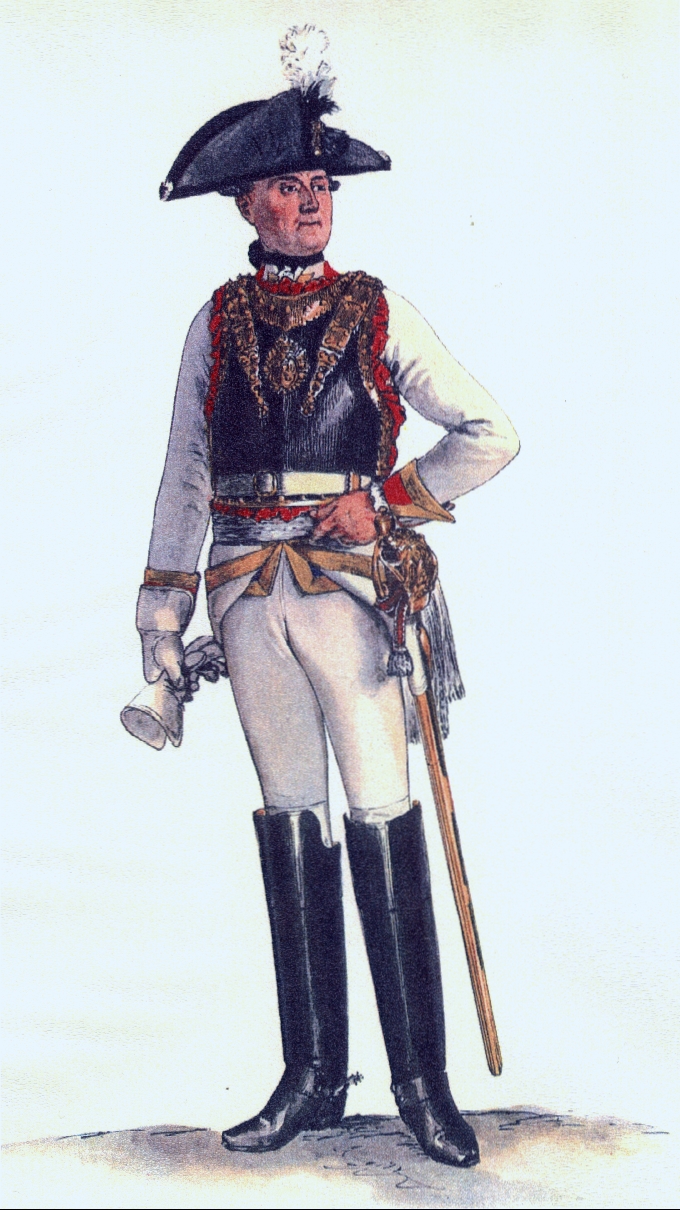 Above: Sabretaches were red, edged with regimental lace and decorated with the crowned ‘FR’ cypher in yellow.
 Above: Horse-furniture was blue, edged with red lace, with three narrow yellow stripes, which as usual is impossible to paint at this scale! As always, you have the choice to either do a simplified version of the lace (as here), or an ‘average’ colour to represent how it looks at a distance (i.e. orange). Having decided to go for the simplified option with a single stripe, I unfortunately misread a colour plate; it looked like red stripes on yellow, so that’s what I did.
 Above: As with all Prussian dragoon regiments of the period, the ‘Blanckensee’ Dragoons wore a distinctive cobalt blue coat. When I last painted Prussian dragoons (1995 or thereabouts), I was for some reason, using a lurid acrylic ‘electric’ blue, as shown in
 Above: The collar, cuffs, lapels and tail-turnbacks of the ‘Blanckensee’ Dragoons were white, the shoulder-strap was blue, buttons were yellow metal and a yellow aiguilette was worn behind the right shoulder. Officers had gold Brandenburg-style buttonhole lace and drummers’ lace was white with yellow stripes. Smallclothes were straw. The hat was unlaced, but had a black cockade and red corner-rosettes.
 Above: The ‘Blanckensee’ Dragoons’ horse furniture was white, edged with three narrow stripes in cobalt blue. The ‘FR’ cypher, coloured cobalt blue, was displayed at the rear corners of the shabraque and on the holster covers.
 However, on 12th November 1757, Warnery along with half of his regiment, fell into Austrian hands when the fortress of Schweidnitz surrendered. Warnery was exchanged the following year, but had to endure a court-martial, at which he was cleared of any culpability for the surrender of the fortress. However, other officers were not so lucky and Warnery appealed to the court for his brother officers to also be cleared. In this he was unsuccessful and, considering this to be a stain upon his honour, Warnery resigned from Prussian service and retired to his wife’s Polish estates. There he became a celebrated military writer (his books included the excellent
  Above: At the start of the Seven Years War, each Prussian hussar regiment had ten squadrons, each of 115-116 men. This strength increased fairly randomly during the war from regiment to regiment, with most regiments having around 140-150 men per squadron (141 men being recorded for the ‘Möhring’ Hussars in 1759), which was significantly weaker than the average squadron strength of the cuirassiers and dragoons. In game terms, each hussar regiment usually operates as two five-squadron ‘battalions’ of 12 figures, as shown here, though an understrength regiment might operate as a single Large 16-figure unit, depending on the scenario.
 Above: The ‘Wartenberg’ Hussars wore a white dolman with yellow cuffs and collar and a blue pelisse with white fur edging (NCOs had brown fox-fur). Braid was yellow and buttons were yellow metal. Officers had gold braid, with a gold lace ‘frame’ around the braiding on the breast. Breeches were straw and the schalavary leggings were blue with yellow lace edging. Some sources show white edging and tassels to the boots, but there is some suggestion that these were a later addition, so I’ve left the boots plain. The barrel-sash was white and yellow (some sources show white and blue), with white ‘whips’, though officers had silver barrel-sashes.
 Above: The ‘Wartenberg’ Hussars wore dark brown busbies with plain white bags and white cords and flounders. Officers had gold cords and flounders. However, I noticed after painting these that Bleckwenn shows the trumpeters as wearing black mirlitons with short yellow plumes. It also shows the trumpeters’ lace and braid as mixed red & yellow (I did plain yellow – bah!).
 Above: Shabraques were blue with white vandycking, piped yellow. Officers’ shabraques had gold piping and were decorated at the front and rear corners with a white shield, edged and crowned with gold, bearing a black eagle.
 Above: Sabretaches were yellow, edged with white lace and decorated with the ‘FR’ cypher in white. They seem to have had a vandycked edge during the 1740s, but changed to a straight lace edge by the time of the Seven Years War. Officers’ sabretaches were edged with gold and were decorated with the same crowned eagle-on-shield design used to decorate their shabraques.

 In
In  Note also that Mark didn’t make any comment regarding the deployment of Stark’s two artillery batteries, so I just placed them on the flanks of his line. Feel free to stick them wherever you want within Stark’s deployment area.
 Above: The Calm Before the Storm. This was the best I could do with the fortifications very kindly loaned by Phil Portway. The fort itself looks fine, though the gateway should be mid-way along the parapet, according to the Page Map. However, we didn’t have suitable terrain-pieces to make the flêches, so had to make do with a straight length of parapet.
 Above: The view from behind rebel tax-evader lines. The forces of monarchy, order and stability mass in the distance. The green patches on the left are areas of soggy ground, where clay was extracted for making bricks (the brick kilns themselves being in the middle of the British start-line, though I don’t have any suitable models).
 Above: Stark’s brigade masses along the ‘rail fence’. According to Mark Hayes’ research, this was actually a stone wall, topped with rails and with another fence immediately in front, with the gap between the two stuffed with hay, so it was a significant obstacle.
 Above: The British have decided to ignore Stark’s fence-line position and instead decide to throw everything against the redoubt, supported by the artillery firing from the high ground to their rear. On the right, Howe has ordered the Light Infantry Battalion to disperse into skirmish order, to screen the advance of the Grenadier Battalion and a battalion formed by the combined 5th & 52nd Regiments of Foot.
 Above: On the left is Pigot’s brigade, consisting of the 38th Foot (yellow regimental colour), 43rd Foot (firing at the redoubt), the 1st Battalion of Marines (in the left-foreground) and a detachment of Light Infantry (skirmishers). They also have a battery of 6pdrs, but the guns presently lack ammunition.
 Above: As the British approach the redoubt, Gridley’s Battery and Frye’s Regiment open fire.
 Above: On the British left and as 12pdr rounds whistle overhead, the 43rd disregard the paltry rebel artillery to open a lively fire upon the defenders.
 Above: On the right, the swarm of British Light Infantry causes considerable disruption among Frye’s men defending the projecting ‘wing’ of the redoubt. Concerned that Frye might be wavering, both Prescott and Putnam ride over to steady the troops.
 Above: Howe urges the 5th/52nd and Grenadiers onward to glory!
 Above: Observing the distant British movements, Stark remains unengaged. He sends a request for orders, but with Putnam embroiled in the firefight for the redoubt, there is no reply.
 Above: In the flêches, the Massachusetts Militia stand ready to counter any British move around the flank, but as the firefight intensifies in Frye’s sector, that looks to be increasingly unlikely. These lads carry the famous ‘Bunker Hill Flag’ that was known to be carried by the Massachusetts Militia on the day.
 Above: In British Grenadier! rules, hits from fire initially become ‘Disruption Points’ (DPs), with three DPs being the maximum. DPs can also be accrued from movement, passing through rough terrain, crossing breastworks, etc. Any hits on a unit that already has three DPs then become permanent hits. Frye’s Regiment defending the breastwork, here has two DPs, as indicated by the two dots on the marker.
 Above: Putnam and Prescott ride forward to steady Frye’s beleaguered regiment. In British Grenadier! a unit can rally off DPs at the end of the turn, provided it has remained stationary and not in mêlée. Units of Line class may then rally off 1 DP, while Elite class units may rally off 2 DPs. Units of 2nd Line class may rally off 1 DP, provided they are not in a position that could be charged next turn. Attached Brigadiers and/or C-in-Cs will also rally off 1 DP each. Militia Class units therefore absolutely require an attached general in order to remove DPs, hence the personal intervention of both Putnam and Prescott. This of course, carries with it some personal risk for those generals.
 Above: Within the main redoubt, Prescott’s Regiment (here depicted by a red-coated unit) and Bridge’s Regiment (in the foreground) remain largely unengaged, except for some desultory long-range musketry. However, that is all about to change…
 Above: On Morton’s Hill, the British artillery has been hammering away at Frye’s Regiment. However, as the Light Infantry climb Breed’s Hill the guns are forced to switch their fire to Prescott’s Regiment on the left.
 Above: The Grenadier Battalion, resplendent in bearskin caps, follows in the wake of the skirmish screen.
 Above: Risking life and limb, Putnam personally inspires Frye’s Regiment to stand their ground. Putnam is actually my George Washington, complete with headquarters flags. I really do need to paint an alternative American army commander base!
 Above: Pigot’s brigade is struggling to push forward in the face of stiffening American fire. The 43rd in particular, are starting to suffer significant losses and Pigot rides forward to steady them. On the left, the Light Infantry detachment is pinned down by effective fire from Robinson’s Detachment of American skirmishers. Unwilling to wait any longer for the Light Infantry to make headway, the 1st Marines move forward, intending to push on through the skirmish screen.
 Above: Over on the right, the 5th/52nd Foot have already passed through their skirmish-screen and soon become engaged in a vicious, short-range firefight with Frye’s Regiment.
 Above: Almost the whole British line is now poised to launch its assault on the redoubt, though stiff fire from the defenders is making it difficult for the British to coordinate their attacks.
 Above: Urged on by the senior commanders, Frye’s Regiment pours a withering hail of fire into the 5th/52nd Foot, cutting down around 20% of their number!
 Above: However, the Americans aren’t getting it all their own way, as the 12pdrs fire at Prescott’s Regiment, smashing whole sections of the parapet and bowling down files of men…
 Above: The 38th and 43rd follow up with a pair of devastating volleys (three double-sixes in a row!).
 Above: The astonishing weight of fire suddenly poured into Prescott’s Regiment cuts down scores of men, leaving half of them dead or wounded! The surviving officers attempt in vain to hold the shocked survivors, but to no avail. The survivors flee from the fort, the officers among them!
 Above: The departure of Prescott’s Regiment leaves a yawning gap on the parapet between Sam Gridley’s tiny battery and Frye’s Regiment. Bridge’s Regiment is unengaged on the flank, but will take a little time to shift across to the threatened parapet. In the meantime, Sam Gridley’s gunners will have to hold as best they can.
 Above: Frye’s Regiment, already heavily engaged, is in no place to plug the gap! Prescott orders one of the unengaged regiments from the flêches to enter the redoubt, but that too will take time to achieve.
 Above: However, Fortune is fickle and she now smiles on the defenders, as the 5th/52nd Foor break and run!
 Above: The Grenadiers , who should have been closely supporting the assault, have been delayed by a combination of bad terrain, bad luck and long-range harassing fire from Stark’s light artillery, which causes a steady trickle of casualties.
 Above: Stark, seeing the British attack starting to waver, decides that he can’t wait any longer for orders to come from Putnam and instead orders his brigade to attack the weakened British right flank.
 Above: Astonishingly, the 38th and 43rd Regiments completely fail to take advantage of the open goal before them and instead continue their cautious advance up the slope to the glacis. The 1st Marines meanwhile, push through the rallying Light Infantry to join the assault.
 Above: Frye’s Regiment once again becomes the focus for large numbers of British skirmishers and loses a few men, though fires yet another devastating volley, cutting down a number of their tormentors!
 Above: To the rear of the parapet, Doolittle and Brewer move their militia into the redoubt.
 Above: Bridge meanwhile, has managed to form his regiment into a new line, facing the empty parapet.
 Above: Robinson’s Detachment meanwhile, continues to be a major thorn in the side of the British left flank. However, help is at hand for the British, as Clinton’s brigade (63rd Foot & 2nd Marines) has arrived and is marching to join the assault. The 6pdr Battery has also finally received its ammunition and is marching to support the British right flank against the new threat posed by Stark’s advance.
 Above: However, Stark’s advance has been slowed somewhat by having to climb over their fortification while under long-range heavy artillery fire from Morton’s Hill.
 Above: Stark brings his left-flanking battalion in to form a brigade reserve.
 Above: Although the 5th/52nd Foot are in retreat, the rest of the British line is finally poised to launch a single massive attack on the redoubt. Howe meanwhile, rides over to steady the Grenadiers. What happens next will decide the day!
 Above: With Howe’s attention fixed on getting the Grenadiers to move forward, the 5th/52nd Foot rout!
 Above: The 43rd Foot, having already suffered heavy losses from Gridey’s artillery and now seeing friendly troops routing, decide that have also had enough and join the rout!
 Above: With the 38th Foot pinned down by fire, the 1st Marines launch a desperate charge on Gridley’s artillery.
 Above: However, the Marines have already suffered considerable disruption thanks to Robinson’s skirmishers and as they reach the parapet, a whiff of grapeshot from Gridley’s 3pdrs cuts great swathes through their ranks!
 Above: With a third of the Marines cut down during their charge, they too join the rout, fleeing past the startled 2nd Marines! With two-thirds of his formed units now fleeing for their lives, Brigadier Pigot loses his nerve! The survivors of the 43rd Foot and 1st Marines disperse and flee in panic to the boats that will carry them back to safety! The 38th Foot and the left-flank Light Infantry detachment meanwhile, fall back from Breed’s Hill, leaving Howe’s right-flanking brigade alone on the slope of the hill.
 Above: As Doolittle’s Regiment fills the redoubt to their rear, Bridge’s Regiment finally regains possession of the parapet and the redoubt is safe!

 Well after two postponements, we finally got to play our
  * The Battle of Bunker Hill was actually fought on Breed’s Hill. The battle was mis-named partly because Colonel William Prescott, having been ordered to fortify Bunker Hill (which stands a short distance to the north), decided instead to fortify Breed’s Hill, but the historical record still showed that he had been sent to Bunker Hill. To compound this, a British map of the battle drawn by one Lieutenant Page (shown below) mistakenly reversed the names of the hills and so the name ‘Bunker Hill’ stuck!
 We based the shape of the redoubt in our scenario map on Lieutenant Page’s well-known map above. However, Page doesn’t show the well-documented flanking ‘flêches’, instead showing a straight breastwork. To add further confusion, another diagram of the redoubt (shown below) looks absolutely nothing whatsoever like the one shown on Page’s map!
 Suffice to say, there is considerable disagreement in the sources, so feel free to make it up…

 As recently mentioned, I was getting a bit bored with all those tricorn hats and mitre caps of the Seven Years War, so decided to dig out my old 28mm AWI collection with its TOTALLY different tricorn hats and mitre caps…
 There were four Hessian combined grenadier battalions in North America. Three (initially titled ‘von Block’, ‘von Minnigerode’ and ‘von Linsing’) were formed from the detached grenadier companies of line infantry (musketeer & fusilier) regiments and the fourth (initially titled ‘von Köhler’) was formed from the grenadiers of three garrison infantry regiments and the ‘flank’ grenadier company of the Grenadier Regiment ‘Rall’.

 Having fought under Cornwallis’ command for the remainder of the New York Campaign, Donop’s brigade continued to serve under Cornwallis for the remainder of 1776 and the invasion of New Jersey. During this time they were reinforced by the Grenadier Battalion ‘von Köhler’ and 42nd Highlanders.
 Above: When I was first building my Hessian force, neither
  Above: The Grenadier Battalion ‘von Block’, commanded by Oberstleutnant Justus Heinrich von Block, was formed from the Grenadier Companies of the Musketeer Regiments ‘von Wutginau’, ‘von Donop’, ‘von Trumbach’ and ‘Prinz Carl’. Command of the battalion changed in 1777 to Oberstleutnant Georg Emanuel von Lengerke and the battalion was thereafter known as ‘von Lengerke’.
 Above: The grenadiers of the ‘von Wutginau’ Regiment (here on the right of the photo or the left flank of the line) had red cuffs, but no lapels. On each side of the breast were four pairs of white lace buttonholes and a pair above each cuff. Smallclothes were pale straw.
 Above: On the right of the line is the grenadier company of the ‘von Trumbach’ Regiment (who became the ‘von Bose’ Regiment in 1778). They had white facings and smallclothes. They also had a pair of white lace buttonholes below each lapel and above each cuff.
 Above: A rear view of the ‘von Block’ Grenadiers, showing the colours of the mitre-caps. The front-plate and band of the cap always matched the regimental ‘metal’ colour, which here was yellow for all four regiments. The cap of the ‘von Wutginau’ Regiment (here on the left) had a red bag, piped yellow and a white pompom with a yellow centre. The ‘Prinz Carl’ Regiment had the same colourings, though with a light blue pompom. The ‘von Donop’ Regiment had a straw bag with yellow piping and pompom. Lastly, the ‘von Trumbach’ Regiment had a white bag with red piping and pompom.
 Above: The Grenadier Battalion ‘von Minnigerode’ was initially commanded by Oberst Friedrich Ludwig von Minnigerode and consisted of the Grenadier Companies of the Fusilier Regiments ‘Erbprinz’, ‘von Ditfurth’, ‘von Lossberg’ and ‘von Knyphausen’. In 1780 command of the battalion passed to Oberst Wilhelm von Löwenstein and was thereafter known as Grenadier Battalion ‘von Löwenstein’.
 Above: The ‘Erbprinz’ Regiment had crimson facings decorated with white buttonhole lace, white ‘metal’ and white smallclothes. The officers’ uniform should be decorated with silver buttonhole lace, but Hessian officers, like their British comrades, tended to remove their coat-lace while on campaign in America. It’s often said that this was done to avoid marking them out as officers to enemy marksmen, but the retention of their gorget and silver & red striped officers’ sash would tend to make that rather pointless! Silver and gold lace buttonholes were expensive items, so they were probably removed merely to save them from being lost or tarnished on campaign.
 Above: The grenadiers of the ‘von Ditfurth’ Regiment had yellow facings, with white lace edging to the lapels and cuffs. ‘Metal’ was white and smallclothes were white.
 Above: On the opposite flank of the line stand the grenadiers of the ‘von Lossberg’ Regiment. This regiment had orange facings without lace decoration, yellow ‘metal’ and white smallclothes. The NCO on the flank has gold lace edging to cuffs and lapels as a mark of his rank.
 Above: For some reason I didn’t do a close-up of the ‘von Knyphausen’ Regiment’s grenadiers. They had black facings without lace, yellow ‘metal’ and pale straw smallclothes. They’re the second base from the left, including the gauntleted officer firing his musketoon.
 Above: A rear view of the ‘von Minnigerode’ Grenadiers, showing the colourings of grenadier caps and tail-turnbacks. The caps of the ‘Erbprinz’, ‘von Ditfurth’ and ‘von Lossberg’ Regiments each had a bag in the regimental facing colour, with a facing-coloured pompom and white piping. The caps of the ‘von Knyphausen’ Regiment had a pale straw bag and pompom, with red piping.
 Above: The Grenadier Battalion ‘von Linsing’ (also referred to as ‘Linsingen’) was commanded by Oberstleutnant Johann Wilhem von Linsing (or possibly ‘Linsingen’) and consisted of the Grenadier Companies of the 2nd & 3rd Battalions of the Guard and the Musketeer Regiments ‘Leib’ and ‘von Mirbach’.
 Above: Another view of the Grenadier Battalion ‘von Linsing’. I do love these goose-stepping Hessians… 🙂
 Above: The grenadiers of the 2nd and 3rd Battalions of the Guard Regiment wore near-identical uniforms, namely red facings with broad white buttonhole lace, white ‘metal’ and lemon yellow smallclothes. Most unusually, the red & white-striped ‘lion rampant’ of Hesse was enameled in full colour on the front-plate of their caps (for all other regiments the badges were merely embossed). Both units had red bags to their caps, piped white with a white pompom.
 Above: The grenadiers of the ‘Leib’ Regiment had lemon yellow facings, white buttonhole lace, white ‘metal’ and lemon yellow smallclothes.
 Above: The grenadiers of the ‘von Mirbach’ Regiment had poppy red facings with white lace edging, white ‘metal’ and white smallclothes. In 1780 the ‘von Mirbach’ Regiment became the ‘von Jung-Lossberg’ Regiment.
 Above: A rear view of the Grenadier Battalion ‘von Linsing’. All four constituent regiments had poppy red tail-turnbacks and white ‘metal’. The ‘Leib’ Regiment had a yellow bag to its grenadier cap, which was piped white with a white pompom. The other three regiments all had a poppy red bag with white piping. The 2nd & 3rd Guards had a white pompom, while the ‘von Mirbach’ Regiment had a light blue pompom.