 In my last post I presented a scenario for the Combat of Zinna (or First Torgau) 1759, fought between Prussian and Austro-Imperial forces during the Seven Years War. As mentioned in that post, my mate Andy James and I played through the scenario last month, so here’s how it went.
If you haven’t done so already, have a look at my last post for details of the background history and the scenario itself. You’ll also find an outline of my Tricorn conversion of Shako rules in the next-previous post.
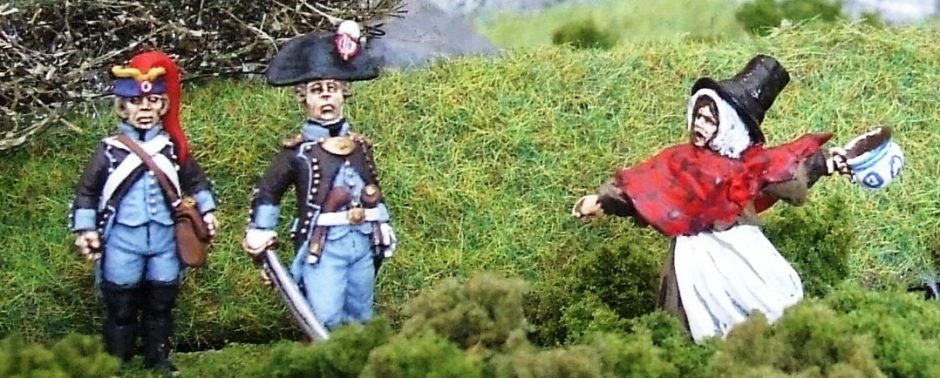
The role of Austrian Generalfeldzeugmeister Friedrich Daniel, Freiherr von Saint-André in this feature will be played by Andy, while the role of Prussian Generalmajor Johann Jakob von Wunsch will be played by a cross-dressing Welshman with a pitchfork…
 Above: The Austro-Imperial forces are shown in white and the Prussians in blue. Only the Trautmannsdorff Cuirassiers and the Grenzer were Austrian Army units. The rest of the army was made up of units from the Imperial Reichsarmee of dubious value. The Imperial cavalry were particularly bad, though the Pfalz Garde zu Fuss Regiment and the Hessen-Darmstädt Regiment were reliable troops. On the Prussian side, this bunch of Frei-Battalions and high-numbered Fusilier Regiments would normally be assumed to be the worst of the Prussian Army, but in fact, these units repeatedly proved themselves to be the equals of the better-regarded Prussian regiments.
 Above: The Reichsarmee deploy as per the map. They are essentially in their camp positions and have just formed up from their tents, so if you’re planning on refighting the battle, I wouldn’t allow any form of flexible deployment for the Reichsarmee.
 Above: The Reichsarmee are also limited in that they have enforced Defend orders. Under the standard rules, ADCs cannot be sent with fresh orders until the end of Turn 2, so they can’t do much except passively react to the Prussian attack until Turn 4 at the earliest. They can however re-deploy within their allotted sectors of the line once the Prussians come within 12 inches.
 Above: A close-up of the Reichsarmee cavalry. The Austrian Trautmansdorff Cuirassiers (on the right of the first line) are the best regiment on the table, in either army (Morale 6 and a large unit, meaning that they can take an extra hit). The rest of the cavalry is awful (Morale 3).
 Above: The view of the Reichsarmee from Zinna. There is only a single cavalry regiment, the bloody awful Kurpfalz Cuirassiers, posted on this flank. The remnants of the Grenzer skirmish out in front, haven fallen back from the Ratsweinberg.
 Above: I did actually manage to find a lot of the necessary Reichsarmee regiments in my collection and also managed to paint some battalions in the week leading up to the game, but the part of the four-battalion Kurmainz Regiment in this feature is being played by four battalions of Bavarians (on the left of the first line). On the left of the second line I also used a freshly-painted battalion of the Baden-Durlach Regiment and a battalion of the Kurtrier Regiment as stand-ins for the 1st and 2nd Battalions of the Ernestinisch-Sachsen Regiment (an interesting unit from many contingents, which historically included at least four different uniforms, with coats of both blue and white cloth!). With its dozens of contingents and bewildering array of uniforms, the ramshackle hullaballoo of the Reichsarmee certainly does make a very attractive wargames army, if a bit rubbish… 🙂
 Above: The painfully-thin line of Wunsch’s Prussian army deploys on the forward slopes of the Ratsweinberg. Lossberg’s combined unit of hussar and dragoon squadrons is hidden beyond the Zinna Ridge, formed up in column and preparing to ride around the enemy’s left flank. While I did have the option to completely change Wunsch’s historical deployment, it seemed perfectly good as it was, so I went with the historical line-up.
 Above: Unlike the Reichsarmee, I had hardly any of the necessary Prussian units for this battle; just the Willemy Grenadier Battalion (4/16) and the Hoffmann Füsiliers (IR 41), plus a couple of Lossberg’s hussar squadrons. However, the Wunsch Frei-Regiment wore very similar uniforms to my two recently-painted Frei-Battalions and the rose-pink saddlery of the Meinicke Dragoons (DR 3) in my collection looks very similar to that of the Plettenberg Dragoons (DR 7), although the Plettenberg Dragoons had coats with red facings. I just used random Füsilier and Grenadier Battalions for the remaining units.
 Above: Wunsch’s Jäger Detachment moves forward to engage the Grenzer. I actually had some very similarly-uniformed regular Fuss-Jäger waiting to be painted, so quickly knocked these up before the game.
 Above: Wunsch’s 12pdrs deploy on the Ratsweinberg and prepare to fire. The enemy are only just in range, but the 12pdrs should be able to shake the nerves of the inexperienced Reichsarmee troops.
 Above: As the Prussians move forward, Major Lossberg’s cavalry move quickly to outflank the enemy.
 Above: The Prussian right wing moves forward to engage the Reichsarmee left.
 Above: Wolfersdorff’s left wing has delayed its march by a turn, in an effort to refuse the left wing. Pogrell’s Dragoons wait to see what the Imperial cavalry do.
 Above: An overview of the battlefield at the end of Turn 2.
 Above: The 12pdrs have started to do their work, causing casualties and disruption among the Kurmainz Regiment.
 Above: Lossberg makes his move and charges over the ridge!
 Above: Historically, Lossberg’s attack came as a complete surprise and fell upon the flanks and rear of the Reichsarmee. However, I was feeling generous as Andy hasn’t played since the 90s and allowed him to turn the Kurpfalz Cuirassiers to face when Lossberg came within 12 inches (a fleeing Grenzer must have shouted a warning as he came sprinting past…). I was going to attack with Lossberg in column to maximise speed and surprise, but as this was going to be a frontal mêlée, I formed Lossberg’s lads into line before charging.
 Above: Not that it mattered, as the Dice Gods were with the Kurpfalz Cuirassiers… (The small dice show the starting factors (5 v 3) and the large dice show the subsequent roll (3 v 6), making a total of 8 v 9 to the Kurpfalz Cuirassiers! With a difference of 1, Lossberg takes the casualty and retreats… Bah!
 Above: A Breakthrough charge takes the victorious Kurpfalz Cuirassiers to the top of the ridge, where they will have a +1 defensive advantage when/if Lossberg charges again. However, they now take 1 casualty for cavalry fatigue, so Lossberg won’t have the -1 disadvantage for having more casualties. It could have all gone horribly wrong if Lossberg failed to rally his cavalry, but he thankfully manages to halt the retreat (by rolling less than their MR of 5). The cavalry of both sides now mill about rallying for a turn, shouting insults. Even if Lossberg finally wins, the taunting afterwards is going to be intolerable…
 Above: Near Zinna, skirmisher fire also starts to find its mark as both the Jäger and the Grenzer suffer casualties. The battalion guns are also now starting to do damage. In the Imperial 2nd line, Ernestinisch-Sachsen Regiment refuses its flank, in case the Prussian cavalry reappears.
 Above: By the end of Turn 5, the Imperial cavalry are on the move! One ADC carrying the order had failed to arrive, but Saint-André had wisely sent two ADCs with the same message. The Prussian 12pdrs slew their guns around and open fire from the Ratsweinberg, but only do very minor damage to the Trautmansdorff Cuirassiers.
 Above: Having seen the ADCs galloping toward the enemy cavalry, Wolfersdorff wisely decided to refuse his left flank with the 2nd Battalion of the Wunsch Frei-Regiment, the Burgsdorf Grenadier Battalion and the battalion guns. Expecting the Imperial cavalry to attack the flank of the infantry, Wunsch sends an ADC to Oberst Pogrel, ordering him and his Dragoons t0 attack!
 Above: However, the Imperial cavalry don’t seem interested in Wolfersdorff’s infantry and are instead making a bee-line for the Plettenberg Dragoons. The arrival of the ADC with his packet of orders now seems somewhat superfluous…
 Above: At last, the Prussian line closes to within musketry range…
 Above: As the two lines open fire on each other, the field is suddenly wreathed in strangely-fibrous powder-smoke… The 2nd Battalion of the Kurmainz Regiment take the worst of it and are already close to breaking.
 Above: Anticipating the forthcoming assault, Saint-André shifts his second line over to the left and brings the Alt-Wurttemberg Regiment (in their funky little yellow hats that they decided to wear against all historical advice) across the river.
 Above: The Kurmainz Regiment might be getting hammered, but they’re also dishing it out to the Hessen-Kassel Füsiliers.
 Above: On the Prussian left flank, the 2nd Battalion of Frei-Regiment Wunsch fires a volley at the Imperial cuirassiers, but to no effect.
 Above: Having shaken the Kurmainz Regiment with firepower, the Prussian infantry launch their first charge, as the Willemy Grenadier Battalion and both battalions of the Hessen-Kassel Füsiliers charge into the 1st & 2nd Battalions of the Kurmainz Regiment. At Zinna, Frei-Regiment Wunsch has cleared away the last of the Grenzer, so the Jäger switch to harassing the Ernestinisch-Sachsen Regiment in the Imperial second line.
 Above: Assisted by battalion guns, the Kurmainz Regiment halt the 1st Battalion of the Hessen-Kassel Füsiliers, but the 2nd Battalion charges home, as does the Willemy Grenadier Battalion.
 Above: Although one battalion didn’t make it into contact, the remaining two Prussian battalions smash the Kurmainz Regiment; the 2nd Battalion is destroyed outright, while the 1st Battalion flees with heavy casualties, disordering the Ernestinisch-Sachsen Regiment as they do so. The 1st Battalion then fails to rally from its retreat and the survivors flee into the forest to the rear. Some very startled regimental gunners also take to their heels!
 Above: Back at Zinna, Lossberg has issued a tot of brandy to his cavalrymen (he rolled a 6 on his initiative die and was able to restore the lost casualty) and charges back up the ridge against the Kurpfalz Cuirassiers! Again, the basic MR odds are 5 versus 3, but the cuirassiers are now defending the ridge, so bump their number up to 4. However, as the Prussians have made good their losses, the Imperials suffer -1 for greater losses, so the odds go back to 5 v 3.
I didn’t record the actual dice-rolls, but the Prussians won by a considerable margin and the Kurpfalz Cuirassiers were swept from the field, though secure in the knowledge that they would always have bragging-rights for beating off a Prussian cavalry charge…
 Above: On the opposite flank, Pogrell and the Plettenburg Dragoons, full of confidence in the Superiority of Prussian Arms (except in the Artillery Arm, who can’t hit a verdammt barn door, it seems!), charge into the Trautmansdorff Cuirassiers, who remain largely untroubled by the Prussian 12pdrs… In a show of solidarity, the Reichsarmee’s Bayreuth Cuirassiers also throw themselves into the fight.
(To go all gamey for a moment; the Prussian Plettenburg Dragoons have their base MR 5, while the Austrian Trautmansdorff Cuirassiers have MR 6. However, they’ve taken a hit from the artillery, so take a -1 for more casualties, bringing them down to 5. The Bayreuth Cuirassiers have MR 3 with no modifiers.)
 Above: It might have been an even fight between the Prussian Dragoons and Austrian Cuirassiers, but the Dice Gods inflict a crushing defeat on Pogrell and his dragoons flee with four hits (one more hit before they break)! Having defeated the Prussian dragoons, the Imperial cuirassiers decide to make breakthrough charges in order to get out of the 12pdrs’ arc of fire.
(Note that I made a mistake here – the breakthrough charges should be made at half speed (5 inches), whereas I let them move their full 10 inch move. C’est la guerre…)
 Above: The right wing of the Reichsarmee infantry waits for the battle to come to them.
 Above: As the Prussian infantry begin breaking through on the Reichsarmee left, the rest of the Reichsarmee infantry slowly start wheeling back away from the breakthrough, in an attempt to prevent them from being rolled up.
 Above: Another view of the same action: On the left, the 2nd Battalion of the Ernestisnich-Sachsen Regiment is utterly smashed by the combined weight of the Willemy Grenadiers and the 1st Battalion of the Hessen-Kassel Füsiliers.
 Above: On the right flank of the Reichsarmee infantry, the 1st Battalion of the Franconian Hohenlohe Regiment crosses over the stream to more closely support the rest of the first line.
 Above: Spurred on by the success of the first line of cavalry, the second line now has a crack at Wolfendorff’s left-flanking battalions. Carefuly staying out of the line of fire of the Burgsdorf Grenadiers, the Hohenzollern Cuirassiers (manfully ignoring the fact that they’ve already taken long-range hits from the Prussian 12pdrs) charge the 2nd Battalion of the Wunsch Frei-Regiment… and are slaughtered…
 Above: The Prussian right wing charges again, this time victimising the 1st Battalion of the Ernestinisch-Sachsen Regiment and their supporting battalion guns. The other three Füsilier battalions move forward to engage in a sharp firefight with the 3rd & 4th Battalions of the Kurmainz Regiment. The Jäger and Lossberg’s cavalry meanwhile move down from the ridge to assist with rolling up the Imperial flank
 Above: The Ernestinisch-Sachsen Regiment is overwhelmed by the assault, but on the left of the Prussian line, the Hoffmann Füsiliers are being shredded by fire from the Kurmainz Regiment, the Pfalz Garde zu Fuss and their supporting battalion guns.
 Above: Wolfersdorf could really use his two remaining battalions about now, but they’re busy fending off the Ansbach Dragoons, who have wisely decided not to attack the angry Prussian infantry! Wolfersdorff’s battalion guns are busy banging away at the threatening Imperial right wing, but are most surprised to see a pair of Austrian ADCs galloping through their position (note to self: add a rule, stating that ADCs must stay at least 6 inches away from enemy units)!
 Above: The ADCs are on their way to the commander of the Imperial cavalry, who is now once again engaging the rallied remnants of the Plettenberg Dragoons at the foot of the Ratsweinberg. Saint-André has realised that the cavalry orders only told them to attack the enemy dragoons and then the Ratsweinberg battery. He needs them to come back urgently and attack the rear of the Prussian infantry!
 Above: The Prussian 12pdrs try to save the Plettenberg Dragoons, but to little effect. The Dice Gods are not with the Prussian gunners today.
 Above: The Imperial left wing has now been completely destroyed by the Prussian assault. However, the Prussian Hoffmann Füsiliers, on the left of the Prussian line, have been broken by Imperial fire. And the next two battalions are also being heavily damaged by the surprising weight of fire from the two surviving battalions of the Kurmainz Regiment!
 Above: Both Imperial infantry commands are now demoralised, which means that all units get a -1 mêlée modifier and will automatically break if they are forced to retreat from combat. The Imperial infantry are split into 1st Line and 2nd Line commands, so have both suffered roughly equal casualties (3 battalions plus guns from the 1st Line and 2 battalions plus guns from the 2nd Line). If they had been split like the Prussians, into Left & Right Wings, the Left Wing would now be completely broken, while the Right Wing would be completely intact. The best Imperial troops, namely the Pfalz Garde zu Fuss and the Hessen-Darmstädt Regiments, have yet to be seriously engaged, though the Garde have suffered casualties from artillery.
 Above: The Ansbach Dragoons retire from the threat of Prussian musketry (not really in the spirit of ‘Attack’ orders! 🙂 ). This gives Wolfersdorff the opportunity to get those two battalions moving and attack the Imperial infantry.
 Above: Sadly it wasn’t to be Oberst Pogrell’s day, as his dragoons were finished off in short order by the Trautmansdorff Cuirassiers. A slightly panicking General Wunsch orders his artillery commander to start slewing his 12pdrs around!
 Above: Lossberg’s cavalry now re-enter the battle, launching a charge deep into the Imperial flank. The 2nd Battalion of the Baden-Baden Regiment stands no chance as the vengeful Prussian horsemen hit their open flank. The Alt-Württemberg Regiment fires a volley in support, but to no effect and the Badeners are annihilated!
(Lossberg’s cavalry use their frontal MR of 5, reduced by 1 for having greater losses = 4. The Badeners use their flank MR of 0 (so +4 v +0). Cavalry against infantry not in ‘Solid Line’ only need to beat their opponent to break them. so even if the Badeners roll a 6, the cavalry only have to roll 3 or more to break them, which they do.)
 Above: Having broken the Badeners, Lossberg launches an immediate breakthrough charge against the Alt-Württemberg Regiment. The Württembergers have already fired a volley, so present bayonets to receive the charge.
 The Württembergers are clearly made of sterner stuff and repulse Lossberg’s cavalry with ease!
(Lossberg again gets his frontal MR, minus 1 for greater losses = 4. He’s still at an advantage against the Württembergers’ frontal MR of 3, but still manages to lose by three points on the dice roll, so takes the three hits and retreats.)
 Above: Near the bridge, Wolfersdorff has cunningly used his infantry’s superior abilities at foot-drill to insert a column behind the Imperial infantry’s right flank (note the use of MDF arrow markers to show that the Prussian infantry are in column). However, the Ansbach Dragoons aren’t going to let them off the hook that easily!
 Above: Back at the Ratsweinberg meanwhile, the Imperial Bayreuth Cuirassiers have a rush of blood to the pallasch and charge the guns! Wunsch has a spectacular view of the action as the Prussian gunners pick up rammers, buckets and worm-screws to comprehensively defeat the Imperial horsemen!
(The gunners have MR 3, +1 for defending the hill = 4. The Bayreuth Cuirassiers also have MR 3, but have already taken a casualty, so take -1 for greater losses = 2 (so 4 v 2). The Bayreuth Cuirassiers only have to beat the gunners by 1 to destroy them, but fluff their roll and are themselves destroyed)
 Above: “MARIA THERESA ON A VELOCIPEDE!” What’s happened here?!
 Above: The Prussian centre has completely collapsed in a single charge by the Reichsarmee infantry! The 1st Battalion of the Baden-Baden Regiment took revenge for the loss of their 2nd Battalion by routing the 1st Battalion of the Hessen-Kassel Füsiliers, while the Kurmainz Regiment routed the Hessen-Kassel 2nd Battalion and completely destroyed the Salmuth Füsiliers!
 Above: Obviously, this was all part of Wunsch’s plan… Inspired by Hannibal at Cannae, he’s planned for his centre to give ground, allowing his elites to then crush the enemy flanks inward… Obviously…
What wasn’t part of the plan was that the retreating battalion would fail to rally and that both Prussian infantry wings would now become demoralised…
And it had all been going so well…
On the plus side for the Prussians, the loss of the Bayreuth Cuirassiers meant that the Imperial cavalry wing was also now demoralised.
 Above: We might be demoralised, but we’re determined to give those uppity Imperials a damned-good taste of our Prussian spunk! With that in mind, the Burgsdorf Grenadiers insert themselves into the Hohenlohes’ rear!
 Above: Meanwhile, the 2nd Battalion of the Wunsch Frei-Regiment successfully fend off the unwanted attentions of the Ansbach Dragoons!
 Above: I’m not sure what they are worried about, but the Alt-Württemberg Regiment and Pfalz Garde zu Fuss back away to the riverbank, along with the last remaining battalion guns.
 Above: The two surviving battalions of the Kurmainz Regiment advance and deliver a crushing volley into the surviving Prussian battalion guns. The gunners flee, taking with them two more morale points… With a sinking feeling in the pit of his stomach, Wunsch checks his roster and realises that his right wing has now reached exactly 50% losses… 🙁
 Above: Back at the Ratsweinberg, the Trautmansdorff Cuirassiers might be demoralised, but they’re more than a match for those Prussian gunners!
(The cuirassiers start with MR 6, -1 for greater losses and -1 for demoralisation = 4. The gunners have MR 3, +1 for defending the hill = 4. So an even fight, but the cuirassiers only have to beat them by 1…)
 Above: Which of course they do… Then followed up by a breakthrough charge, which destroys the second 12pdr battery, right in front of the horrified Wunsch!
 Above: Lossberg has taken casualties, but his men are still keen for a scrap. However, there’s nothing he can do to save the situation.
 Above: The Wunsch Jäger continue to take pot-shots at the Württembergers. While not exactly battle-winners, this tiny group of skirmishers has been a constant pain in the arse to the Imperial left flank throughout the day, rolling a remarkable number of sixes!
 Above: However, with the 50% casualty threshold having been reached (two elite battalions with MR 5 and the battalion guns with MR 2 = 12. The remaining units are the grenadiers with MR 5, the Frei-Battalion with MR 4 and the Jäger with MR 3 = 12), the Prussian right wing requires a morale-check. We roll a 2 and the right wing disintegrates! 🙁
With a formation having been destroyed (the second formation, in fact – we lost Pogrell’s small command earlier), an Army Morale check is required. We add up the total MR value of all the lost formations (24 for the right Wing and 5 for Pogrell = 29) and then add the MR value of the lost Army-level artillery (6) = 35. We’re well over the maximum 50% threshold, so it’s Goodnight Vienna (or Torgau?) for Wunsch’s Prussians! 🙁
 Above: The gleeful Reichsarmee jeers the fleeing Prussians on their way… We’re never going to hear the bloody end of this… 🙁
 Thanks to Maurizio’s efforts, we’ve found an error in the Tricorn skirmishing rules: Skirmishers hit on a 5 or 6, not on a 6 as it previously stated. QRS Page 1 has therefore been amended to v1.2.

 In
In 


 Having generated the potential battlefields, Königsegg chose 09, 17 and 58 as his final three maps. A d3 was then rolled to decide which of these would be the final battlefield, resulting in map 58 being the final map.
 During secret deployment, both sides opted to place their infantry on the eastern side of the field, where the spring crops would make going difficult for the cavalry. The cavalry were all massed in the more open ground on the western flank.
 Above: The view of the battlefield from behind Austrian lines as the troops start moving. Königsegg has grouped all his dragoons and hussars on the left under Maquire, while the cuirassiers are all massed in reserve behind the left flank. His two leading infantry divisions have six battalions apiece (one also having a battalion of Grenzer deployed in skirmish order).
 Above: The third division consists of five infantry battalions and two grenadier battalions and remains on the Fickmühlenberg, along with the bulk of the artillery (two heavy batteries and three light batteries), who are content to fire long-range over the heads of the leading divisions.
 Above: To everyone’s surprise, the Austrian line abandons its lovely defensive position and advances under the barrage… As the Whitecoats close with the Prussian line, the Holy Roman Umpire spots a flaw in Königsegg’s Cunning Plan…
  Above: The dragoons and hussars of the Austrian left wing.
  Above: The Prussian left wing, its flanks secured by the villages of Gross-Fahrtgasse and Klein-Fahrtgasse, contains all the ‘regular’ infantry and grenadier battalions, plus an additional artillery battery.
  Above: The Prussian centre contains all of Frederick’s Guard infantry battalions (three battalions of the Garde Regiment (IR 15) and the solitary battalion of the Grenadiergarde Regiment (IR 6), as well as the reserve heavy artillery batteries.
 Above: The Prussian right wing consists of all Frederick’s cavalry in a single formation; two regiments of cuirassiers, two regiments of dragoons and an elite battalion (half-regiment) of hussars, plus the reserve regiment of Guard cuirassiers (the Gensd’Armes (CR 10), incorporating the Garde du Corps (CR 13).
  Above: The overall view of the battlefield from the Prussian side.
 Above: The Prussian cavalry move quickly to secure the gap between the villages of Fickmühlen and Poppenweiler.
 Above: The Austrian cuirassiers seem content for the time being, to watch the cavalry battle from their hilltop. On their right, the Austrian light artillery, finding itself out of range of the Prussian lines, limbers up and moves forward.
 Above: The Austrian right wing advances on Klein-Fahrtgasse. However, as the Austrian heavy guns fall silent, it’s now Gesichts-Handflächen all round at Königsegg’s headquarters as they realise that the infantry have now masked their own guns!
 Above: The Prussians breathe a sigh of relief, as a few battalions were really starting to suffer from the Austrian bombardment!
 Above: At Grosse-Fahrtgasse, Frederick and his staff observe as the heavy guns tear lumps out of the Austrian centre.
 Above: Grenzer work their way forward through the Fahrtgasse-Holz and start sniping at gunners on the Prussian left wing.
 Above: At Fickmühlen, the cavalry clash! The leading two regiments of Prussian cuirassiers, with the Gensd’Armes and hussars in support, charge the two regiments of Austrian dragoons. A regiment of Austrian hussars, with the second regiment in support, attempts to intervene.
 Above: The odds are not in the Austrians’ favour. Just to go all ‘gamey for a second; the baseline numbers are shown on the dice; 6 for the cuirassiers, 5 for the dragoons and 4 for the hussars. The Prussian cuirassiers and the Austrian hussars get +1 for having rear support, while the central Austrian dragoon regiment gets +1 for secured flanks. Nobody has casualties and nobody is staggered, so no negative modifiers.
 Above: On the left, the Prussians win by 4, so the Austrian dragoons take 4 casualties and retreat. The Prussians elect to rally in place. On the right, the best Austrian result still means that the Prussians win by 1, so the Austrian dragoons and hussars both take 1 casualty and retreat, while the Prussian cuirassiers retire to rally behind their hussars. With no more mêlées to fight, both Prussian cuirassier regiments now take a single casualty for cavalry fatigue.
 Above: Both Austrian dragoon regiments managed to rally from their retreat, but sadly for the Austrians the hussars couldn’t be persuaded to hang around! However, the great mass of Austrian cuirassiers has now moved down off the Fickmühlenberg and looks set to intervene…
 Above: In the centre, the Austrian infantry have been taking a pasting from the Prussian heavy guns and have now attracted the attention of two regiments of Prussian dragoons.
 Above: On the Austrian right, the advance has slowed in order to allow their battalion guns to keep up with the advance through the fields of spring crops.
 Above: Frederick watches as his dragoons advance on the Whitecoats!
 Above: As the Prussian dragoons charge, the surviving Austrian hussar regiment attempts to intervene… and is utterly smashed! The dragoons ride on into the infantry, but the Whitecoats stand their ground and the dragoons are sent packing! However, the second regiment of Prussian dragoons don’t seem bothered by the flight of their comrades and advance on the Austrian infantry…
 Above: At last, the Austrian cuirassiers engage the Prussians.
 Above: As the cavalry clash for the second time, the Austrians generally gain the upper hand: Near Fickmühlen the Prussian hussars are swept from the field and the Austrian cuirassiers (with the blue standard) charge on, also defeating the supporting Prussian cuirassiers. On their left, the next Austrian cuirassier regiment (with the red standard) throws back the first line and breaks through, but is in turn thrown back by the Prussian Gensd’Armes.
 Above: However, although things are suddenly going well for the Austrians on the left flank, Königsegg had suffered a crisis of confidence and had already ordered the right wing to withdraw (while reinforcing them with the reserve).
 Above: Another view from behind the Austrian right flank.
 Above: And another view from the Austrian right flank…
 Above: The view from behind the Prussian right flank. No expense was spent in the making of this report…
 Above: The second wave of Prussian dragoons charges the Austrian infantry!
 Above: Once again, the heroic Austrian infantry repel the Prussian dragoons! However, this Austrian division has already lost one battalion to the intense Prussian gunnery.
 Above: The Prussian cavalry very much got the worst of the last round of combat, with one hussar regiment broken outright. To make matters worse, one regiment each of dragoons and cuirassiers fail to rally and also flee, leaving only the Gensd’Armes, a cuirassier regiment and a dragoon regiment on the field. Nevertheless, they are still game for a fight, despite losing over a third of their starting strength.
 Above: Opposing them are four largely-intact regiments of Austrian cuirassiers (two of them completely fresh) and two regiments of dragoons, though the dragoon division is still demoralised due to losing the two hussar regiments earlier.
 Above: As the Austrian infantry tries to withdraw (covered by their battalion guns), the Prussian left wing advances!
 Above: King Frederick decided to retreat only one ‘dot’, to Niemes. The Austrians now had the option to pursue…
 According to Da Roolz, both participants in a battle must remain stationary to reorganise for the turn following a battle, so Frederick remains at Niemes, while Königsegg remains at Münchengrätz. Bevern meanwhile, has finally obeyed his orders and has marched from Kratzau to Liebenau, in a belated pursuit of Königsegg!

 Here’s my version of the campaign map:
 Austrian Army List:


 The only change I’ve made to the procedure is that a defender in mountainous terrain can add or subtract 1 from his roll. You may wonder why he’d want to subtract 1… If he can force a draw in the first round, he can defend behind pre-prepared defences.
 Turn 1:


 I knew it wouldn’t take long for people to find the flaws in
 When a rare opportunity for a game presented itself a couple of weeks ago, I had a quick trawl of potential Seven Years War battles to find one that would be small enough to serve as a simple introductory


 Following a brief refreshment break to fortify themselves in the western suburbs of Torgau (Wunsch had given each battalion a barrel of wine from a local winery), Wunsch’s force emerged from Torgau. His artillery quickly deployed and brought a heavy fire down upon the grenadiers and Grenzer on the Ratswein. This bombardment was followed up with a swift bayonet-charge by the ‘Willemy’ Grenadier Battalion and I./’Wunsch’ Frei-Regiment and the enemy was quickly put to flight. With the enemy outpost routed, Wunsch wasted no time in occupying the high ground, establishing a thin line of infantry and all of his heavy guns (ten 12-pounders) on the crest.
 However, Oberst von Pogrell of the ‘Plettenberg’ Dragoons had a plan to deal with the enemy cavalry. He had only three squadrons against fifteen, but nevertheless led his dragoons forward in a feint, before rapidly turning about in an attempt to entice the Imperial cavalry to pursue. As Pogrell had hoped, the Imperial horsemen took the bait and charged straight into the sights of the 12-pounders now positioned on the Ratsweinberg. Shocked by this sudden, devastating bombardment, the Imperial horse milled about in confusion as Pogrell turned his dragoons about and charged! The Imperial cavalry broke and fled straight through the lines of Imperial infantry, causing much dismay among the footsloggers.
 It would perhaps be easy to pass off this incredible victory as a mere fluke against low-quality opponents, but Wunsch followed it up by driving a French force out of Leipzig and on 29th October won another astonishing victory, this time against Austrian regulars, at the
 Terrain
 Well it’s taken a while, but here is the first draft of Tricorn, being my adaptation of Shako Napoleonic rules for the wars of the mid-18th Century.
  Tricorn has actually been around since the mid-1990s, when the
  Although these rules are aimed initially at the Seven Years War, they’re also eminently suitable for the War of Austrian Succession, the War of Polish Succession and the Silesian Wars in the European Theatre. I will expand these to include North America, India, the Turkish Wars and the ’45 Jacobite Rebellion and I’ll also add army lists for pick-up games.
 [QRS Page 1 (above) edited 4 Mar 26 to v1.5:
  [QRS Page 2 edited 4 Mar 26 to v1.5 (although there weren’t actually any changes to this page):
  [QRS Page 3 edited 4 Mar 26 to v1.5:
  [QRS Page 4 edited 4 Mar 26 to v1.5 (although there weren’t actually any changes to this page):
  [QRS Page 5 edited 4 Mar 26 to v1.5:
  Designer’s Notes


 Last month I played a small historical refight of the


 Note that there was no official numbering system for these units. The historian Hans Bleckwenn gave them an arbitrary numbering system based on their date of formation and this has continued to be used by many other historians such as Christopher Duffy and the contributors to the

 Frei-Bataillon ‘Le Noble’ (F1 under Bleckwenn’s classification system) was raised in June 1756 by the former Pfalz Lieutenant Colonel Franciscus de le Noble, who continued to command the unit throughout the war until disbandment in 1763. The unit initially consisted of five companies, each of 100 men taken from the districts of the Holy Roman Empire, ten of whom were rifle-armed (and differently-uniformed) Jäger, for a total of 500 men, plus a headquarters detachment and a battalion gun detachment consisting of two 1pdr guns (which were probably replaced by 3pdr guns later in the war, in common with most other such units). This increased during the winter of 1758/58 to a little over 800 men (presumably with a commensurate increase in Jäger?).
 For models I’ve used standard Old Glory 15s Prussian Musketeers, with the Firing Line pack used for the skirmishers. In Shako/Tricorn a light infantry battalion may either fight as a formed unit or may break down into to skirmisher stands, so the whole lot wouldn’t be deployed on table as shown here. If there was a sufficiently large Jäger Detachment (150 men or more) they might also create an additional, permanently-detached skirmisher stand, but Le Noble’s Jäger Detachment was very weak (which is a good job, as I can’t find any suitable figures with the required headgear).
 F1 ‘Le Noble’ had a reasonably colourful coat, with light blue cuffs, lapels, collar and shoulder-strap and white metal buttons, though without lace. One mistake I made was that the pompoms should be light blue over dark blue, but I mistakenly painted them plain light blue. That said, it’s not very noticeable, so I’m not going to correct it.
 Frei-Bataillon F3 ‘Von Kalben’ was raised in September 1756 by the Prussian officer Heinrich Detlev von Kalben, consisting of five companies, each of 100 men, plus a headquarters detachment and a battalion gun detachment of two 1pdr guns, which were replaced by 3pdr guns during the winder of 1758/59. There was no Jäger Detachment. The unit was increased to 800 men during the winter of 1757/58 thanks largely to a draft of conscripted PoWs and in 1760 a tiny Hussar Detachment of just twelve men was added.

 The uniform of Frei-Bataillon F2 ‘Von Kalben’ was the plainest of all the Frei-Infanterie units. The coat was plain dark blue, without lapels or collar. However, a splash of colour was provided by the standard red coat-linings and light blue small-clothes. The metal colour was yellow and the unlaced hates were decorated with light blue pompoms. These figures are again by Old Glory 15s.
 As mentioned above, I did already have one painted Frei-Bataillon from the 90s and this is it. Frei-Bataillon F8 ‘Du Verger’ was raised in March 1758 in Saxony from French deserters and comprised five companies, totaling just over 800 men, including 50 Jäger (10 in each company) and two 1pdr battalion guns (upgraded to 3pdrs in 1759).

 My apologies to those of you who have seen this all before on my blog, but I think it’s worth mentioning that this week marks the 225th anniversary of the surrender on 24th February 1797 of the French Légion Noir (‘Black Legion’) to an outnumbered and rag-tag force of Welsh Yeomanry, Militia, Royal Navy, Volunteers and armed civilians on Goodwick Sands, near the port of Fishguard in Pembrokeshire, West Wales. Later immortalised as the only Battle Honour to be won by the British Army on British soil, the ‘Battle’ was in fact a relatively bloodless comic-opera.
 Having flipped to painting Napoleonics for a few weeks, I’ve now flopped back to painting my Seven Years War armies, starting with some cavalry regiments for the Imperial
  The Electoral Rhenish District (Kurrheinischen Kreis)
 The
The  The two contingents forming the Kurpfalz Cuirassiers had different uniforms, though I’ve used
  The
The  Upon his appointment to command the Reichsarmee in 1758, Prince Friedrich Michael of Pfalz-Zweibrücken reinforced the Reichsarmee cavalry arm with the Pfalz
  Franconian District (Fränkischen Kreis)
 The
The  Trumpeters are recorded as wearing reversed colours of red coats with white facings, all richly decorated with golden lace (the county of Bamberg is recorded as complaining about the expense of the trumpeters’ lace).
 Descriptions of the standards are very vague, though the squadron standards seem to have been red and probably featured the black Imperial eagle on the obverse and county heraldry on the reverse. The regimental standard was probably similar, though in white. I confess to having again used a spare Austrian cuirassier standard here.
 The
The  Officers of the regiment wore silver lace instead of white and had red sashes striped with black. Drummers are known to have worn reversed colours of light blue coats, faced white, probably decorated in mixed light blue & white lace.
 The
The  Swabian District (Schwäbischen Kreis)
 The Swabian District raised two cavalry regiments; the
  I did actually discuss the
  The uniform of the Hohenzollern Cuirassiers was very similar to that of the Bayreuth Cuirassiers described above, with white coats, red facings and horse furniture. However, they had white ‘metal’ and white lace edging to hats and horse furniture and straw breeches. It is also not known for certain if they actually wore cuirasses. Nevertheless, I’ve used