 Like most wargamers, every so often I get a rush of blood to the wallet and buy a new army (ARMIES in the most catastrophic cases) and start an entirely new project. In fact, every wargames project starts in this manner, but some are less successful than others…
One such failed project is my 28mm French Army for the War of Spanish Succession…
My good mate Jase was back from New Zealand for a few weeks and we went to the ‘Colours’ show at Reading and happened to linger a while in front of the Front Rank Miniatures trade stand…
Those Front Rank Spanish Succession figures looked utterly gorgeous…
Within minutes we’d spent all our cash on lead and were heading back to Wales, considerably poorer. However, as soon as we got home the figures were under the brush and the first units were looking absolutely spiffing…
Did I say that he was back for a few weeks from New Zealand…?
Well that was a bloody silly idea… How in the name of all that is holy were we meant to have a game?!
Well anyway, I managed to paint a cavalry brigade and an infantry brigade and every so often the mood makes me take the brush to them for a bit more work, but that soon passes… Maybe one day I’ll finish them off… They are VERY nice figures…

Above: The 1st Battalion of the Bourbonnais Infantry Regiment. At the Battle of Blenheim in 1704 [edited: NOT 1715, you idiot!], this regiment fielded two battalions as part of the Marquis de Nangis’ Brigade of the Marquis de Blainville’s Corps, along with a battalion each from the Foix and Agenois Regiments.

Above: The Bourbonnais Regiment in close-up. Note that this regiment was simply dressed in plain grey/white. The colour of French uniforms was actually the colour of unbleached wool and is theoretically white, but is often depicted as grey.
Most French infantry regiments had a distinguishing facing colour visible at the cuffs and/or distinctive stocking and/or waistcoat colours, but many were simply plain white/grey and Bourbonnais was one of these regiments. To get this colour I used a light grey (Humbrol 64) as the base colour and used the translucency of Humbrol’s white paint to get the grey show through – I didn’t mix up a grey shade.
 Above: A close-up of the command group of the Bourbonnais Regiment. The regiment’s button & lace colour was yellow/gold and the drummers wore the ‘Royal Livery’ of dark blue with red facings, waistcoat and stockings, with white & crimson patterned coat-lace, which is repeated on the drum-belts.
Note that some of the Front Rank French officer figures are modelled with waist-sashes, which while common among other armies as the mark of an officer, weren’t officially a part of a French officer’s dress. However, I had to paint them somehow, so went for white with gold tassels, which was officially the pattern for the cravats attached to French regimental flagstaffs. I used cream as the base-colour for the sash, to give the white top-coat a subtly different shade, hopefully suggesting silk instead of wool.

Above: A rear-view of the Bourbonnais Regiment.Each French infantry battalion carried two colours; in the 1st Battalion one would be a King’s Colour, which was normally a white cross on a white field (yes, really…). The other colour was a Regimental Colour, which had a white cross with corner panels in various colours and designs. A regiment’s 2nd, 3rd and subsequent battalions each carried two Regimental Colours – only the 1st Battalion would carry a King’s Colour. Very occasionally a regiment might have a design (such as fleur-de-lys or a latin motto) repeated on both the King’s and Regimental Colours.
Note the grenadiers on the right of the line, with their leather grenade-haversacks. This was the age of grenadiers actually lobbing grenades – after this period hand-grenades went out of fashion for another 200 years and the term ‘grenadier’ was simply an honorific for an elite soldier who guarded the flank of the line.

Above: Soldiers of the La Reine Infantry Regiment. At Blenheim this regiment fielded three battalions and formed a whole brigade in its own right, that of the Marquis de Buzancois, part of the Marquis de Rosel’s Corps.
The facings and stockings of the La Reine Regiment were red, while the waistcoats were dark blue with white lace piping around the seams and button-holes. Buttons and lace were silver/white.
The soldiers shown on the right are the regiment’s Grenadiers. Later in the 18th Century, French Grenadiers would be easily identified by their tall fur caps, but at this time they wore cocked hats like the rest of the battalion (the whole Grenadiers du Roi Regiment did wear fur caps at this time, however). Grenadiers were distinguished by their moustaches, the additional lace on their coats and their grenade-bag and associated cross-belt.
 Above: The de Levy Cavalry Regiment. At Blenheim this regiment formed one-third of Massenbach’s Cavalry Brigade (alongside the de Royal and de La Ferronaye Regiments), which formed part of the Marquis du Bourg’s Corps.
This regiment had grey/white coats with red facings and gold/yellow buttons and lace (this was a VERY common uniform combination for the French Army of this period). Shabraques were most likely red, edged yellow, though one source suggests yellow edged red.

Above: The de Levy Regiment’s command group in close-up. Note the exquisite modelling that Front Rank put into these figures – particularly the texture of the officers’ wigs, the creases of the cloth and the details of lace, buttons and buttonholes. The quality of casting also equals the quality of modelling. Note also that the officers’ coats are open to reveal breastplates rather than waistcoats.

Above: Another view of the de Levy Regiment, showing the regimental Guidon (cavalry colour). All the flags shown here are by GMB Designs.
Note that French cavalry tactics of the period emphasised the use of massed volleys of pistol-fire at short-range, hence my choice of pistol-armed figures. The French cavalry generally did not perform well and generally suffered at the hands of cavalry trained to deliver a full-blooded charge with cold-steel, such as the cavalry of Sweden, Prussia and Great Britain.
 Above: A rear-view of the de Levy Regiment, showing the details of the trumpeter’s uniform, which was the livery of the regiment’s Colonel-in-Chief, the Duc de Levy. Note the ‘false sleeves’ on the back of the coat; these were a common feature of cavalry trumpeter’s uniforms throughout the 18th Century.

Above: The de Royal Cavalry Regiment served in the same brigade as the de Levy Regiment above. Note that these regiments were usually very small; normally only two squadrons apiece, with no more than 240 men.

Above: The de Royal Regiment’s uniform was dark blue, faced red with gold/yellow buttons and lace. Quartered black & white hat-cockades are also described for this regiment. Shabraques were probably dark blue with aurore (i.e. pinkish yellow-orange) edging, though black edging is described in one source.

Above: The de Royal Regiment’s trumpeters wore Royal Livery, which was very much like that of infantry drummers described above: dark blue with red facings and crimson & white patterned lace. This regiment’s trumpeters are also recorded as having crimson & white hat-feathers, as shown.
 Above: A rear-view of the de Royal Regiment, particularly showing the back of the trumpeter’s coat.

Above: “All For One And One For All!” These fine fellows barely need any introduction: they are of course, the legendary King’s Musketeers Regiment (Les Mousquetaires du Roi) of ‘The Three Musketeers’ fame. Although this regiment barely left the confines of Versailles during this entire period, it was seeing these figures that made me HAVE to build this army and they were consequently the first unit I painted.

Above: Thanks to the BBC, people nowadays expect to see these chaps wearing strange leather fetish-wear, but in reality they wore this spectacular uniform of red coats with blue tabards emblazoned with a sunburst, cross and fleur-de-lys.
The term ‘Musketeers’ confuses a lot of people, as it suggests that they were an infantry regiment. In fact they, along with the single squadron of Horse Grenadiers, were the ‘Dragoon’ (i.e. mounted infantry) element of the King’s Household Troops (La Maison du Roi) and as a result were issued with infantry-style muskets for dismounted work, as well as pistols and swords for mounted shock-action and they also had drummers rather than trumpeters. The French Army of this period still used Dragoons primarily as mounted infantry, using horses for mobility but fighting primarily on foot. However, the majority of armies were increasingly using Dragoons as shock cavalry and the Mousquetaires du Roi also tended to be used as shock cavalry on the rare occasion they appeared on the battlefield.

Above: The Mousquetaires du Roi had two squadrons, though these were much stronger than those of the line cavalry, roughly twice the strength, in fact. The squadrons were defined by the colour of their horses, with the senior squadron being the ‘Grey Squadron’, and the junior squadron the ‘Black Squadron’.
 Above: The Grey Squadron had gold/yellow buttons, coat-lace, hat-lace and shabraque-edging. Tabards for both squadrons had silver/white lace edging and crosses with gold/yellow fleur-de-lys, though the sunburst behind the cross was different for each squadron; the Grey Squadron had a red sunburst, edged white. Note that drummers’ tabards were very heavily decorated with strips of lace.
 Above: A rear view of the drummer, showing the details of the tabard.

Above: The Black Squadron had silver/white buttons, coat-lace, hat-lace and shabraque-edging and gold/yellow sunbursts on the tabard.
 Above: A close-up of the right-hand side, showing the details of kit. Note the powder-flask, suspended by a crimson & yellow cord.

Above: Close-up of the left-hand side. I should note here that when painting black horses, I always highlight them with a little red-brown mixed into the black. For tails and manes I highlight with a very dark grey.
Anyway, that’s it for now. My next instalment will be our latest ACW game – a refight of the Battle of Cedar Mountain, 1862.
 Hello. This is Huw Puw reporting once again from the front line for The Fish Guardian.
 Above: Lt Col George Bankcroft advances on Penclippin Farm with one of his own companies and that of the Fish Guards. Two of his companies, led by his 2IC, Major ‘Slaps’ Lewis, advance down the eastern bank of the river. Their woolly quarry is soon sighted…
 Above: Thanks to alert patrols and their network of Mams who know and see all, Captain Gough’s ‘A’ Company of the Greenjackets has already set up defensive positions at Penclippin Farm and has called for reinforcements from Whitland.
 Above: Lt Col Foley, CO of the Greenjackets, has rushed to the scene with his Headquarters Company and ‘B’ Company, as well as an officer of the local St John’s Ambulance Brigade. He has sent word to the Whitland garrison to send relief forces at once.
 Above: How green is your valley? This one is pretty green.
 Above: A relief column appears, marching through the shattered village of Cwfelin Boeth.
 Above: Captain Alison de Carnelle’s Foot Hussar Company of the
  Above: On the Welsh left flank, the Login and Glandŵr Companies advance.
 Above: Reaching the crest of the hill, the Login Company spots its woolly prey. However, the Glandŵr Company unwisely shows itself on the riverbank and is immediately taken under fire by the Greenjackets’ ‘B’ Company.
 Above: The cadets continue to march in a ladylike manner, without showing too much ankle… The armour presses on impatiently.
 Above: Lt Col Foley meets up with Captain Gough at Penclippin to gain a personal appraisal of the situation. As the bullets start flying, Lt Col Gough’s group scarpers for cover.
 Above: The Greenjackets’ ‘B’ Company continue to fire upon the raiders along the riverbank.
 Above: The sheep, startled by a group of Welshmen with a determined look in their eye, panic and flee for safety!
 Above: However, the sheep soon encounter more Welshmen lurking in the bushes at the bottom of the hill and scurry back up the slope!
 Above: With the sheep trapped, the Login Company advances to round them up. On the river bank, the Glandŵr Company becomes more generally engaged with the Greenjackets, but gets the worst of the firefight.
 Above: Meanwhile, back at Penclippin, a fierce firefight soon ensues between the Llanglydwen Company and ‘A’ Company of the Greenjackets, defending the farmhouse. The Fish Guards advance, but stay hidden to avoid scaring the sheep. The secret weapon is brought forward – Rocsi the Wonder-Dog!
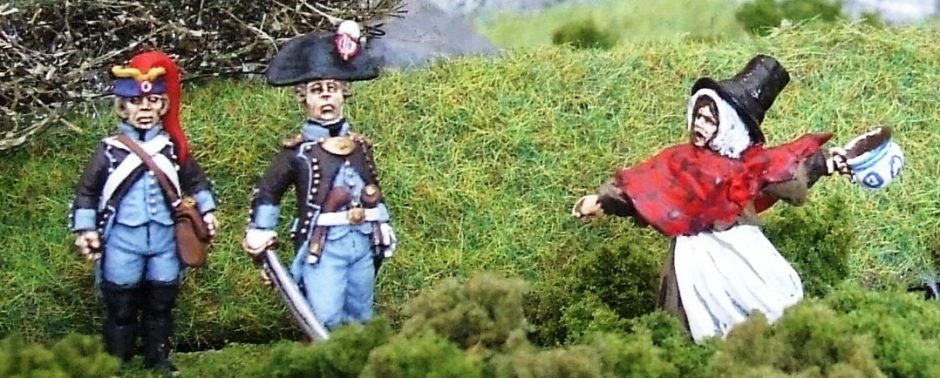
 Above: The humanity! As if this civil war weren’t horrible enough, a Morris Man capers from one of the farm-buildings and calls to one of the Greenjackets as if he recognises one of them! Horrified to be thought of as Morris-men, the Greenjackets temporarily panic, but are soon brought back to their senses and proper military bearing by the stirring sight of the Regimental Colour. War is hell…
 Above: Spotting a suitable phone box, I moved forward in order to phone my editor with a live report of the day’s action.
 Above: To the Greenjackets’ enormous relief, the Morris Man capers off in search of new prey…
 Above: Worried by the distant sound of engines and the rattle of tracks, Major Lewis deploys a ‘Boyos’ anti-tank rifle team…
 Above: Ignoring the raging firefight around her, Rocsi successfully rounds up the sheep, along with the Morris Man.
 Above: The armour pushes forward, but the Cadets continue to proceed in an orderly and ladylike manner.
 Above: Lt Col Foley and Captain Gough watch the Morris Man disappear into the distance. Captain Gough is doubly relieved, as he was terrified of having his shameful secret revealed and being ‘outed’ as a Morris-dancer in front of the men…
 Above: I conduct a live interview with one of the Greenjackets “Excuse me, but what is your opinion on the morality of Morris Dancing between consenting adults?”
 Above: My interview is rudely interrupted by an armoured car roaring past.
 Above: “Captain Gough! Is that you? I didn’t recognise you without the bells, hankies and whiffling-stick!” It’s no good, the Morris Man is back and has outed Captain Gough. Recoiling from the whistles, cat-calls and titters of his men, Captain Gough staggers away from the battle, a broken man.
 Above: “Quick boys! Let’s get these girls away and then we can have first dibs!”
 Above: As the Login Company covers the theft of the sheep, the Boyos team opens up on the Royalist tankette… And misses.
 Above: With the defenders of Penclippin Farm thoroughly suppressed by fire from the Llanglydwen Company, Rocsi herds the sheep back to Welsh lines. The Greenjackets, now alerted to the theft, open fire speculatively on the hedgerows to their front.
 Above: The Cadets’ armoured car, spraying machine gun fire, moves somewhat rashly to outflank the Welsh line.
 Above: The rest of the Cadets are still in no such rush however, though wisely give the Morris Man a wide berth, as he capers off toward Whitland.
 Above: Despite suffering some casualties from the armoured car’s machine gun, the Fish Guards gamely return fire with a volley of Molleston Cocktails (named for the Pembrokeshire village where petrol bombs were first used against Royalist tanks). One finds its mark and disables the armoured car, forcing the crew to bail out.
 Above: Inspired by the sacrifice of their armoured car detachment, the Cadets hitch up their skirts and risk showing an ankle to the uncouth soldiery as they step up the pace.
 Above: “Excuse me, but is it true that you’re here to give relief to the Greenjackets?”
 Above: The Morris Man dances off into the distance. His body was later found face-down in the Tâf, with a service issue Webley bullet in his back.
 Above: Lt Col Foley manages to calm Captain Gough and settle his nerves with a tot of Pimms. “Christopher old chap, don’t worry. Your secret is safe with me. Goodness knows, when I was in the Sudan, a chap would do anything to stay sane and Morris, while being an unnatural act abhorred by God, wasn’t unknown. Heaven forbid, at least it’s not Jazz.”
 Above: True to form, the cads and bounders known as the Fish Guards, machine gun the armoured car crew as they make good their escape.
 Above: The depleted Llanglydwen Company lays down covering fire as Rocsi and her woolly charges make good their escape.
 Above: The Boyos team doesn’t get a second chance as the tankette returns fire with twin machine guns, instantly eliminating the threat.
 Above: Horrified at the loss of his Boyos, Major Lewis orders the Login Company to disengage.
 Above: The surviving armoured car crew make good their escape.
 Above: On the other side of the river, the survivors of the Glandŵr Company withdraw northward up the river.
 Sorry for the slow rate of blog-posts just lately! My excuses are many and varied, but the main reason is that just lately I’ve been ill with Manthrax (like Man Flu but even worse) and ‘between computers’! Sorry!
 The scenario lasts 8 turns, starting with the Union 1530 turn and ending with the Confederate 1900hrs turn. The last turn for both sides is a Twilight turn, with maximum artillery range being reduced to 48cm.
 Above: An overview of the battlefield at 1530hrs: Having taken the Rohrbach Bridge following a bloody assault during the morning, the Union IX Corps has finally established a strong bridgehead east of the Antietam Creek. In front of them stands D.R. Jones’ weak division, manning a pathetically-thin line east of the city of Sharpsburg.
 Above: The Union left (southern) flank (Ewing’s brigade of Scammon’s division).
 Above: Rodman’s division, in the Union centre. The larger brigade is Harland’s, while the smaller unit is Fairchild’s brigade, which included the 9th New York Zouaves. As we were slightly short of Union infantry figures, I confess that I used the Confederate Tiger Zouaves (with a suitable Union command stand) to represent this unit, as they wore a very similar uniform of blue jacket with red trim, topped off with a red fez and blue tassel. However, the 9th New York Zouaves had blue trousers, while the Tigers had blue & white striped trousers, as shown here (what the heck…).
 Above: The Union IX Corps viewed from the rear, looking toward Sharpsburg. The bridge in the foreground had been the scene of bitter fighting during the morning.
 Above: On the Confederate right flank stands Toombs’ weak brigade and a supporting battery of artillery. Toombs had been instrumental in defending the bridge during the morning’s battle and was only forced out of position once the Union forces discovered a ford that allowed them to outflank his position. Toombs’ infantry are concealed in a cornfield, which at this time of year is fully-ripe and much taller than a man. The cornfields block line of sight (reducing visibility to 2cm), though are removed once a unit has trampled through them in line or supported line formation.
 In the Confederate centre, Kemper’s and Drayton’s brigades, with a second battery of artillery, take cover behind a low stone wall on the forward slope of the ridge.
 Above: On the Confederate left, the remaining two batteries occupy dominating positions on Cemetery Hill, with Evans’ brigade (actually a combined unit formed from the remnants of Garnett’s and Evans’ brigades) deployed in support on the rear slope. Walker’ brigade meanwhile, guards the western approaches to Sharpsburg.
 Above: Rodman’s division surges forward in an effort to eject Toombs’ and Kempers’ weak brigades from their strong position on the ridge. Fairchild’s Zouaves in particular, are eager to carry their bayonets to Kemper’s Rebels!
 Above: After a surprisingly tough fight, Fairchild’s Zouaves are only able to push Kemper’s boys grudgingly back from the stone wall to the crest of the ridge. In the foreground, Harland’s assault stalls in the face of intense artillery fire from Toombs’ supporting battery.
  Above: In the distance, Welsh’s brigade makes heavy going through the small patch of woodland on Fairchild’s right, while Christ’s brigade by contrast, ignores the threat of the guns on Cemetery Hill to launch a bold direct attack on Sharpsburg.
 Above: A short while later, Kemper’s and Toombs’ brigades have been destroyed and Toombs himself is mortally wounded and carried from the field. In the distance, Welsh’s brigade destroys Drayton and the ridge is completely cleared of Rebs. However, Christ’s brigade suffers heavy casualties during its assault and is routed. The Union artillery exacts vengeance on Walker’s brigade and crushes it. Evans now finds himself leading the last remaining brigade of Jones’ division and withdraws from Cemetery Hill, hoping to mount a close defence of Sharpsburg. Only A.P. Hill can now save the day…
 Above: In the nick of time, A.P. Hill’s division streams onto the field…
 Above: Rodman’s division might have taken the ridge, but both brigades are low on ammunition and now find themselves under fresh assault by A.P. Hill. The corps commander rides forward to encourage the men, while in the distance Welsh leads his brigade on to enter Sharpsburg!
 Above: With Welsh’s brigade having gained a foothold in Sharpsburg, the rest of IX Corps starts to move forward to exploit their success.
 Above: In the foreground, Ewing’s brigade moves forward to Snavely’s Farm, but comes under fire from newly-arrived Reb artillery. In the distance, Harland’s green troops might have taken the ridge, but now come under pressure from Hill’s veterans and look set to lose what they have gained.
 Above: Branch’s Rebel brigade, accompanied by two batteries, takes up position along the stone wall opposite Ewing.
 Above: On the ridge, the Rebel brigades of Brockenbrough and Pender take Harland to task on the crest of the ridge.
 Above: Fairchild’s Zouaves find themselves in an even worse situation, as they have now broken through Kemper’s brigade and its supporting battery, only now to find themselves isolated and unsupported on the reverse slope, faced by Gregg’s far stronger Rebel brigade. Already weak, Fairchild’s brigade is rapidly crushed by enemy fire and is soon annihilated. General Rodman attempts to rally them, but falls to a shot through the head from a Rebel marksman.
 Above: Despite sudden reverses on the ridge, Sturgis’ division (Ferrero’s and Nagle’s brigades) forms columns and marches forward eagerly into the fight. Crook’s brigade meanwhile, struggles to extricate itself from the woodland along the banks of the Antietam.
 Above: Finding himself facing superior forces, Ewing takes cover behind the stone wall at Snavely’s Farm.
 Above: But what’s this?! It seems that despite being securely positioned within the houses of Sharpsburg and being accompanied by their divisional commander, Welsh has suffered a crisis of confidence and has ordered a withdrawal, which has turned into a panicked rout from the town! Evans’ men send them on their way with a large volume of fire and Archer’s newly-arrived brigade takes advantage of the vacuum to occupy the buildings so recently vacated by Welsh!
 Above: Wilcox manages to rally Welsh’s brigade and throws them once again into Sharpsburg. Lovell brings his brigade down from Cemetery Hill to support the assault, but all to no avail! Welsh’s men are cut to pieces by musketry from Archer and Gregg, while Lovell’s assault is halted by Evans and his supporting artillery.
 Above: In the meantime, a general assault on the ridge starts to develop, as Ewing, Nagle and Ferrero roll forward, supported by Crook and whatever artillery can find the range. However, Rodman’s division has now completely disintegrated and the few survivors are streaming back across the bridge, taking the divisional artillery with them.
 Above: Branch’s Rebel brigade and its supporting artillery is being thinned out by long-range Union artillery and can’t hope to hold against the coming assault, but it all serves to draw Union forces away from the main prize…
 Above: A.P. Hill has learned from Jones’ mistakes and keeps Pender’s, Brockenbrough’s and Gregg’s brigades well behind the crest-line (marked by the fence) rather than expose them to the superior Union artillery power.
 Above: Evans’ and Archer’s men occupy Sharpsburg and jeer as Welsh’s brigade flees back up the road to the bridge. However, Lovell’s brigade is rallying behind the Lutheran church and steels itself for a second assault… It’s now all-or-nothing, as the sun is setting…
 Above: Evans’ stalwart artillerymen load their guns once again and wait for the renewed assault on Sharpsburg…
 Above: Lovell surges forward once again, but runs into a storm of flying lead and steel. His charge is halted and the survivors go to ground as darkness falls. The assault on Sharpsburg has failed.
 Above: As fleeing Union soldiers head back to the bridge, Cox orders Sturgis’ fresh division to form the rearguard as IX Corps starts its withdrawal across the Antietam, leaving over a quarter of its men lying on the field of battle…
 The Warsaw Pact’s Northern Front crossed the Inter-German Border two days ago, rapidly breaking through the forward units of the German Schleswig-Holstein Territorial Command, annihilating the 81st Heimatschütz Regiment and surrounding the 71st Heimatschütz Regiment in Lübeck.
  The Heimatschützen’s sacrifice has allowed time for NATO’s LANDJUT Command to crystallise a main line of resistance along the Kiel Canal. The German 6th Panzergrenadier Division is on the right, with its flank resting on the Elbe and covering the main approaches to Hamburg. The Danish Jutland Division is on the left, holding a wide swathe of land across Schleswig-Holstein, with its left flank resting on the Baltic and the British 1st Infantry Brigade is in reserve. The line is spread very thin, though gaps are being covered by the ubiquitous local Heimatschütz platoons and the line should soon be strengthened by the arrival of the US 9th Motorized Infantry Division, which is presently unloading at Hamburg. However, the 1st Jutland Mechanised Brigade is still forward of the canal, forming a bridgehead to allow German units and the Jutland Dragoons to withdraw across the canal.
 Rapidly approaching from the south are the leading elements of the East German 28th Motorisierte-Schützen Regiment Wilhelm Florin, which is the spearhead unit for the 8th Motorisierte-Schützen Division Kurt Bürger. The regimental reconnaissance force has identified NATO defensive positions around the village of Gnissau and the regiment’s 3rd Battalion has been ordered forward to mount a hasty attack.
 Above: Lieutenant Colonel Simmondsson deploys the defenders as ‘hidden unit markers’, which include a proportion of dummy markers, as per the original Battlefront: WWII rules. Each ‘Manoeuvre Element’ (i.e. Company) gets issued a number of dummy markers based on the Troop Quality of the unit – better units get more dummies, as they are assumed to be better at camouflage and creating dummy positions. It’s a simple system that negates the need for a map and umpire. Obsersteutnant Marx then deploys his troops and plans his preparatory barrage.
 Above: Going by the deployment of NATO positions, the western side of the battlefield appears to be more weakly defended, so Marx deploys the bulk of his force there, aiming to swing around the wooded ridge and assault Gnissau from the west. The tank battalion leads, with the Motor Rifles following close behind, mounted in their thin-skinned BTR-60 PB carriers. The supporting artillery proceeds to hammer the wooded ridge (they have three turns of pre-planned fire with the whole battalion – one battery is then available in Direct support thereafter, along with the Motor Rifle Battalion’s own 120mm mortars).
 Above: The East German 2S1 122mm artillery battalion does good work on the ridge and disorders or suppresses almost the entire Danish ‘B’ Company (mech infantry). Further out to the west, the German T-55s are most surprised (and relieved) to discover that the bulk of NATO positions there are actually dummy positions! Nevertheless, in front of the ridge a T-55 is destroyed by Carl Gustav 84mm recoilless rifles, while another T-55 is driven back. NATO artillery also now starts to fall among the East German APCs…
 Above: Despite being suppressed by artillery himself, the Danish Forward Observer times his defensive fire mission perfectly, dropping 155mm rounds in the midst of a Motor Rifle Company just as they were dismounting from their APCs in preparation for an assault on the ridge. An APC and a rifle squad are eliminated and most of the rest are disordered. The T-55s will now have to fight through the wood without infantry support!
 Above: With the East Germans threatening to turn the Danish right flank, the CO calls up an air-strike and a flight of RDAF F-16s screeches over the battlefield…
 Above: Suddenly, disaster strikes the Danes! With Warpac artillery landing in and around their foxholes, T-55s rampaging through the position and the Company Commander being pinned down, panic suddenly rips through the Danish ‘B’ Company and the majority of them flee from the ridge, accompanied by their attached Forward Observer.
 Above: Only a single infantry section remains on the ridge, resolutely holding its position against the invaders.
 Above: A hedge at the foot of the rear slope unfortunately impedes the Danish retreat.
 Above: At Strenglin however, the East Germans suffer a bloody nose as Land Rover-mounted Danish TOWs knock out a German ATGM vehicle and the Forward Air Controller’s vehicle. Thankfully the FAC survives and starts calling for some airborne vengeance…
 Above: From their position the East German ATGM teams are able to spot the Land Rovers, but don’t want to give away their position by firing.
 Above: But not to worry, as a Soviet Frontal Aviation Su-17 ‘Fitter’ soon arrives and easily avoids the paltry AA fire that the Danes are able to throw up.
 Above: Somewhat unwisely, the Danes have packed a small wooded hill with assets – as well as the two TOW Land Rovers, there are also two recce Land Rovers and a Forward Observer with his M113! They all fit neatly under the Su-17’s bomb template…
 Above: The Danish right flank is now completely overrun. The Danish ‘B’ Company managed to rally at the hedge-line and has occupied a small built-up area next to the road, but they can’t hope to hold out for long against this onslaught.
 Above: ‘B’ Company does what it can to rally, but some elements are still stuck on the wrong side of the hedge! However, the first T-55 to emerge from the wooded ridge suddenly explodes as a TOW missile finds its mark – but from where?!
 Above: Back on the high ground at Gnissau, the Danish CO personally directs the fire of two dug-in M150 TOW Carriers and begins to organise a counter-attack.
 Above: Ignoring the threat of ATGM fire from Strenglin, the Centurions of ‘A’ Company burst out of their camouflaged positions in front of Gnissau and wheel to the right, aiming to strike at the right flank of the East German tank battalion.
 Above: In the distance, the Danish ‘C’ Company, mounted in its M113s, follows the Centurions in a counter-attack against the East German right flank. In the foreground, the reservist ‘D’ Company gets out of its foxholes and moves forward in support.
 Above: Having successfully run the gauntlet of fire from AT-4s ATGMs and AGS-17 grenade-launchers, the Centurions successfully reach the eastern end of the wooded ridge. In the foreground, the Squadron Commander with one of his Troops engages the T-55s on the northern slope to take the pressure off ‘B’ Company’, while his other two Troops head around to engage the BTRs south of the ridge.
 Above: Unaware of the approaching Danish tanks, the East German Pioneer detachment moves forward in support of the attack.
 Above: The view from the wooded ridge. The dismounted East German Motor Rifle Company is still struggling to move forward following its hammering by NATO artillery and the tanks on the ridge are still unsupported… The Danish counter-attack might just work!
 Above: The commander of 7th Company frantically attempts to get his men to redeploy to face the approaching enemy tanks, but his lads are shaken and move sluggishly in response to the threat. The panzer crews are made of sterner stuff, however and a single T-55 platoon moves to meet the Centurions.
 Above: The Tank Battalion and the 8th and 9th Motor Rifle Companies charge on, aiming to overrun ‘B’ Company and Gnissau, regardless of the puny tank threat.
 Above: However, Captain Bigglesson’s F-16 appears just as the East German air defence unit is re-locating to a safer location. The 7th Company’s deployed SA-7 ‘Grail’ SAM team fails to dissuade the Danish aviator and he successfully destroys a BTR-60 belonging to 9th Company.
 Above: Meanwhile, Lieutenant Maverikski’s Su-17 returns to club baby seals and ignores the Centurions to finish off the Danish Land Rovers before returning to the People’s Mess for a samovar and Order of Lenin.
 Since getting back into my first wargaming love of Napoleonics in 2015, thanks to our
  One of my major objectives after Waterloo was to build up sufficient French and Austrian forces for the 1809 Danube Campaign. The main task was to paint LOTS of Austrians, as I only had a small Austrian army in my collection, but I also needed to expand my French army in pretty much all areas. I’ve also been expanding my Young Guard for later campaigns, so I’ll cover those in a separate piece.
 Above: The 9th Light Infantry Regiment.
 Above: The 10th Light Infantry Regiment. At first glance these look exactly the same as the 9th, though there are subtle differences in cuff detail, headgear, epaulettes and gaiter-trim.
 Above: The 7th Chasseur a Cheval Regiment.
 Above: The 4th Cuirassier Regiment. I have actually cheated here slightly, by painting them in their 1810 uniform with ‘aurore’ (pinkish-orange) facings. Up until 1810 the Cuirassiers only had scarlet or ‘jonquil’ yellow facings. Scarlet was worn by the 1st to 6th Regiments, while jonquil was worn by the 7th to 12th Regiments. In 1810 that changed to scarlet for the 1st to 3rd, aurore for the 4th to 6th, jonquil for the 7th to 9th and pink for the 10th to 12th.
 Above: The 5th Hussars again. I must admit that I’ve cheated here slightly, as I’ve depicted them in the uniform recorded for 1805-1808, which featured sky-blue shakos with black trim and trumpeters in scarlet uniforms with white shakos and yellow plumes. By 1809, the shakos for the rank and file had changed to plain black and the trumpeters were wearing ‘reversed colours’, with sky-blue shakos and white plumes. Note that as with all AB Figures cavalry in ‘charging’ poses, they often benefit from a bit of arm-bending, so that some are pointing their sabres at the enemy. Some careful plume-bending can also look good, as here.
 Above: The 1st (Polish) Light Horse Lancers of the Guard. In 1809 these were actually simply ‘Light Horse’ and didn’t become Lancers until a year or so later. However, AB don’t do the correct figures for 1809, so these will do for now, as we need them for subsequent campaigns.
 Above: One of the Lancers had a mis-moulded lance, so I decided to convert him into an Eaglebearer with the help of a drill, some brass wire and the Eagle cut from a spare infantry Eaglebearer. I think he looks rather nice and I now wish I’d done the same for the 2nd (Red) Lancers! 🙁
 Above: For some reason I had a load of spare Guard Lancer officers knocking around, so I painted some as Duchy of Warsaw generals and this one specifically as General Krasinski; some time commander of the 1st (Polish) Light Horse Lancers of the Guard and latterly a Guard cavalry brigade commander. Even as a general, he typically wore a sumptuous version of the full dress ‘gala’ uniform of the Guard Polish Lancers, as shown here.
 Above: For the Italian theatre of the 1809 Campaign and for the Battle of Wagram, I needed a model for General Grouchy, in his role as commander of a corps of Dragoons. Grouchy has in latter years attracted something of a bad reputation, thanks to Bonapartist propaganda slating his performance as a Marshal during the Waterloo Campaign. However, in earlier campaigns and particularly in 1809, he proved himself as an extremely capable cavalry commander
 Above: Prince Eugene de Beauharnais, Viceroy of Italy. Although not a Marshal of the Empire and having almost no military experience, Eugene, as Napoleon’s adopted son, was given an independent command as commander of the Army of Italy. After a shaky start, Eugene surprised everyone by not only defeating an Austrian invasion but also then pursuing the Austrian army back into Hungary before joining Napoleon at Vienna and playing a decisive part in the subsequent victory at Wagram. He also proved to be a very popular civil governor of northern Italy – sometimes nepotism works!
 Above: Eugene is frequently depicted in a Marshal’s-style blue uniform, heavily laced with gold and with white Marshal’s ostrich-feathers edging his hat. However, I’ve depicted him here in the green uniform prescribed for him as Viceroy of Italy. I’m not sure if he was actually wearing this in 1809, but this seems to have been the uniform he wore at Borodino in 1812 and it does mark him out as a commander of Italian troops. With him is an Italian staff officer (green uniform, faced sky blue), an Italian line infantry colonel in regimental uniform and a French staff officer in a sky blue concoction of his own (based on a uniform worn by Baron Lejeune).
 Above: Lastly, we have Marshal Bessieres, resplendent in his typical uniform; the ‘undress’ uniform of a Colonel of the Guard Chasseurs a Cheval. He is escorted by a pair of Guard Chasseurs in full dress and a dismounted Chasseur officer, in undress like his boss.
 This week I’ve been painting more Cold War Cloggies! As discussed in


 In terms of organisation, during the 1980s Brigade Recce Platoons had three patrols, each of 2x M113 C&V 25. The Platoon HQ then had a single M113A1, an FN-MAG-armed Land Rover and a pair of Carl Gustav 84mm MAWs.


 And so to the infantry:
 Up until the late 1980s/early 1990s, the standard Dutch combat uniform was plain olive-drab, the shade of which faded to a slightly greyish-green though not as grey-green as West German or Canadian uniforms. I’ve used Humbrol 86 Olive Green, mixed with a little white for highlight. After this they switched to a new uniform made from British Disruptive Pattern Material (DPM) camouflage. National flag badges were sometimes worn on the shoulders, so I’ve painted them here simply in order to break up the green monotony! The national flag badges became standard with the change to DPM uniforms.
 The helmets are something of a sore point… Dutch troops during this period were equipped with a US M1 helmet, which was then to be covered in hessian sacking. The hessian would then be camouflaged (with varying degrees of success) by the individual soldier, using brown boot-polish and green ‘webbing-polish’ (what the British Army would call ‘Blanco’). This would then be topped off with an olive drab scrim net, all held in place with a rubber band made from a tyre inner-tube.
 However, Team Yankee haven’t modelled them with the all-important scrim-net, just a cloth/hessian cover! I tried doing some with the camouflage, but it looked too bold without the subduing effects of the hessian material, scrim-net and general weathering, so I wasn’t happy with them at all. From a few photos in 1980s-vintage books, Dutch troops from a distance generally look as though they’re wearing sand-coloured helmet covers, so I decided in the end to go with Humbrol 155 US Olive Drab, highlighted with Humbrol 83 Ochre. In retrospect, these do look a bit too light and a light brown might be a better colour than ochre… 🙁 Lastly, the helmets were finished off with their rubber band in Humbrol 67 Dark Grey.
 As for weaponry, the standard small-arms for the Royal Dutch Army during this period were the

 From 22-28 October 1944, the 53rd (Welsh) Infantry Division, with supporting elements from 7th Armoured Division, 79th Armoured Division and 33rd Armoured Brigade, won a remarkable (and now largely forgotten) victory at the Dutch city of ‘s-Hertogenbosch.

 160 Brigade would attack on the right, straddling the railway. The 2nd Monmouthshire Regiment (2 Mons) would advance on the right (north) of the railway, along CUP Route through Kruisstraat and Rosmalen. The 4th Welch Regiment (4 Welch) would advance on the left (south) of the railway, along SPUR Route, through Nuland and Molenbeek. The 6th Royal Welch Fusiliers (6 RWF) would form the brigade reserve. Each battalion would also be supported by the Cromwell tanks of 5th Royal Inniskilling Dragoon Guards (5 Skins – 7th Armoured Division – minus ‘B’ Squadron), divisional engineers and specialist armour (Crocodiles, AVREs and Crab Flails) from 79th Armoured Division to deal with the numerous fortifications and obstacles.


 Above: As the heavy and medium artillery of 3 AGRA pounds Nuland and the factory, 4 Welch Group breach the antitank ditch with the aid of AVREs, fascines, SBG bridges, bulldozers and a Churchill ARK. The Cromwells of 5 RIDG are soon across and providing close support to the infantry. Beyond the railway, 2 Monmouths Group advance along a very narrow corridor toward Kruisstraat.
 Above: On the British left, 1 HLI Group, supported by a squadron of 5 RTR, cross the antitank ditch and bypass Nuland; heading for Maleskamp and Coudewater.
 Above: Despite massive artillery preparation and smokescreens, the Sappers supporting 4 WELCH Group get heavily ‘stonked’ as they attempt to breach the minefields in front of Nuland. Nevertheless, the Sappers carry out their tasks despite heavy losses and soon breach the obstacles, allowing 4 WELCH and 5 Skins to move through into Nuland and the fortified factory complex.
 Above: Hemmed in between the railway and the soggy polder land of the Maas valley, 2 MONS Group attempt to make headway along the Dyke Road to Kruisstraat, but are delayed by their own artillery barrage.
 Above: Artillery preparation on Kruisstraat causes some disruption, but the German defenders remain largely intact and wait for the British to follow up their barrage.
 Above: Grenadier-Regiment 745 is deployed in considerable depth, with a lot of heavy weaponry held in reserve – here we see the position at the Bruggen road junction.
 Above: Jagdpanthers and StuGs mass behind the ramparts of Fort Alexander, ready to mount a counter-attack. The guns of Artillerie-Regiment 1716 are deployed in the fields around Hintham and the fort.
 Above: Fort Alexander is a remnant of the outermost 18th & 19th Century defences of ‘s-Hertogenbosch, but still provides a good defensive position for the waiting Fallschirmjäger.
 Above: A pre-planned strike by a squadron of Typhoons hits the Bruggen road junction. However, by sheer luck, the German commander has massed two entire flak companies in the immediate vicinity and the RAF suffers heavy losses for little gain. The lead Typhoon pilot pulls up after delivering his bombload. His squadron-mates are not so lucky.
 Above: The Luftwaffe puts in an appearance over the battlefield.
 Above: 1 HLI moves up through the woods and hedgerows towards Maleskamp. Suddenly there is contact with the enemy, as the lead Cromwell is destroyed by a waiting 88 (just off picture).
 Above: With the fighting still going on in Nuland and the factory, elements of 4 WELCH and 5 Skins bypass the defenders and push on toward ‘s-Hertogenbosch.
 Above: At the tip of the advance, the leading 5 Skins Cromwell pushes warily forward into the unknown.
 Above: Füsilier-Bataillon 712 defending Nuland suffers terrible losses to artillery during the initial assault. 4 WELCH and the ‘Funnies’ make short work of the village itself and swing around to assault the southern trench-lines simultaneously from front and rear. However, the defenders of the factory are determined to go down fighting.
 Above: Now beset from all four sides, the defenders of the factory continue to hold their ground.
 Above: North of the railway, the first Cromwell to reach Kruisstraat falls victim to a German antitank gun. As the traffic jam continues to build up behind them, the British armour attempts to deploy off the Dyke Road, as infantry move up on the left. British Forward Observers and Forward Air Controllers meanwhile, attempt to find advantageous elevated positions atop the railway embankment and on industrial spoil heaps.
 Above: As the rearmost mortar positions of Füsilier-Bataillon 712 are engaged by infantry, the Cromwells push on towards the city. However, they soon run into the next German position – a strong ‘Pakfront’ of 88s, PaK 40s, self-propelled guns, Panzerschrecks and the German ‘secret weapon’… The division’s 4.2-inch mortars lay a smoke screen in front of the tanks as they attempt to deploy off the road.
 Above: The second pre-programmed British air-strike arrives, hitting the vicinity of Fort Alexander. The German heavy armour is caught in the open as it moves forward. However, thick flak from quadruple 20mm guns puts the RAF off their aim and they cause little damage.
 Above: A Typhoon streaks low across the German armoured column.
 Above: As a Typhoon climbs out over Rosmalen, we get a good view down the long axis of the battlefield. The British are advancing from the far table edge, toward the camera.
 Above: The Luftwaffe chases the Typhoons.
 Above: Grenadier-Regiment 732 waits in Maleskamp for the British assault to reach them.
 Above: With close assistance from some AVREs, 4 WELCH finally clears the factory complex and Füsilier-Bataillon 712 is annihilated.
 Above: With the factory finally cleared, the traffic jam behind 4 WELCH finally begins to move.
 Above: At the spear-point of 4 WELCH Group’s advance, the destruction of an 88 by accurate fire from the Royal Artillery encourages the Irish cavalrymen to do something rather rash… One Cromwell soon goes down to a 75mm PaK 40, while another two (including the British squadron commander) go down to the puny 47mm gun of a Panzerjäger 35R(f).
 Above: With the leading tanks burning and their comrades under steady antitank fire, the British commander pushes up infantry and Crocodiles to take on the PaKfront. British artillery meanwhile, pounds the German positions, but to little effect.
 Above: With Nuland cleared, General Ross decides to launch Operation SAUCEPAN! 53 RECCE is soon motoring up the southern PAN Route, with 1 E LANCS following close behind, safe in their new Kangaroos.
 Above: Part of the PaKfront in close-up – a PaK 40 is flanked by two Panzerjäger 35R(f)s, while a StuG III B covers the flank.
 Above: The ‘secret weapon’ (37mm PaK 36 on a UE 430(f)) opens up at the flank of a 5 RTR Cromwell! The Cromwell is disordered by the 37 and is then finished off by a Panzerschreck.
 Above: As Operation SAUCEPAN drives forward past Nuland, the PaKfront, having held on for as long as possible is assaulted from all sides and is annihilated.
 Above: Despite traffic jams caused by burning AFVs at the head of the column, Operation SAUCEPAN drives on through Maleskamp as the position is finally overrun by 1 HLI and 4 WELCH. However, increasing resistance at the Coudehard Sanatorium and Windmill positions force SAUCEPAN to grind to a halt and 1 E LANCS dismounts to force the dug-in German infantry out of their trenches.
 Some of the team (from left to right): Richard de Ferrars, Martin Small, Paul Davison, Steve Uden, Ken Natt and Mark Davies. Missing In Action are Paddy Green and Gary Loosen. By a strange coincidence, Gary Loosen later found out that one of his relatives had died at ‘s-Hertogebosch and later attended the 70th Anniversary commemorations at ‘s-Hertogenbosch in October 2014.
 Regular readers of this blog will remember that we were following the major actions of the
  The Commanding Officer of the Camrose & Treffarne LDV, the Reverend Gethin Thomas, has managed to gather together a weak platoon of survivors and plans to defend the old mediaeval manor house of Robleston Hall, to give time for the Bishopric to mount a counter-attack. However, the Blackshirts, buoyed up by their victory at Camrose, are already hard on his heels.
 The brief respite of battle is shattered as a section of Blackshirts, commanded by BUF Storm-Leader 2nd Class Ronald Biggsworth-Hill, opens up on the manor with rifles and Lewis Guns. A light tank from the King’s Dragoon Guards soon joins in with its heavy machine gun. An anti-tank rifle team prudently deploys to cover the Keeston road.
 With the defenders suppressed by the massive storm of lead directed against Robleston Hall, the time is ripe for BUF Storm-Commander Fussell to order his assault sections in for the kill. On the right, a platoon of the Loyal West Carmarthenshire Greenjackets prepares to assault another group of LDV, holding a house at Furzy Mount.
 The LDV holding Furzy Mount spot the Greenjackets moving in the undergrowth and open up with a fusillade of rifle fire.
 Commanding the defenders is Lt Col Archibald Carruthers MC, late of the 9th Royal Deccan Horse. He thoroughly enjoyed the last battle and catching up with his old India chum Gussie, but these chaps seem to be decidedly common and not the sort to enjoy a good ruck in proper sporting fashion…
 As Blackshirts move past to assault Robleston Hall, Lt Christopher Gough of the Greenjackets has his own problem to deal with and urges his men forward.
 The Greenjackets open up on Furzy Mount with a withering hail of rifle and Lewis Gun fire. Nevertheless, the LDV seem undeterred and return fire.
 “Sgt Stace! Where are you?! For God’s sake man! Shout out so I can come to you! I’m bally well lost in the brambles! Ow! Bloody nettles…”
 Meanwhile, Biggsworth-Hill’s Blackshirts continue to pour fire into Robleston Hall. Within the hall, militiamen lie dead and wounded.
 The Blackshirt assault goes in! The doors are kicked open and grenades are swiftly lobbed inside.
 Only two wounded Anglican survivors stagger out of the Hall. Knowing the BUF’s reputation for brutality, they expect to be murdered at any moment, but on this occasion they’ve caught the Blackshirts in a good mood. A Loyalist medic patches them up and they’re sent back for interrogation. The Blackshirts push on through the Hall, but are met by a renewed volley of fire from the outbuildings, as the Reverend Thomas makes his last stand.
 “Sgt Stace! Send a man back to beat down these nettles for me! ”
 At Furzy Mount, Sgt Stace of the Greenjackets continues to direct fire against the Anglican defenders, who are starting to suffer casualties.
 Greenjackets fix bayonets and ready grenades…
 As the Greenjacket assault goes in on the front door, Lt Col Carruthers and his surviving men make good their escape out of the back door… How easy is it to ride a Welsh Black, one wonders…?
 With their objective taken, Greenjacket patrols push forward to make contact with the enemy. As they advance, their platoon commander’s cries of nettle-induced anguish recede in the distance…
 But here come the cavalry! Spearheaded by cavalry and armour, General Picton’s flying column arrives at Dudwells and pushes on to the aid of the militia.
 “Come back, you silly sods! Don’t you know it’s the 20th Century?!” A tank commander’s cries are lost, as the Pembroke Post Office Lancers, their pith helmets festooned with spare elastic-bands in the finest traditions of the Post Office (you never know when they might come in handy for parcelling up loot or prisoners), scent blood and charge off to glory, medals and a well-earned cuppa.
 The Pembroke Post Office Lancers are part of the Albertine contingent sent by sea from Pembroke Dock to reinforce the Bishopric. The Albertines are unquestionably well-trained and well-equipped, but they are insufferably smug. With skills honed to perfection on the tent-pegging field, the ‘Parcel Force’ charge through the defile at Dudwells to the green fields beyond…
 … Pausing only briefly to do the day’s scheduled 2nd Collection at Dudwells Post Box…
 Without any visible enemy, the Mounted Posties put on a fine display of impromptu tent-pegging.
 They might be silly buggers, but they’re silly buggers with style, panache and bulging sacks.
 However, nobody likes a show-off… Least of all Blackshirts with a Vickers Machine Gun… A long burst of fire scythes into the leading section of lancers, cutting two of them down. A third is thrown from his horse and into the Camrose Brook.
 Once they stop laughing, the St David’s Armoured Corps advances to take on the Blackshirt machine gun. At the rear of the column, the sound of “Ten Green Bottles” and “Stop The Bus, I Want a Wee-Wee” being sung lustily, announces the arrival of the motorised infantry.
 The Anglican armour moves forward, but is soon engaged in a duel to the death with the BUF anti-tank rifle team. As the armour provides supporting fire, the Post Office Lancers gallop for cover among the undergrowth skirting the Camrose Brook.
 Meanwhile, back at Robleston Hall, the Reverend Thomas decides that he can hold out no longer and that discretion might be the better part of valour. God does help those who help themselves, after all… He and his men break cover and run as fast as they can for the safety of Dudwells and the relief column.
 Seeing the LDV fleeing from Robleston Hall, BUF Storm-Leader 2nd Class Biggsworth-Hill has a rush of blood to the head and breaks cover in an attempt to cut off the enemy retreat. However, a new enemy has the deuced bad manners to machine-gun his men in the open! The bounders!
 Other Blackshirts attempt to give covering fire, but they too are now coming under fresh enemy fire from Dudwells.
 The fresh arrivals are the Bishop of St David’s Foot Guards. Formed chiefly from former members of the disbanded Welsh Guards, they are very experienced and highly-disciplined soldiers. With covering fire being provided by the armoured lorry’s Lewis Gun, the Guards quickly dismount and begin engaging the Blackshirts.
 Seeing Blackshirts in the open, the Bishop’s Foot Guards unleash months’ worth of pent-up frustration at being made to wear such ridiculous uniforms and being called ‘Chocolate Soldiers’ by children and their Albertine allies!
 With the Blackshirts hard on their heels and with bullets whizzing past their ears, the Reverend Thomas’ last surviving men leg it!
 The King’s Dragoon Guards’ sole tank moves to support the anti-tank rifle team and begins to engage the Anglican light tank. One of the anti-tank rifle gunners is wounded, but they continue firing.
 Meanwhile, back at Furzy Mount, a particularly officious policeman causes delay to the reserve BUF unit, but they are finally moving forward again.
 The KDGs’ tank is hit by 13mm heavy machine gun fire from the Anglican tank! With a track blown off, the KDGs are now immobilised. Nevertheless, with commendable courage, they remain in their tank and continue firing at the enemy armour!
 The KDGs’ belligerence pays off as they score hits on the enemy tank, damaging the running gear. The Anglican tank crew panic and bail out, taking cover behind their stricken tank. The KDGs keep firing and succeed in causing further damage to the Anglican tank.
 Suddenly there is a screech of brakes and tyres, followed by a crash and a lot of Australian-accented swearing! The Albertine Australian Light Horse have arrived… By bus…
 As one section of Australians takes up position in the house, another moves forward to the hedgerow and takes the BUF under heavy fire. The second bus arrives and disgorges another section of infantry and a Vickers Machine Gun team. The Vickers Gun also takes up position in the house.
 Resplendent in their ‘Kangaroo Feathers’ dyed Albertine purple, the Australians cut quite a dash despite their lack of horses. The regiment was formed from RAAF airmen, who were waiting to receive a delivery of new Saro flying boats at RAF Pembroke Dock, but were stranded when the war broke out. Being Australians, they formed a surfers’ colony at Freshwater West beach for a few months, but eventually grew bored and decided to join up for fights and giggles.
 Despite achieving a marked fire superiority over the BUF, the Foot Guards suffer casualties as the two men manning the lorry’s Lewis Gun are cut down by enemy fire. Undaunted, the Foot Guards’ CO and standard-bearer heroically man the Lewis Gun, providing an inspiration to all who witness it.
 While the Anglican tank crew cower behind their tank, their colleagues in the armoured car move forward in an attempt to finish off the Royalist tank and the pesky anti-tank rifle team.
 The Blackshirts are now starting to suffer heavy casualties from the enormous weight of fire being put down by the Guards and Australians. Their only hope now is for the Greenjackets to get weaving and flank the Australians.
 “View Halloo!” Meanwhile, a section of the Post Office Lancers is distracted by a fox and some belligerent sheep…
 The Lancers have a grand old time, chasing sheep along the Camrose Valley…
 Exasperated, the Squadron Commander orders the bugler to sound the Recall in a desperate attempt to get his men to do something useful!
 Finally back in some sort of order, the Post Office Lancers sneak along the Camrose Valley in an attempt to flank the BUF anti-tank rifle team.
 Bored with sheep, the wayward cavalry section spots more interesting quarry – two wounded anti-tank gunners. They charge…
 …Straight into the sights of the BUF Vickers MG team… To the horror of all those watching, the 20th Century finally catches up with the Lancers, as they are mercilessly cut down in a hail of fire. The Squadron Commander tries to encourage the rest of his men to charge the MG, but to no avail. Finally, the Australian MG manages to find the range and exacts revenge on the BUF machine-gunners on the Lancers’ behalf.
 Meanwhile, the Anglican tank crew have finally plucked up the courage to remount their tank, despite the hail of incoming fire. However, the KDGs have now found the range…
 Having re-mounted their stricken tank, the Anglican tankies’ enthusiasm is short lived as their tank brews up, forcing them to bail out once again.
 “Sod this for a game of soldiers!” With the Foot Guards’ jeers ringing in their ears, the Anglican tank crew make good their escape.
 “I wonder if that bus is a runner…?”
 The St David’s Tank Corps’ day gets even worse as the armoured car loses its duel with the anti-tank rifle team. This time nobody escapes the conflagration.
 The Foot Guards, far from being alarmed by the failure of their armoured support, just shrug and keep pouring fire into the Blackshirts, who are now starting to pull back and break under the strain.
 A St John’s Ambulance Cadet tends to the wounded Guardsmen in the back of the armoured lorry.
 The newly-arrived Australians, seeing Reverend Thomas and his men fleeing across the field toward them, pour fire into the stable-buildings of Robleston Hall, which are now occupied by the Blackshirts. The accurate Australian fire causes considerable damage and the Blackshirts pull back, leaving half their number dead in the stables. One Australian is wounded in the hedgerows by return fire, though the Australians in the house are now receiving the attentions of the enemy tank and are pinned down, with casualties.
 With the rest of the Blackshirts dead, wounded or retreating, the reserve Section moves up to cover their withdrawal. BUF Storm-Leader 2nd Class Biggsworth-Hill, the hero of Camrose Bridge, is reported as Missing. The KDGs, duty done, set fire to their disabled tank and make good their escape on foot.
 The Reverend Thomas finally reaches safety, though only two of his men are left alive at the end of their ordeal. Lt Col Carruthers is missing along with his men, while two men are known to be prisoners of the Blackshirts, poor devils… Nevertheless, the enemy has been halted and is falling back to Camrose. The Keeston Line is safe (for now).
 In my last post I looked at a few armies that were allied to Napoleonic France. However, the French Army itself also contained quite a number of foreign Regiments and Legions within its ranks, raised from Germans, Italians, Swiss, Dutch, Spaniards, Portuguese, Irish, Corsicans, Croats, Poles, Lithuanians and others.
 There had for many years been Irish volunteers in the French Republican armies (as there had been in the Royal French Army of old) but in 1803, these volunteers were consolidated into the French Army as a new Irish Legion. The ‘Legion’ consisted initially of a single light infantry battalion and no other combat-arms, so was from the outset referred to frequently as a ‘Regiment’ rather than a ‘Legion’. Although the Legion reached a strength of 2,000 men in four battalions, it never did raise any cavalry or artillery, so was formally re-titled in 1811 as the ‘3rd Foreign Regiment (Irish)’.
 The Legion was dressed in uniforms cut in French light infantry style, but coloured ’emerald green’. Collars were ‘primrose yellow’, while lapels, cuffs, shoulder-straps and turnbacks were all green, piped yellow. Sources are split on the cuff-detail – some say they were pointed, while others say that they were Brandenburg-style, with a yellow cuff-flap. Buttons were yellow metal. Waistcoats were white and breeches are recorded as both green and white in different sources. Belts were white.
 The Legion was presented with an Eagle in December 1805 and this was carried by the Legion’s 1st Battalion. Accompanying the Eagle was a flag of unique design (shown above), having a green field with gold-yellow fringe and gold-yellow Irish harps in the corners. In the centre was a tricolour panel, bearing the regimental title and bordered by a gold-yellow wreath.
 The Hanoverian Legion was raised in 1803 following the French occupation of Hanover, theoretically consisting of a Light Infantry regiment of two battalions and a Chasseur a Cheval regiment of four squadrons. However, it never managed to achieve its full strength due to disease and desertion.
 The Hanoverian Legion, while serving as a single battalion in Spain, had a slightly unusual organisation, comprising one Carabinier (elite) company and four Chasseur companies. There was no Voltigeur company.
 The Hanoverian Legion for some reason was never presented with an Eagle. However, each infantry battalion carried a standard French 1804 Pattern infantry regimental flag, as shown above. The corner-medallions, which would normally show a regiment’s number, were instead decorated with silver cloth discs.
 The Legion du Midi (also sometimes known as the Piedmontese Legion) was raised in 1803 from Piedmontese volunteers. It was originally intended that the Legion would comprise three line infantry battalions, two light infantry battalions and a battery of artillery. However, the Legion’s first posting was to the Caribbean and disease soon whittled this organisation down to two light infantry battalions.
 The Legion’s coats were initially produced from dark red-brown cloth, looted from a Capucin monastery. The colour is therefore known as Capucin and remained the Legion’s uniform colour throughout its existence. Waistcoats and breeches were white, but Capucin overall trousers were also very common. Collars, lapels, cuffs, cuff-flaps and turnbacks were sky-blue and buttons were yellow-metal. Belts were white. Like the Hanoverian Legion, lapels appear to have been cut in the line infantry style, with square ends.
 Like the Irish Legion, the Legion du Midi was presented with an Eagle, which was carried by the 1st Battalion. This was dressed with a standard 1804 Pattern infantry regimental flag with silver corner-medallions, as for the Hanoverian Legion.

 ]
]
 Above: Duchy of Warsaw Foot Artillery. There is something very appealing about this relatively simple uniform of dark green with black facings piped red and white cross-belts over the top. The artillery of the Kingdom of Italy wore a very similar uniform in the same colours, but these have a coat cut in Polish style, with short lapels. The Italians wore coats cut in French style.
 Above: The Duchy of Warsaw Horse Artillery wore the same colours as the Foot Artillery, but the coat was a single-breasted jacket in the same style as that worn by the Polish Chasseur a Cheval regiments. This was topped off with a single cross-belt, a waist-belt suspending a cavalry sabre in a steel scabbard and a black cavalry busby with red pompom and dark green bag.
 Above: It took some considerable digging, but after several years I finally found a description for the uniform of a Hessen-Darmstadt general! The single-breasted coatee was dark blue, with red collar and cuffs and blue turnbacks, all heavily edged and decorated with silver ‘foliate’ lace, akin to that worn by French generals. Epaulettes were silver and the waist-sash was mixed silver & red. The bicorne hat was unlaced and had a white ostrich-feather edge. I couldn’t find any information on the shabraque, but went with blue, edged silver. I used a spare French general figure.
 Above: The Westphalian Horse Artillery of the Guard wore a uniform very similar to that of the French Horse Artillery of the Line, so I’ve used French figures for these chaps. Like the French Horse Artillery, they wore a dark blue uniform with red collar, cuffs, turnbacks and trouser-stripes, epaulettes, plumes and shako-cords with yellow-metal buttons.
 Above: Like the Polish artillery, there’s something about the uniform of post-1810 Saxon Foot Artillery that I find very appealing. The 1810 Pattern coat was cut in the Germanic ‘Spencer’ style that had already become military fashion in Bavaria and other Confederation of the Rhine armies. The coat was green (the exact shade of which varies depending on what you read or see – I’ve gone for a slightly bright ‘French Dragoon’ green), with lapels, collar, cuffs and turnbacks in red, with yellow metal buttons and without lace. Shako cords and carrot-shaped pompoms were red, while trousers were grey. In full-dress the trousers could also have red piping at the seams.
 Above: I make no apologies for posting a few photos of this next unit, which is probably my favourite Napoleonic unit; the Saxon Garde du Korps.
 Above: While the Army of Saxony was fairly indifferent in terms of quality and was occasionally downright awful, the Saxon heavy cavalry (i.e. the Garde du Korps, Leib Cuirassiers and Zastrow Cuirassiers) were absolutely superb and among the finest cavalry in the world at the time. The Garde du Korps and Zastrow Cuirassiers in particular, won immortal fame alongside the 14th Polish Cuirassiers, in storming the Great Redoubt at Borodino on horseback! A feat possibly unique in military history?
 Above: Not only are they epic units to wield in a wargame, they are also some of the most beautiful models to come from the talented hand of Mr Barton. The Garde du Korps are modelled here as they fought at Borodino, with cloaks rolled en bandolier over the shoulder as limited protection from sabre-cuts and with the fancier items of uniform such as white helmet-plumes and shoulder-scales removed.
 Above: The yellow-cream shade of the Garde du Korps’ coat was something I wanted to get ‘looking right’. It’s very difficult to know exactly what colour historic uniforms were, as time and age alters the colour of surviving uniform dyes and the paints of those artists who recorded them, but these coats seem to have been a deep yellow-cream shade: perhaps not as pale as the ‘pale straw’ of 18th Century Prussian Cuirassiers, yet not quite yellow-buff or even canary-yellow I often see them depicted on the wargames table and in modern artwork.
 Above: The Garde du Korps trumpeters wore red coats with blue facings and blue/yellow lace. At the shoulders they had red ‘swallows’ nests’ with a lace lower-edge. They also carried silver trumpets on white cords and helmet crests were red. However, I made one error, in that their horses should be black, just like the rank-and-file. Somewhat unusually, it was the officers who rode greys in this regiment, not the trumpeters.
 Above: This Garde du Korps officer figure is a single-piece casting and has to be one of my favourite all-time models. As mentioned above, the officer here should be riding a grey horse, not the trumpeters! Ah well…
 Note that for some reason, Tony Barton didn’t do standard bearers for the Saxon cavalry, which is a shame. He tends not to model them when there is historical evidence that they didn’t carry them in battle (e.g. French light cavalry and British cavalry). I’ve got no information either way with regard to Saxon cavalry, but I had one broken sabre in the unit, so decided to turn him into a standard-bearer. 🙂 The standard is by Fighting 15s.
 Above: Here we have a Baden general, which is produced from a spare French general figure. Baden generals wore a dark blue double-breasted coat with silver buttons and epaulettes. Cuffs, collar and turnbacks were red. The collar and cuffs had silver lace edging and silver foliate lace decoration. There was also a strip of silver lace down the edge of the buttoned-over lapel. The waist-sash was mixed silver, gold and red. The cocked had had a silver scalloped lace edge and white ostrich-feather trim. The cockade for generals was black instead of the usual yellow/red Baden national cockade worn by Baden troops.
 Above: The Baden Foot Artillery wore a uniform almost exactly the same as that worn by Bavarian artillery, being a dark blue ‘Spencer’ coat with black collar, cuffs and lapels, red turnbacks on the tails and yellow-metal buttons and shoulder-scales. Some sources describe red piping on the black facings, just like the Bavarians, though other sources do not show this. I’ve opted for the plain black without red piping. Belts were white.
 Above: The Baden Light Dragoon Regiment was a very well-regarded cavalry regiment that saw quite a bit of action in the main theatres of war. In 1809 they were brigaded with the Hessen-Darmstadt Chevauxleger Regiment as the cavalry reserve for Massena’s IV Corps, seeing action at Eggmuehl (where they also provided escort for Napoleon), Aspern-Essling and Wagram. In 1813 they were one of the largest cavalry regiments in Napoleon’s reformed Grand Armee and were brigaded with the French 10th Hussars as part of Ney’s III Corps, fighting at Luetzen, Bautzen, Gross-Beeren, Dennewitz and Leipzig. Consequently, they’re a very handy regiment to have as part of a French army, even if you don’t have a Baden contingent.
 The uniform of the Baden Light Dragoon Regiment was almost identical in style to those worn by Bavarian cavalry regiments and I therefore used AB Figures Bavarian cavalry figures. The only bit of ‘fettling’ required is to clip the shoulder-scales off the shoulders and file them down into pointed shoulder-straps (the officers and trumpeters require no fettling).
 Coats, overall trousers and shabraques were all sky-blue, with red facings, trouser-stripes and shabraque-edging. Shoulder-straps were sky blue, piped red. Trumpeters had red shabraques with white edging, plus red swallows-nests on the shoulders and white lace edging to the facings and chevrons running up the sleeves. Trumpeters also had ‘false sleeves’ handing down their back (like the Bavarians) which were edged with white lace.