 I promised a little while ago that there would be some breaks from the wall-to-wall Seven Years War coverage and that the Olive Drab would return! So even though I’m still painting tricorns and lace, here’s a look at some of my 15mm Cold War Canadians.
 For most of its existence, the 4th Canadian Mechanised Brigade Group (4 CMBG) was the land component of Canadian Forces Europe. It’s held a great interest for me since I read Kenneth Macksey’s superb book ‘First Clash’ in my teens and then passed through CFB Lahr in West Germany, on my way to an exchange trip to Canada in 1989. ‘First Clash’ was originally written as a training manual for Canadian soldiers and dramatised the events of an actual exercise in West Germany, going into enormous wargame-friendly detail regarding the course of the battle. 4 CMBG therefore became my very first ‘Ultra-Modern’ wargames army in 1/300th scale (back when such things really were ‘Ultra-Modern’ rather than the distant history they are now). I lost interest in 1/300th gaming a very long time ago, but couldn’t help slowly building up a force of 15mm Canadian vehicles using QRF models YEARS before any suitable infantry figures were available. I also wrote some Cold War Canadian orders of battle and TO&Es.
 Then, just a few years ago, QRF finally brought out their Canadian infantry models and they were soon followed by more models from Team Yankee and Armies Army (this latter range was bought by PSC, but is presently out of production and has been sold on, but will hopefully reappear). So at long last, it’s possible to build a full Cold War Canadian force and do games in 15mm! 🙂
Anyway, first some historical background…
 In 1957 the brigade, then designated as 4th Canadian Infantry Brigade Group (4 CIBG), was deployed to West Germany, replacing 2 CIBG as Canada’s contribution to 1 (Br) Corps of the British Army of the Rhine (BAOR) and NATO’s Northern Army Group (NORTHAG). In 1959 and with 4 CIBG about to be rotated back to Canada, the decision was taken to leave the four permanent Canadian Brigade Groups in place as regional organisations. This meant that 4 CIBG would become the permanently forward-deployed brigade and sub-units would then be rotated through it from the other brigades. With three strong infantry battalions (each with four rifle companies), a strong armoured regiment (with four strong squadrons of Centurion Mk 11 tanks), a field artillery regiment (M101 105mm howitzers), an engineer regiment, a nuclear-capable missile battery (Honest John tactical missiles) and a recce squadron (Ferret armoured cars), 4 CIBG was one of BAOR’s strongest brigades and often referred to as a ‘Light Division’.

 4 CIBG became fully mechanised from 1965 to 1966, adopting new equipment such as M113 armoured personnel carriers, Lynx recce vehicles and M109 self-propelled 155mm howitzers, being re-designated in 1968 as 4 CMBG. However, in the same year, Pierre Trudeau‘s newly-elected administration brought about wholesale cuts and reorganisation, most notably combining the traditional three-Service structure into a single-service Canadian Armed Forces (CAF), later shortened to Canadian Forces (CF).
The funding for Canadian Forces Europe was reduced by half; 1 Canadian Air Division in West Germany, having only just been reduced during the previous administration from twelve to six fast jet squadrons, was further reduced to three squadrons and retitled 1 Canadian Air Group (1 CAG). One of 4 CMBG’s three mechanised infantry battalions, one of its four armoured squadrons and the missile battery were also disbanded. Around a third of 4 CMBG’s remaining personnel, including a full infantry battalion, armoured squadron and artillery battery, were withdrawn to Canada, to be flown over to West Germany during build-up for war. At a stroke therefore, the forward-deployed strength of 4 CMBG had been dramatically reduced from 6,700 men in 1968 to 2,800 in 1970. The Canada-based brigades also lost their heavy armour and their NATO reinforcement role. On top of all of this, 4 CMBG was transferred from NORTHAG in Northern Germany to the US-led Central Army Group (CENTAG) in Southern Germany, where it took on an ill-defined reserve role for the US VII Corps and II (GE) Korps.
 All these shenanigans caused massive dismay within NATO and accusations that Canada wasn’t pulling her weight within the alliance. In response, the Trudeau administration offered a brigade as a wartime reinforcement to NATO’s AFNORTH Command in Norway or Denmark (this was in addition to Canada’s standing commitment of a single battalion group to ACE Mobile Force (Land)). This brigade, known as the Canadian Air-Sea Transportable (CAST) Brigade Group, was to be equipped with the new and wholly inadequate Armoured Vehicle General Purpose (AVGP) family of wheeled armoured vehicles; chiefly the Grizzly APC and Cougar Direct Fire Support Vehicle. Widely derided in the Canadian Forces as ‘Hong Kong North’ (a reference to Canada’s doomed reinforcement of Hong Kong in 1941), the CAST Brigade mission would eventually be abandoned in 1988.

During the 1970s it soon became apparent that the remaining Centurions were reaching the end of their days, being increasingly unreliable and wholly inadequate in the face of the new generation of Soviet threats such as the T-64 and T-72 main battle tanks. Despite governmental reluctance to invest in heavy armour, Trudeau was finally persuaded (with the help of a German offer linking German tanks to a wider trade deal) to replace the Centurion with a new main battle tank. Several options were considered, with Leopard 2 being the preferred choice, though not yet available. Leopard 1 was therefore chosen as an immediate interim option until funding and production capacity enabled the hoped-for upgrade to Leopard 2.
In 1977, 35x ex-Bundeswehr Leopard 1A2 were leased for the Royal Canadian Dragoons to begin Leopard conversion training in Germany, followed in 1978/79 by the purchase of 114x Leopard C1 (this number included some turretless driver-training models), plus Leopard-based Taurus armoured recovery vehicles and Beaver bridgelayers. The infantry also got some new toys to play with, as their M113-mounted M40A1 106mm Recoilless Rifles were replaced with the considerably more capable BGM-71 TOW ATGM (16 M113-mounted TOW launchers per battalion in 4 CMBG, with half that number in Canada-based units). The guns of 4 CMBG’s artillery component were also upgraded, from M109 to longer-ranged M109A1. The older M109s were cascaded down to units in Canada, where three additional M109/M109A1 regiments were formed.
 The election of Brian Mulroney‘s administration in 1984 brought about a re-emphasis on Canadian defence and the immediate return of 1,000 men to the forward-deployed element of 4 CMBG in West Germany. This meant that the three armoured squadrons could now be permanently manned, with a fourth ‘flyover’ squadron mooted, which would theoretically take over the stored reserve tanks (though it doesn’t appear that this was ever practiced during exercises). There were also numerous incremental upgrades to 4 CMBG’s vehicles and weaponry, including the creation in 1987 of a whole new 4 Air Defence Regiment, one battery of which was assigned to 4 CMBG, equipped with twelve M113 vehicles mounting the revolutionary ADATS missile system.
 There also even wild talk of equipping the two mechanised infantry battalions of 4 CMBG with a British-conceived turretless 120mm tank destroyer designated ‘Chimera’ to supplement their TOW ATGMs. Each battalion would receive sixteen Chimera, which would then be paired with the sixteen M113 TOW carriers already present. However, the Chimera project never got any further than the concept stage in 1984/85 and the idea was soon quietly shelved without any prototypes being built, though it makes a very interesting ‘what-if’. 4 CMBG did however, receive a boost to its anti-tank capability in the late 1980s, with the adoption of the potent M113A2 TUA (‘TOW Under Armour’), which represented a massive advance over the old M113 TOW carrier.
The Canadian Defence White Paper of 1987 brought even greater changes to 4 CMBG; most notably the re-establishment of 1st Canadian Infantry Division, the headquarters of which was formed in West Germany in 1988. 4 CMBG, along with some divisional elements, would now be the forward-deployed element of an entire division, with 5e Groupe-Brigade du Canada (one Light Armour Regiment (Cougar & Lynx), two Light Mechanised Infantry Battalions (Grizzly) and an M109 regiment) becoming the follow-on brigade, alongside further elements such as an additional artillery regiment of M109 and a divisional recce regiment equipped with Lynx. This meant that the much-derided CAST Brigade mission to AFNORTH was now finally ditched. The supporting 1 Canadian Air Group also now reverted to its previous title of 1 Canadian Air Division and would be similarly reinforced from Canada during the build-up to war.
 The long-held plan to purchase Leopard 2 didn’t materialise until well into the 21st Century (and a wholly different range of world problems), though with the recreation of 1st Canadian Infantry Division, plans were put in place to purchase a further two squadrons of Leopards, thus allowing Militia units to gain proper tank experience and to provide additional tank support for 1st Canadian Infantry Division. However, the Cold War ended before these plans could be implemented. Other abandoned plans included the purchase of a light section/platoon-level ATGM such as MILAN, the replacement of M113 with a tracked MICV and the purchase of self-propelled mortar vehicles such as the M125 81mm mortar carrier.
Nevertheless, despite all the political machinations, defence cuts and problems caused by under-manning and inadequate equipment, the Canadian Forces, as one of only two all-volunteer armed forces in NATO (the other being the UK, with the USA becoming the third in 1973), maintained very high standards of discipline and training, were highly motivated and were very well-regarded by their NATO allies throughout the last two decades of the Cold War.
 Above: The single Canadian tank regiment in 4 CMBG was crewed by the Royal Canadian Dragoons (RCD) until 1986, when they were replaced by the 8th Canadian Hussars (Princess Louise’s) (VIII CH). The regiment had three tank squadrons (A, B & C Sqns) equipped with Leopard C1 and a recce squadron (D Sqn) equipped with Lynx. Each tank squadron was still organised along WW2 lines, with a Sqn HQ of 3x Leopard C1 and four Troops, each with 4x Leopard C1, for a total of 19x Leopard C1 per Squadron. The HQ Squadron had another 4x Leopard C1, bringing the regimental total to 61x Leopard C1. Curiously, most published sources list 77x Leopard C1, which must presumably include the stored reserve tanks and which might have been used to form a fourth tank squadron in wartime.
In game terms, each of my model vehicles, aircraft and heavy weapons represent 2-3x actual items, while a stand of troops represents a headquarters or infantry section/squad. The unit shown above therefore represents an Armoured Squadron Group consisting of the Armoured Sqn HQ, three Armoured Troops and supporting elements (a Mech Infantry Platoon plus artillery FOO, engineer section and air defence Blowpipe section) following on in M113s. The fourth Troop has been detached to form part of a Mechanised Company Group (see below).
 Above: The Leopard C1 was largely based on the Leopard AS1 which was in turn developed for the Australian Army from the basic Leopard 1A3. The Leopard 1A3 was the first model to adopt a ‘square’ welded turret instead of the rounded cast turret of earlier models and had spaced armour, giving it much the same level of armour protection as the Leopard 1A2, but with greater interior space. The Leopard AS1 and C1 both adopted the superb Belgian fire-control system developed for the Belgian Army’s Leopard 1BE and improved it further by adding a laser rangefinder, though the Canadians did away with the Australian modifications for fighting in a tropical environment. The Canadians improved the design further by adding a low-light TV (LLTV) system which, while not up to the standard of the thermal imaging systems then in development, still gave it a considerable night-fighting advantage over most other tanks then in service.
 Above: As previously discussed in an earlier article, I’ve used the excellent Team Yankee Leopard 1 plastic kits for most of my Leopard C1s, though I’ve also got some older metal Leopard 1A3 models by QRF. QRF have since produced a ‘proper’ Leopard C1 model in metal (as well as a Canadian Centurion Mk 11 if you want to go ‘old school’). The distinguishing features are the cage-mount for the LLTV camera replacing the IR searchlight box on top of the gun-mantlet and the use of a C6 GPMG (Canadian-made FN MAG) mount in lieu of the MG 3 used by the Germans and most other nations.
Unlike all other Canadian vehicles, which used a standard three-colour camouflage scheme, the Canadian Leopards were factory-painted in the standard NATO ‘Yellow-Olive’ (RAL 6014) infra-red-absorbing paint scheme, so looked much the same as West German or Dutch Leopards, apart from the black Maple Leaf emblem on the turret sides. I use Humbrol 155 US Olive Drab over a basecoat of Humbrol 75 Bronze Green for Yellow-Olive. The crews weren’t allowed to re-paint these tanks or even touch up scrapes, lest they ruin the IR-absorbing properties. However, the Canadian Leopards were sent back to the factory in the late 1980s, where they received a new paint-scheme in the new standard NATO three-colour camouflage scheme of green, black and red-brown.
Note that the Maple Leaf emblem had a white edge when painted on tanks, but was usually plain black without the white edge when painted on other AFVs. Other markings included small Canadian flags, weight discs and NATO tactical markings painted front and rear (either in true colours or low-visibility black) and callsigns painted in large black figures on the hull sides and rear. However, as I swap these hulls with other turrets to make Dutch and German Leopards, I’ve left off the hull-markings and have instead painted the callsign on the turret rear.
One other thing worth mentioning is that according to veterans and photographic evidence, the crew never wore crew helmets, only the black Royal Canadian Armoured Corps beret.
 Above: The Squadron Group’s attached infantry platoon dismount from the M113s and move forward. The callsign 42B on the M113 indicates the 3rd vehicle of the 2nd platoon of the 4th company of the infantry battalion to which it belongs. The full platoon of four vehicles would be marked 42, 42A, 42B and 42C. The armoured regiment followed the same pattern, with A, B, C & D Squadrons having 1, 2, 3 & 4 as their squadron callsign. The RHQ used 9.
The M113s are painted in the standard Canadian three-colour camouflage scheme that was in use from the 1960s to the 1990s. Each type of vehicle had a mandated camouflage pattern, though the precise application of the pattern did vary from vehicle to vehicle. There was once a fantastic website called ‘Armoured Acorn: The Canadian Armour Website’, which had graphic representations of all the mandated camouflage patterns, as well as a lot of actual examples and variations seen in the field, PLUS graphical orders of battle for various NATO and Warsaw Pact armies, as well as a lot of WW2 stuff. Tragically however, the site is now long-dead, though some of it can still be found via the Wayback Machine at this link.
 The base colour was a bluish grey-green that tended to fade to the blue (some vehicles I saw parked up in Canadian bases in 1989 were almost turquoise!). I use Humbrol 78 (Cockpit Green) for this colour, which is a little bright, but doesn’t look anywhere near as bright on the table as it does here in these photographs! The other colours were khaki-green (for which I use Humbrol 159 Khaki Drab – my standard WW2 British tank colour) and black (which I heavily highlight with Humbrol 67 Tank Grey). I should add that all my vehicles get a final dry-brush of Humbrol 72 Khaki Drill.
Note that Canadian M113s almost always had a spare roadwheel attached to the glacis, though the Team Yankee kit doesn’t include a spare wheel. QRF however, now produce a Canadian M113 in metal, which includes a spare wheel.
Units based in Canada were meant to reverse the grey-green and khaki-green, thus making khaki-green the dominant colour. Grizzlies and Cougars seem to have been painted that way as standard and I’ve seen photos of M109s painted both ways, but I don’t recall ever seeing a photo of a Canada-based M113 variant or Lynx painted in the ‘Canada scheme’.
 Some photos show the khaki-green part of the scheme as brown and restored vehicles often have red-brown in lieu of khaki-green. In the case of old photos, this is sometimes an artefact of the colour film processing, but some units did started using brown paint once the Leopards had adopted the NATO three-colour camouflage scheme. In the case of 8th Hussars, there are photographs of them on parade in 1981 using additional bands of dark red-brown as a fourth camouflage colour. These seems to be a scheme unique to that regiment and they don’t appear to have used it once the regiment deployed to 4 CMBG in 1986.
 Above: The 1st Troop of Lynx recce vehicles from the armoured regiment’s D Squadron moves forward (‘4’ indicating D Squadron and ‘1’ indicating the 1st Troop). Although administratively a part of the Armoured Regiment, D Squadron was actually a brigade recce asset (having replaced the former independent Brigade Recce Squadron of Ferret armoured cars) and would therefore be separated from its parent regiment in wartime to conduct Brigade recce tasks. Close recce tasks for the regiment were actually therefore performed by the RHQ’s own Lynx Troop (which presumably had ‘9’ callsigns, though I’ve not had this confirmed).
 Above: D Squadron Lynxes move through a village. Sources disagree regarding the number of Lynx operated by 4 CMBG. Veterans tell me that D Squadron RCD had three Troops, each with seven Lynx (Troop HQ with one Lynx and three patrols of two Lynx), while the RHQ Lynx Troop is described as having four patrols of two Lynx. However, published sources repeatedly state a total of 20x Lynx for the regiment, although usually then stating that they were all massed in D Squadron, ignoring the RHQ Lynx Troop, so that can’t be right.
 The Mech Infantry Battalions each had a Close Recce Platoon also equipped with Lynx. This is described in most sources as having 11x Lynx, organised into an HQ of 2x Lynx and three patrols of 3x Lynx. However, some sources suggest 9x Lynx, organised into an HQ of 1x Lynx and four patrols of 2x Lynx.
In game terms I use 3x model Lynx for each of the D Squadron Troops and 4x Lynx for the Close Recce Troop/Platoons. These models are resin & metal models by Team Yankee. I’ve also got four metal models by QRF for my infantry Close Recce Platoon.
 Above: A Mechanised Infantry Company dismounts from its M113s. One Mechanised Infantry Battalion, the 1st Battalion Royal 22e Régiment (1 R22eR – known colloquially as the ‘VanDoos’), was permanently assigned to 4 CMBG throughout the 1980s. The other battalion in 4 CMBG was the 3rd Battalion Royal Canadian Regiment (3 RCR) until 1984, when they were replaced by 2nd Battalion Princess Patricia’s Canadian Light Infantry (2 PPCLI or ‘Princess Pats’) until 1988, when 3 RCR returned to 4 CMBG.
Canadian infantry battalions were strong, being still organised along WW2 lines with four rifle companies and a support company. The British Army by contrast had long since reduced the strength of its battalions (in most cases) to three rifle companies, in line with virtually all other NATO armies.
 Canadian infantry companies were organised along the classic ‘triangular’ theme; each of three platoons, with three sections apiece. Each infantry section at full strength (which it rarely achieved) had ten men led by a Sergeant, with a Master Corporal as 2IC. The section organisation was reminiscent of that employed in WW2, with a Rifle Group of seven men (including the Section Commander) armed with C1 Assault Rifles (FN FAL – also known as FNC1) and a Gun Group of three men (including the Section 2IC) equipped with a pair of C2 Light Machine Guns (also known as the FNC2, being a heavy-barreled version of the C1 fitted with a bipod and fed with 30-round magazines). Some units such as the PPCLI experimented with splitting the section into two equal ‘Fireteams’, each having one of the C2s. The Section would also be issued with M72 66mm Short-Range Anti-Armour Weapon (Light) or SRAAW (L) for point-defence against enemy armour.
Canadian C1 Rifles generally had natural red-brown wood furniture on the butt, pistol-grip, foregrip and carry-handle. C2 LMGs lacked the foregrip furniture surrounding the barrel, but had a strip of wood attached to each leg of the bipod.
 In Mechanised Infantry Sections, one rifleman would be designated as the M113 Driver and would be equipped with a C1 SMG (Canadian version of the British Sterling SMG) and things could be complicated further in defensive battles by dismounting the Browning M2 .50-Cal HMG from the M113 (which carried a tripod for that purpose) and re-allocating men to operate the weapon.
In 4 CMBG each section would be further burdened with a Carl Gustav 84mm Short-Range Anti-Armour Weapon (Medium) or SRAAW (M), which would be allocated to the Rifle Group. Units based in Canada however, would normally have only one Carl Gustav per platoon rather than one per section.
The organisation and weaponry changed radically at the end of the 1980s with the adoption of the C7 Assault Rifle (an improved Canadian version of the M16) and the C9 LMG (Minimi). The Section was now split into two equal fireteams, each including a C9 LMG and an M203 40mm Under-Barrel Grenade Launcher. One fireteam also carried the section’s Carl Gustav. However, this change only really took effect in the 1990s (though I was given weapon training on the C7 during an exchange visit in 1989).
 The standard Canadian Combat Uniform was introduced in 1963 and continued with minor modifications until the 21st Century and the introduction of CADPAT camouflage uniform. The uniform was plain greyish olive green (a colour defined as Olive Green 107) and the baggy pockets on the jacket and trousers were designed to be big enough hold C1 rifle magazines in lieu of ammo pouches on the webbing (which curiously didn’t have front ammo pouches, though a chest-rig was issued to C2 LMG gunners). However, the 1982 Pattern webbing finally brought back the much-missed ammo pouches and the jacket was modified at the same time, deleting the lower pair of front pockets. Boots were black leather. I use Humbrol 86 Light Olive, with quite a lot of white mixed in for the highlight. Humbrol 155 US Olive Drab for the webbing.
The US M1 Pattern helmet would typically be covered with a US Mitchell Pattern helmet cover (the classic ‘Vietnam’ style). This was reversible, with (appropriately enough) a maple leaf foliate pattern on one side featuring brown twigs, various shades of green leaf and occasional copper-brown dead leaves. I use Humbrol 80 Grass Green mixed with the same quantity of white for the base shade, Humbrol 160 German Camouflage Red Brown for the twigs, Humbrol 76 Uniform Green and 116 US Dark Green for the green leaves and Humbrol 62 Leather for the dead leaves, secured with an olive drab elastic band, for which I use Humbrol 155 US Olive Drab.
 The reverse side of the Mitchell Pattern cover was a ‘cloud’ pattern in five shades of sand and brown designed for use in arid terrain, though I’ve seen photos of Canadian troops using the ‘arid’ side in areas of dead grass and leaves (presumably during winter). During the 1980s Canadian troops also started receiving US Woodland Pattern helmet covers and the photo showing a .50 Cal team near the top of this page shows two men; one wearing the Mitchell Pattern cover and his mate wearing the Woodland Pattern cover. Of course, these were frequently covered in the field with scrim, camouflage netting, foliage and other ‘garnish’.
Soft headgear consisted of a soft, brimmed ‘Combat Cap’ (i.e. a bush-hat) in olive green or a British-style beret (pulled down over the right ear, with cap-badge over the left eye). Berets were rifle green for most regiments and corps, though the Royal Canadian Armoured Corps wore black, the Canadian Airborne Regiment wore maroon and the Royal Canadian Military Police wore scarlet.
 Above: The platoon would ride in four M113 APCs, with the Platoon Commander’s vehicle also carrying a Weapons Squad, consisting of a C5 General Purpose Machine Gun (the venerable Browning M1919 .30 Cal re-bored to 7.62mm) and an M19 60mm Mortar, which was a simple hand-held light mortar, very much like the old WW2 2-inch mortar it replaced. In Canada-based units the Platoon Weapons Squad would also include the platoon’s solitary Carl Gustav.
The Company Headquarters rode in another two M113s and in some cases also included a fourth Weapons Squad, with another C5 GPMG and M19 Mortar. With the change to new small-arms at the end of the 1980s, the C5 GPMGs were replaced with the superlative C6 GPMG (FN MAG). Taking a leaf out of the British Army’s book, C6 GPMGs could be fitted with mortar sights to enable indirect fire.
In game terms the whole company is represented by 1x Commander stand, 9x Infantry stands (3 of them with Carl Gustav), 1-2x C5 GPMGs and 1-2x M19 Mortars, with 9x M113s. Up to 3x Infantry stands may be swapped out for M2 HMGs dismounted from the M113s. That might seem like a lot of M113 models, but any attached FOOs, Blowpipe teams, Pioneers and Engineers will also utilise them.
 Above: Mechanised Infantry Companies rarely operated in isolation and would invariably have elements attached from the battalion’s Support Company and might also swap platoons with the armoured regiment to form combined-arms Groups. Here we have a Mechanised Company Group, which has swapped out one platoon for a tank troop.
The models here are metal Canadian infantry figures and plastic M113 & Leopard kits, all by Team Yankee.
 Above: Each mechanised battalion had a Support company consisting of a Mortar Platoon, Anti-Tank Platoon, Recce Platoon and Pioneer Platoon. The Mortar Platoon (as shown above) consisted of eight C3 81mm Mortars carried by M113 APCs, which in game terms becomes four of each. Despite what Team Yankee and other wargames army lists might tell you, the Canadians never managed to obtain a self-propelled mortar carrier such as the M125 (81mm mortar carrier based on the M113) and the mortars would therefore have to be dismounted to fire.
Support Company callsigns mostly began with a 5: Mortar Platoon was 52, AT Platoon was 56 (or sometimes 55) and Pioneer Platoon was 58. The exception was the large Recce Platoon, which even though it was subordinate to the Support Company, had callsigns starting with 6.
The mortars and crews here are metal figures by QRF, while the M113s are plastic kits by Team Yankee.
 Above: The Anti-Tank Platoon was equipped with sixteen (or eighteen – sources disagree) with TOW ATGM launchers mounted on M113s. A lot of wargame rules and army lists refer to this combination as the ‘M150’, but it would appear on deeper investigation that the ‘M150’ designation was never officially applied in the US Army, Canadian Forces or NATO generally.
Tactically these would normally be split up on a mission basis, with most companies and squadrons in the battlegroup having 2-4 M113/TOW vehicles assigned. The mechanised infantry companies benefitted not only from the boost to their anti-tank capability, but also from the night vision capability provided by the TOW launchers.
 As mentioned above, 4 CMBG upgraded its AT Platoons during the late 1980s and replaced the M113/TOW combination with the new M113A2 TUA (TOW Under Armour). This vehicle was also adopted by the Norwegian Army as the NM142 and had an armoured turret fitted with thermal sights and a ready-to-fire TOW 2 missile mounted in a box on either side of the turret. A C6 GPMG was fixed coaxially to the outside of the righthand missile box and could be fired from within the turret. The turret was offset to the left and the standard M113 commander’s cupola (without HMG) was shifted to the right. Note that all M113A2 TUA were delivered to 4 CMBG already painted in the new NATO three-colour scheme and exercise photos from 1989 show them working alongside older M113s still painted in the former Canadian three-colour scheme.
[Edited to add that Butler’s Printed Models have just released the M113A2 TUA! 🙂 ]
 Above: When fighting a defensive battle, a proportion of the battalion’s TOW teams would be dismounted from their M113 and a tripod was provided for that purpose. The M113A2 TUA was also equipped with a dismountable launcher. Dismounting TOW isn’t an option in Team Yankee rules (yet another reason not to play them), so of course they don’t produce models for dismounted TOW teams… QRF thankfully fill that capability-gap!
 Above: An M577 command vehicle belonging to the battlegroup Headquarters Company (9 callsign). Note that this camouflage scheme is slightly different to that of the M113 or Lynx, but this is the mandated scheme for the M577 and all such vehicles would be painted the same. This is a very nice little model by QRF, though looks a little small next to this rather over-scale Team Yankee Lynx!
The Lynx is an engineering recce vehicle belonging to 4 Canadian Engineer Regiment (4 CER), hence the 11 callsign (for the 1st Troop of the regiment’s 1st Squadron) and the commander’s standard Canadian Forces rifle green beret. The regiment was equipped with M113 Dozers and Beaver armoured bridgelayers (based on the Leopard 1 chassis and known in German service as the Biber). Sadly I can’t get M113 Dozers or Beavers in 15mm, though Armies Army briefly sold the M113 Dozer before the range went out of production.
 Mechanised Infantry Battalion Pioneer Platoons also operated the M113 Dozer. These would have 58 as their callsign.
 Above: 1 Royal Canadian Horse Artillery (1 RCHA), in addition to its four batteries of M109A1 self-propelled 155m howitzers, also included an Air Defence Troop, equipped with fifteen Blowpipe SAMs. In wartime these SAMs would be distributed among the various sub-units of 4 CMBG. Their transport officially consisted of M151 MUTT jeeps, but ‘First Clash’ describes Blowpipe teams being carried by M113 and they were probably carried in the infantry’s M113s.
The rather underwhelming performance of Blowpipe as revealed by the Falklands War of 1982, where it was used by both sides, led to the much-improved Javelin (not to be confused with the US anti-tank weapon of the same name), which was adopted by 4 CMBG in the late 1980s. Happily, Javelin was visually identical to Blowpipe, so we can use the same models. 🙂
These models are taken from the Team Yankee Canadian M113 pack. For some reason and as mentioned above with regard to the mortar platoon, the Team Yankee game-writers like most heavy weapons to be vehicle-mounted, so the Blowpipe gunners are ‘based’ on a plinth enabling them to be fixed firing their Blowpipes from the top-hatch of an M113 (they do the same thing with their British Blowpipe gunners). This of course, is bollocks. Blowpipes would ALWAYS be dismounted to fire. I’ve therefore cut down the plinths to make a thin base under their feet and stuck them onto normal card bases.
Canadian Forces Europe also included two Airfield Defence Batteries (numbered 128 & 129), equipped with 40mm Boffin Guns (hydraulically-operated naval Bofors Guns) and more Blowpipe SAMs. Blowpipe Troops and Batteries were also formed in the three M109 regiments back in Canada to support the three Canada-based brigades.
 Above: The anaemic air defence element of 4 CMBG meant that the brigade would invariably be supported by air defence elements from the US VII Corps or II (Ge) Korps. In ‘First Clash’ the brigade was under US VII Corps command and was therefore supported by a US Air Defence Artillery (ADA) group consisting of M163 Vulcan Air Defence System (VADS) and M48 Chaparral SAM vehicles. These model Vulcans are by Team Yankee (the US M113 pack contains all the necessary parts for the M163), while the Chaparrals are by Butler’s Printed Models. If under II (Ge) Corps command the support would more likely come from Flakpanzer Gepard and Roland SAMs. The Gepard model below is a metal model by QRF.
 However, in 1988 the extremely expensive Canadian Low-Level Air Defence Project finally bore fruit with the arrival of the super-advanced Air Defence Anti-Tank System (ADATS) and the creation in West Germany of 4 Air Defence Regiment RCA. 4 Air Defence Regiment absorbed the two existing Airfield Defence Batteries (renaming them as 127 & 128 Air Defence Batteries), which were now each equipped with four ADATS vehicles and eight radar-guided Oerlikon GDF twin 35mm guns. A new 129 Air Defence Battery was formed for the air defence of 4 CMBG, equipped with twelve ADATS vehicles (three Troops of four). The 1 RCHA Blowpipe/Javelin Troop was also absorbed into 129 Battery and was now transported in M113 (three launchers per vehicle). A further ADATS battery (119 Air Defence Battery) was also formed in Canada.
 Most unusually and as the name suggests, ADATS also had a secondary anti-tank role and its laser-guided missiles were capable of defeating 900mm of homogenous steel armour, which is on a par with TOW 2. Note that while the cancelled US version of ADATS also included a co-axial 25mm cannon, the Canadian version was only fitted with missiles.
As my Cold War armies are strictly limited to 1984/85, I don’t have any ADATS in my collection, but the Team Yankee ADATS models are very tempting…
 Above: 444 Tactical Helicopter Squadron was assigned to 1 Canadian Air Group/Division at CFB Lahr, tasked with providing tactical helicopter support to 4 CMBG. It had a unique organisation of twelve CH-136 Kiowa Light Observation Helicopters, whereas the squadrons assigned to the other three Canadian brigade groups had a 6/6 split of CH-136 Kiowa and CH-135 Twin Huey. The Kiowas of 444 Sqn would provide 4 CMBG with liaison, light transport, reconnaissance, artillery forward observation and forward air control support. For heavier transport or anti-tank helicopter support the Canadians would have to rely on their US and German allies.
This is a pretty rare model from the Entex ‘Pocket Pak’ range and is actually about 1/110th scale rather than 1/100th, so is slightly small, though not prohibitively so. The model is of very poor quality, but beggars can’t be choosers! The canopy is moulded in a horrible emerald green transparent plastic and the side-windows are moulded as part of the fuselage, so I’ve just painted over the lot and used my black/gun-metal/silver method for painting windows.
I’ve also attached a spare Minigun (some M113s in Vietnam were fitted with miniguns, so they’re always spare on the Team Yankee M113 sprue). Canadian Kiowas in reality were probably unarmed, though the Canadians did conduct Kiowa/Minigun trials and there is a photo of a Canadian Kiowa firing a minigun (which is suspended from a test-rig beneath the aircraft). So as always, if you give me an inch I’ll take a mile…
Sometime around 1989, the traditional paint-scheme of olive drab and grey with full-colour markings was modified, with a leaf-green shade replacing the grey and the markings being replaced by subdued versions in black. In photos of the later scheme, the dark olive drab bands often look brown compared to the brighter green bands.
Anyway, that’s more than enough olive drab for now! Tricorned service will be resumed shortly…

 Preparation work for Murfreesboro is proceeding well here at Fawr Towers! In the last thrilling instalment I’d built the basic terrain boards and was waiting for the PVA glue to dry. With that done, I sanded down the slopes a little more to lessen the ‘step’ and started modelling the Confederate fieldworks covering the frontage of Hanson’s, Anderson’s and Chalmers’ brigades, as per the scenario map:
 In addition to the fieldworks, I needed to model the pivotal rocky outcrop known afterwards as ‘The Slaughter Pen’. This is a classic piece of exposed ‘Limestone Pavement’ as we might see on the western Brecon Beacons, Derbyshire Peaks or Yorkshire Dales, so being very familiar with such geology, I considered accurately modelling such a geological feature…
 These days I use supermarket play-pit sand. I can get very fine sand from the lovely beach sand-dunes hereabouts, but it contains a lot of salt which can leach out to leave a deposit on water-based paints. Pembrokeshire County Council also tends to take a dim view of people stealing the beach, even if it is just one bag at a time… I picked up my last sack of play-sand at Tesco in 2015 for about £5 and it’s served to cover three demo-games and every figure and tree-base I’ve made since, so it’s good value! And there’s still plenty left.
 I described the various known flags last time, but got one key fact wrong: the headquarters flag for McCook’s XX Corps (shown above) was apparently red, not blue. The headquarters flag for XIV Corps was apparently identical, though with a blue field and the number ’14’. The divisional headquarters for XIV Corps carried blue flags with stars indicating the number of the division and it’s therefore probably that XX Corps went with a similar scheme, except using red as the flag colour.
 PLEASE let me know if you have better information, as these flags are very easy to remove and replace with more accurate versions! 🙂

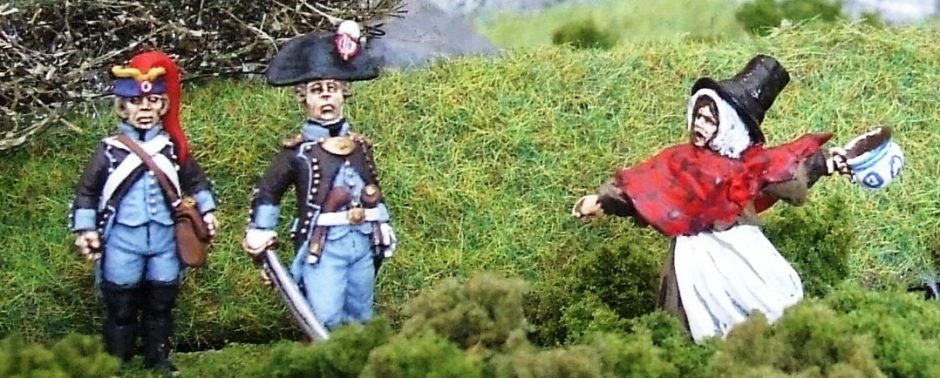
 Above: ‘Old Rosie’ has attracted some admirers from the local civilian population.
 Above: A young staff officer salutes a ‘Southern Belle’…
 Above: “Oh God, on second thoughts…”

 Above: Thomas’ divisional commanders: Rousseau (1st Division) and Negley (2nd Division). Fry‘s 3rd Division was largely absent, though elements intervened in the latter stages of the battle.

 Above: McCook’s divisional commanders: Davis (1st Division), Johnson (2nd Division) and Sheridan (3rd Division).

 Above: Crittenden’s divisional commanders: Wood (1st Division), Palmer (2nd Division) and Van Cleve (3rd Division). Van Cleve had a particularly striking ‘badger’ beard, which was fun to replicate.
  Above: I’ve also painted some more Union artillery. God I hate painting limbers…
 Above: And I’ve also painted three more brigades of Union infantry. I’ve still got another four guns and sixteen bases of infantry left to fo for the Union side, but should have those finished by this time next week. Then I’ve got about thirty bases of Confederate infantry to paint, plus a load of Western-specific infantry command stands and mounted commanders.


 I’m using two thicknesses of polystyrene board; the base-boards are 20mm thick and the top-layer is 10mm thick. I cut the rivers out of the 10mm boards and then glue them onto the baseboards using PVA glue:
 It needs to be emphasised at this point that this is a job that requires a lot of space and can get VERY messy! Thankfully we’ve had a long period of unseasonably dry and warm weather here in normally-soggy Wales, so I was able to do it all in the garden. Mrs Fawr very unkindly took some photos of me in action and clearly photoshopped out my hair (obviously)…
 Oh and I had ‘help’…
 After ungluing the dog, the next stage was to mark out the position of roads, railway and hills:
 Then the messiest stage of all; cutting out the hills, smoothing them off with a sanding-block, gluing them on to the boards and then using the sanding-block to carve out the roads and fords:
 The next stage will be some terrain-detailing in the form a rocky outcrop (the ‘Slaughter Pen’) in the centre of the table and some hasty Confederate breastworks. Once those are done I’ll paint the whole board with PVA and coat it in fine sand for a bit of texture (I find that it also adds toughness and rigidity to the boards) before painting and flocking.
 Lastly, I’ve painted a command base for Morton’s special Pioneer Brigade (posed here with some of the infantry from the last photo). This brigade was formed from the massed regimental pioneers from all the regiments of the Army of the Cumberland. The Pioneers didn’t carry regimental colours, but a flag (probably the brigade headquarters flag) is recorded for them later in the war and that’s good enough for me…
 With the glorious weather now starting to break, I’m very pleased to report that the biggest terrain jobs are now complete. As the weather gets colder and wetter I can do all the painting and flocking indoors, one board at a time. However, the initial cutting, carving and gluing phase always needs a lot of space in order to lay out the full map and check the alignment of roads and rivers, but that’s now done! 🙂
 As discussed
  In
In  Above: I’ve now completed the three battalions of Wissembach’s Brigade, which formed the second line of the Prince of Anhalt’s 4th Column at Minden, so here’s the whole formation in all its glory. Scheele’s Brigade (which I covered in
  Above: Prince Carl Leopold of Anhalt-Bernburg is commonly referred to as the ‘Prince of Anhalt’ in most English language accounts, which leads to all sorts of confusion, as there were seemingly dozens of princes of various branches of the Anhalt family (the House of Ascania), including one who at Minden was commanding a brigade on the French side! Prince Carl Leopold of Anhalt was also known by his family name of
  Above: Prince Carl Leopold of Anhalt-Bernburg held a commission in the Army of Hessen-Kassel and was Chef of the
  Above: Wissembach’s Brigade. This consisted of three single-battalion infantry regiments; the
  Above: The
  Above: The
  Above: The
  Above: The
  Above: The rear of the
  Above: The
  Above: The
  Above: The
  Above: The grenadiers of the
  Above: The
 Above: The
  Above: A rear view of the
  Ab0ve: Wersabé’s Hanoverian Grenadier Battalion (shown on the right) forms up alongside Maxwell’s British Grenadier Battalion (shown on the left). As discussed in
  Above: Hanoverian Grenadier Battalion ‘Wersabé’. As mentioned previously, Hanoverian grenadiers battalions of the first half of the war were ad hoc affairs, formed from whatever was available on a given day. They were therefore of extremely variable strength and composition and this is therefore a conjectural wargames unit, comprising a figure from each of the six line regiments painted thus far, plus another six selected at random from the nine other regiments present at Minden. It’s possible that all fifteen regiments were represented and a large 16-figure unit might therefore be more appropriate, but I’ve kept it as a conservative 12-figure unit.
 Above: Hanoverian Grenadier Battalion ‘Wersabé’. From 1759, the Hanoverians formed three permanent Grenadier Battalions at the start of each campaign, though these proved to be rather weak (roughly half the strength of a line infantry battalion), so in 1760 the strength was fixed at 500 men per battalion. In 1762 a massive increase in the strength of each regiment’s grenadier company enabled an increase to six grenadier battalions.
 Above: A rear view of Hanoverian Grenadier Battalion ‘Wersabé’.
 Above: The military-minded
 Above: The
  Above: By sheer luck, just as I was painting the
 I’m not sure if

 Last time I used 25mm thick base-boards, with 12mm thick boards glued on top, but this time I’m going with 20mm base-boards and a 10mm top-layer, then more 20mm boards to make the hills.
  Although the battlefield wasn’t covered in snow, it was still very much a winter battlefield, being fought on New Year’s Eve. I’m therefore going to use muted, wintry/dead shades of
  I’m also going to use a lot of bare tree armatures (again by Woodland Scenics) for the woodland. Instead of using bases, the trees will be ‘impaled’ on sewing needles and these can then be stabbed into the terrain-boards. This doesn’t damage the boards and does look very effective, as the trees blend seamlessly into the terrain, as can be seen in this shot of the Cassinga game:
 In terms of troops, I’m using my own collection of
  Strictly speaking, both sides would have been very much in ‘winter mode’, with the Union troops in particular being equipped with greatcoats, as shown in the picture above. The Union Army in the Western Theatre also tended to wear slouch-hats alongside the ‘classic’ peaked blue forage caps, which can also be seen above. However, I don’t plan to make specific ‘winterised’ or ‘westernised’ armies, as that way lies madness, so my existing troops will have to do!
  That said, as my existing Confederate army is geared toward the Army of Northern Virginia at Gettysburg, the flags are almost all of the classic Confederate ‘Battle Flag’ type, which was hardly used in the Western Theatre at this time. I’m therefore making a stack of new brigade command stands, divisional leaders and corps leaders for my Confederates, featuring the
  My Union regiments don’t need any alternate flags, though I am going to make a new command stand for Morton’s special Pioneer Brigade, featuring a blue & white flag with crossed axes that was recorded as being used by the Pioneers of the Army of the Cumberland some time later (below).
 In terms of senior commanders, I need a Union army leader base for General
  I’d also like to do some theatre-specific Union corps and divisional leader stands, but the organisational history is slightly complicated and the details of flags are pretty vague. Here’s all the information I’ve got…
 XXI Corps was known to be using a system of red, white and blue horizontally-striped flags by September 1863. The Corps HQ flag had a black eagle in the centre with ’21’ in a shield on the eagle’s breast (right). The three divisional HQs didn’t have the eagle, but instead had either one, two or three black stars near the hoist. The corps HQ flag had a gold fringe, while the divisional HQ flags did not have a fringe.
 As mentioned recently, I’m presently building a British-Hanoverian-German Allied army for the Seven Years War, using the order of battle for the
  Button and Lace Colouring: In the British Army, only the officers (and sometimes the NCOs) followed the regimental ‘metal’ colour; either silver or gold. The rank-and-file always had white metal buttons and white hat-lace, regardless of regimental ‘metal’, while the coat-lace followed a regimental pattern and colouring, which was often quite intricate. In the Hanoverian Army, the buttons of all ranks followed the regimental ‘metal’ colour and the other ranks’ lace on both hat and coat was either plain yellow or white accordingly.
 Waistcoat: British waistcoats were invariably coloured red and were heavily laced, but Hanoverian waistcoats were usually coloured to match the regimental facing colour and in 1759 they removed all the lace. A few Hanoverian regiments (mainly those with black facings) had waistcoats of a different colour.
 Equipment: Personal equipment was much the same as the British, consisting of a pale buff leather cross-belt buckled at the front, a buff waistbelt and a black cartridge box. However, unlike the British, all companies were armed with a ‘hanger’ (short sword) and not just the Grenadiers. They also don’t appear to have used belly-boxes like the British, which is a pain when using Eureka British figures!. The lack of a hanger on the figures isn’t obvious, but the belly-box is impossible to hide and I just have to live with it. However, Hanoverian muskets were banded, so the wrongly-banded musket on Eureka’s British infantry actually fits! 🙂
 Officers’ & NCOs Distinctions: Hanoverian officers followed the general theme described above, though with expensive metallic gold or silver lace. A yellow sash was worn over the right shoulder and a gorget was worn at the throat (which was gold for all regiments). Hanoverian officers would also be clean-shaven, while the rank-and-file (unlike the British) had moustaches. Hanoverian NCOs didn’t wear sashes like their British counterparts, but wore straw-coloured gloves and carried polearms as their ‘badge of office’.
 Above: The
  Above: The
  Above: A rear view of the
  Above: The
  Above: As discussed above, the
  Above: A rear view of the
  Above: A Grenadier of the
  Above: The brigade of Major General Johann Daniel Victor von Scheele (also spelled ‘Schele’ in many sources) formed the first line of the 4th Column, which was in turn commanded by Lieutenant General Prince Carl Leopold of Anhalt-Bernburg. The brigade consisted of three Hanoverian infantry regiments; ‘Scheele’, ‘Reden’ and ‘Hardenberg’. However, as mentioned above, the ‘Hardenberg’ Regiment somehow managed to get itself entangled with Spörcken’s column during the approach march and was sucked into Spörcken’s attack.
  Above: The
  Above: The
  Above: A rear view of the
  Above: A Grenadier of the
  Above: The
  Above: The
  Above: The
  Above: A Grenadier of the
  Above: The
  Above: The
  Above: The
  Above: A Grenadier of the
 As mentioned last time, we recently had a playtest of ‘Tricorn’ (my Seven Years War variant of ‘Shako’ Napoleonic rules). I decided to go for
  I particularly wanted to test an idea for abstracting battalion guns in the game. This works by increasing the firepower of musketry (4, 5, 6 to hit in Shako terms) while reducing the movement speed for any unit accompanied by a battalion gun (from 4 inches to 3 inches per turn when in line formation).
 The incorporation of the ‘winner losses’ rule meant that even élite cavalry would eventually be worn down by repeated charges and could then become vulnerable to the injection of fresh enemy cavalry into the fight. Additionally for campaign purposes, players were more inclined to keep a portion of their cavalry fresh and in reserve to conduct post-game pursuit of the defeated enemy. However, Phil and Mike were not over-keen to adopt this concept and were happy with the existing rules for cavalry becoming ‘blown’ for a turn after combat, so I agreed to play the rules as written and see how it panned out.
 Above: The bulk of the Austrian infantry were deployed in ‘ambush’ positions on the left wing, behind the walled parkland, ornamental lakes, fishponds, boggy streams and reed-beds along the valley from Sullowitz to Lobositz.
 Above: Another view of the Austrian left wing. Löwenstein’s powerful cavalry wing is just off-table, though could be immediately brought on to table (in two columns) once an ADC delivered orders to Löwenstein, whose figure is visible on the table-edge, behind the far flank of the infantry.
 Above: The Austrian right wing consisted of a number of infantry regiments under the command of Wied, plus four grenadier massed battalions, a position battery with pitifully-few heavy guns and Lacy’s recently-arrived division.
 Above: A closer look at Lacy’s command, plus two of the four grenadier battalions.
 Above: A detachment of the Karlstädter-Lykaner Grenzer skirmishes forward of Lacy’s main line.
 Above: Radicati’s Austrian cavalry division forms up behind the sunken road to the west of Lobositz.
 Above: Hadik’s Advance Guard Division (wrongly assumed by Frederick to be a rearguard covering the Austrian retreat), consisting of the massed Carabinier (élite Cuirassier) and Horse Grenadier (élite Dragoon) Companies plus the Hadik and Baryany Hussar Regiments, forms up on the plain and is immediately taken to task by Kyau’s Prussian cavalry, who have been ordered to mount a reconnaissance in force into the valley.
 Above: Draskowitz’s Grenzer, reinforced by some grenadier companies and Hungarian volunteers, harass the left flank of the Prussian army from the steeply-sloped vineyards of the Lobosch. Frederick is forced to send Bevern with several regiments to eject the Grenzer from the mountain.
 Above: The view from behind the Prussian centre. As Bevern begins his ascent of the Lobosch on the left, Kleist’s infantry deploy into line, while Schwerin and Katzler deploy their cavalry.
 Above: As Kleist’s line advances past Frederick’s headquarters at Wchnitz, four batteries of heavy guns follow him down the road. On Kleist’s right, Prince Ferdinand of Brunswick deploys the rest of the Prussian infantry as two more heavy batteries open fire from the Homolka Spur.
 Above: Attended by his staff, Frederick awaits news of the cavalry clash.
 Above: As his few heavy guns open fire on the approaching Prussians, Browne sends an aide with orders for Radicati to support Hadik. A second aide is dispatched with orders for Löwenstein to bring his cavalry to the centre with great haste! Neither ADC was seen again and the cavalry remained unmoving… More ADCS were dispatched…
 Above: Feldmarschall von Katte deploys…
 Above: And so it begins… Hadik and Kyau clash on the plain.
  Above: Kyau has a massive advantage in terms of quality and quantity and with Radicati’s cavalry still stationary behind the sunken road, Hadik doesn’t fancy his chances against the mass of Prussian cuirassiers!
  Above: On the Prussian left, the battle is initially even between the Prussian Gelbe-Reitere (so-called due to wearing dark yellow coats instead of the usual pale straw colour) and the massed Austrian Carabinier companies, but the Carabiniers eventually fall back. Next to them, the massed Austrian Horse Grenadier companies fare badly against the ‘Rochow’ Cuirassiers led by their talented Colonel, Friedrich Wilhelm von Seydlitz. The ‘Baryanay’ Hussars are similarly beaten off by the Prussian Leib-Carabiniere. So Round 1 goes to the Prussians.
 Above: But what’s this?! Having not been engaged in the initial combat, Hadik’s own regiment, the ‘Hadik’ Hussars charge alone and unsupported against the Leib-Carabiniere, who are blown following their combat against the ‘Baryanay’ Hussars!
 Above: Astonishingly, the ‘Hadik’ Hussars throw the Leib-Carabiniere back in disorder! In their panic, the fleeing Prussian horsemen disorder the ‘Bayreuth’ Dragoons and the ‘Hadik’ Hussars use the confusion to retire back to the safety of their own lines.
 Above: On the opposite flank, Bevern’s infantry come under intense skirmisher fire from the Grenzer hidden among the vines, rocks and stone walls on the steep slopes of the Lobosch. However, casualties are remarkably light.
 Above: Waiting behind the skirmishing Grenzer is a stronger line of formed troops. Draskowitz has placed his strongest element, the combined companies of grenadiers and Hungarian volunteers, in the centre with Grenzer formed on the flanks. The position is very strong and Draskowitz is optimistic that he might be able to hold the position, or at least inflict significant damage on the Prussians.
  Above: As the battle rages on their flank, Kleist pushes forward onto the plain as the guns move up, ready to deploy and bombard the waiting Austrian line.
 Above: Frederick watches as the battle for the Lobosch unfolds. He is alarmed that he has misread the situation and that the Austrians now seem to be making a stand, though is confident that they would crumble in the face of his army, just as they had in the last war.
 Above: On Frederick’s right, Moller’s battery on the Homolka Spur hammers away at the Austrian battery, but to little effect.
 Above: Katzler’s Prussian cavalry division forms column to the right and moves around the back of Wchnitz and the Homolka. Descending through the saddle and into the plain, Schwerin is intending to follow his orders and move across the plain (cleared by Kyau) to engage the Austrian battery and the left flank of Wied’s Austrian infantry. However, Kyau has not yet cleared the plain…
 Above: As its supporting artillery opens fire on the approaching Prussian cavalry, the Austrian left wing waits for orders… Two ADCs can be seen galloping over the bridge on the west side of Lobositz, yet both fail to reach their destination… A suspicious-looking group of Grenzer deny all knowledge, yet are sporting very nice new pelisses…
 Above: Hadik’s cavalry mill around blown following their previous combats and are in danger of being swept away by the freshly-rallied Prussian cuirassiers.
 Above: However, the Austrian gunners earn their pay as they ignore the incoming fire from the Homolka and accurately bounce some round-shot through the Prussian cuirassiers, stalling their advance.
 Above: Things are about to get very hot for the Austrians, however…
 Above: With the Gelbe-Reitere damaged by Austrian guns, the Austrian Carabiniers charge again and throw back the yellow-coated Prussian horsemen, who rally at the foot of the Homolka, disrupting Prince Ferdinand’s attempts to get his infantry into some semblance of order! The Prussian ‘Rochow’ Cuirassiers meanwhile, utterly rout the Austrian Horse Grenadiers, though this remains the only bright spot for the Prussians at this time, as the heroic Austrian hussars throw back the combined unit of Gensd’armes and Garde du Corps and completely crush the 2nd Battalion of the ‘Bayreuth’ Dragoons!
 Above: On the Lobosch, Bevern’s Prussian infantry finally engage Draskowitz’s main line, though casualties are now starting to mount. The Grenzer skirmishers have fallen back, though continue to be an irritant.
  Above: Schwerin’s division of Dragoons and Hussars follows Katzler onto the plain. Katzler has formed his cuirassier division into line near Sullowitz, though is waiting for Kyau to clear away Hadik’s cavalry!
 Above: On the Lobosch, Bevern has decided to go in with the bayonet rather than engage in a fruitless firefight. However, his supporting battalions are too far to the rear to provide any meaningful support and the centre battalion (1st Battalion of the ‘Kleist’ Musketeers) is beaten off with heavy losses by the Austrian grenadiers and Hungarian volunteers.
 Above: However, the 2nd Battalion of the ‘Kleist’ Musketeers defeats a battalion of the Karlstädter-Lykaner Grenze and the other Grenzer are starting to waver in the face of determined Prussian attacks.
 Above: Having pushed well forward of the flanking divisions, Kleist completes his orders and halts his infantry as the heavy guns deploy within effective range of Wied’s line.
 Above: Down on the plain, the cavalry battle continues. The Austrian Carabiniers have pushed too far and are charged by the vengeful Gelbe-Reitere. The Carabiniers are broken, but Hadik’s astonishing run of luck continues as the ‘Baryanay’ Hussars throw back the ‘Rochow’ Cuirassiers!
  Above: As the hussars fall back to rally yet again, Hadik (who has now suffered in excess of 50% losses) somehow manages to keep his division in the battle, though his men are now demoralised!
  Above: The carefully-ordered lines of cavalry from the start of the battle are only a distant memory as the Prussians try to re-order their lines amid the chaos!
 Above: Katzler’s cuirassiers have also now become embroiled in the swirling cavalry battle. Schwerin’s cavalry also now attempt to deploy onto the plain, but rallying cavalry keep getting in the way.
 Above: It’s not only the cavalry… Prince Ferdinand of Brunswick’s infantry have become utterly disordered by the combined effects of terrain and stampeding cavalry.
 Above: Back on the Lobosch, Bevern’s aggressive tactics have finally broken Draskowitz’s defenders. However, it wasn’t without cost, especially in the ‘Kleist’ Musketeers. Although the Grenzer have been beaten off, Bevern still has to fight his way through the difficult terrain of the Lobosch, so it’s going to be some time before his division can join the main attack.
 Above: Draskowitz’s boys run for it! They had hoped for support from Lacy or Wied, but that support was not forthcoming, due to yet more Austrian command and control problems!
 Above: As Kleist waits for the flanking divisions to move up, his heavy guns hammer Wied’s Austrians. In the distance, Moller’s battery on the Homolka has ceased fire and Moller is moving his guns forward, to more closely support the attack.
 Above: Here they come again! As the Austrian ‘Erzherzog Joseph’ Dragoons charge the ‘Bayreuth’ Dragoons frontally, the indefatigable ‘Hadik’ Hussars strike yet again at the left flank of the Prussian Leib-Carabiniere.
 Above: The view from the Austrian side: The green-coated ‘Erzherzog Joseph’ Dragoons clash with the Prussian Dragoons. The ‘Cordua’ and ‘Stampach’ Cuirassier Regiments finally cross over the sunken road to provide support.
 Above: The view a short while later: Prince Ferdinand’s attempts to get his infantry into some semblance of order are frustrated yet again by Kyau’s recoiling cavalrymen!
  Above: The view from the other side of the cavalry battle: The Gensd’Armes and Garde du Corps, having destroyed the newly-arrived Austrian ‘Cordua’ Cuirassiers, are rallying behind Katzler’s fresh cuirassier regiments and the ‘Bayreuth’ Dragoons.
 Above: Pulling back, we can see Radicati’s remaining regiments; the ‘Erzherzog Joseph’ Dragoons and the ‘Stampach’ Cuirsassiers rallying at the sunken road, along with the ‘Baryanay’ Hussars, following their successful charges against the Prussian horse. However, the ‘Cordua’ Cuirassiers have been swept from the field, Löwenstein is still refusing to move from the left flank and there are still an awful lot of Prussian cavalry on the plain!
 Above: The heroic ‘Hadik’ Hussars, having rallied behind the Lobositz battery, charges yet again! Kyau’s Prussian cavalry are demoralised and the Gelbe-Reitere are rallying and have already taken heavy casualties. They are completely swept away by the hussars’ charge!
 Above: Further mêlées on the plain see the Prussian ‘Markgraf Friedrich’ Cuirassiers and ‘Brandenburg’ Dragoons thrown back by the determined Austrian counter-attacks, but the fresh Prussian Leibregiment zu Pferde (here on the left) destroys Radicati’s remaining regiments, leaving the ‘Baryanay’ Hussars feeling very lonely…
 Above: The ‘Hadik’ Hussars rally behind Browne’s headquarters at Lobositz. At this moment an ADC gallops past to inform Browne that Löwenstein’s cavalry is at last on the move! However, it’s still going to take some considerable time for the Austrian horse to move from the extreme left flank to the centre.
 Above: With only Hadik’s two weakened hussar regiments left to oppose them, the (mostly) fresh divisions of Katzler and Schwerin can now comply with their orders and engage the left flank of Wied’s line in front of Lobositz.
 Above: Although the ‘Alt-Dessau’ Musketeers are still being arsed about by the milling horsemen, the rest of Prince Ferdinand’s division has finally got itself into some semblance of order and is advancing on Wied. The grenadiers of Ferdinand’s second line have shifted position to the left and have turned back into line formation (the arrow markers have been removed). They will now move forward to provide support to Prince Ferdinand’s own regiment in the first line. The 3rd Battalion of the ‘Alt-Dessau’ Musketeers is similarly shifting to the left, to provide rear-support to the single battalion of the ‘Zastrow’ Musketeers.
 Above: On the left flank of Prince Ferdinand’s first line, the ‘Hülsen’ Musketeers have crossed over the stream to link up with Kleist’s division on their left. Behind them and just out of shot, the ‘Quadt’ Musketeers have also crossed over the stream and are moving up to provide rear-support. Seeing the artillery deploying near the culvert, Wied shifts the fire of his artillery onto that point, doing nothing to the Prussian guns, but inflicting casualties on the ‘Zastrow’ Musketeers as the Austrian roundshot bounces through their line.
 Above: On the Austrian right, Wied’s and Lacy’s infantry remain unmoving as orders fail to get through, despite the short distance from Browne’s headquarters! [Phil’s luck in dice-rolling for the hussars was definitely cancelled out by his dice-rolling for the ADCs!] Wied’s infantry have been hammered hard by the Prussian guns, but now the guns start to fall silent as Kleist resumes his advance and Bevern finally emerges from the vineyards of the Lobosch.
 Above: On the Austrian left, the bulk of the whitecoats remain unmoved (quite literally) by the cavalry battle in front of them. To their rear, Löwenstein’s cavalry had started to move, but it was all too late.
 At long last, I’ve had a game and not just with myself!!! 🙂
 The original version of Shako actually included a Seven Years War variant, but I didn’t like it at all and so wrote my own. I dug it out again last year following a Napoleonic game with Phil using


 As the fog started to disperse, a few Austrian cavalry could be seen on the plain. Frederick immediately assumed that Browne must be in retreat and that this was his rearguard. General Kyau was ordered to take his cavalry, along with that of General Katte, and mount a reconnaissance-in-force, to clear away the rearguard and locate Browne’s main body.


 The Austrian Army – Feldmarschall von Browne
 Terrain Effects
 Deployment & Fog Of War
 Sorry for the sparsity of posts over the last few weeks. Mrs Fawr has been cracking the whip… 🙁 Thankfully however, my rate of painting has been maintained and I’ve been making good progress on my new ‘Western Allied’ army for the Seven Years War, starting with the British.
  I always like to use a historical order of battle as a ‘To Do’ list, so I arbitrarily picked the order of battle for the
  Above: At Minden, the British infantry battalions were grouped in two brigades under the command of Major Generals Waldegrave and Kingsley, along with the two battalions of the Hanoverian
  Above:
  Above: Lord von Spörcken. I couldn’t find information on Hanoverian infantry officers’ horse furniture, but assumed that it followed the British pattern of being coloured according to the regimental facing colour and then edged in the regimental ‘metal’ colour.
 Above: Waldegrave’s Brigade at Minden. This brigade formed the first line of Spörcken’s command and consisted of the
  Above:
  Above: 12th Regiment of Foot (Napier’s). Note that the tail-pockets were edged with the regimental lace and the cuffs had a ‘ladder’ of buttonhole lace running up the lower sleeve. This was the most common arrangement of lace on British infantry uniforms. Note also that the 12th curiously didn’t use ‘reversed colours’ (i.e. a yellow coat with red facings) for its drummers and instead issued them with a red coat, albeit with ‘false’ sleeves on the back and extra lace decoration on the sleeves.
 Above: The Grenadier Company of the 12th Regiment of Foot (Napier’s). The grenadiers were almost always separated from their parent regiment on campaign, so they’re unbased here, awaiting basing with the rest of Maxwell’s Grenadier Battalion (see below). Although the actual role of grenade-lobbing was long gone, the traditional and distinctive items of grenadier dress; the brass match-case on the cross-belt, the ornately decorated mitre cap and the basket-hilted short sword were still worn. Lace ‘wings’ had also been added to the shoulders during the 1750s.
 Above:
  Above: 37th Regiment of Foot (Stuart’s). Like the 12th Foot, the drummers of the 37th did not wear reversed colours and instead wore red coats with yellow facings, though decorated with additional lace on the sleeves. Note that British drummers of all companies wore a mitre cap that was very much like that of the grenadiers, though was a few inches shorter and lacked the tuft on the top. They also sometimes had a different embroidered design on the front, though I’ve gone with the usual ‘GR’ cypher here. Many of these cap designs are not known, though a design showing ‘piled trophies’ was popular.
 Above: The Grenadier Company of the 37th Regiment of Foot (Stuart’s). The grenadiers of the 37th wore a cap very similar to those of the 12th above, with cypher and foliage embroidered in red. However, the regimental number ’37’ was embroidered on the rear band in Arabic rather than Roman numerals and the back lacked the embroidered ‘flames’. Note also the ‘hat company’ Sergeant, carrying a pole-arm and wearing a sash around his waist. The Sergeants’ pattern of sash was crimson with a central facing-coloured stripe.
 Above:
  Above: 23rd Regiment of Foot (Royal Welch Fusiliers). The 23rd wore blue facings and as a Royal regiment also had blue breeches, though waistcoats remained red. The regimental lace was white with thin black and red lines, though again, I’ve just painted it plain white. The 23rd were one of the few regiments authorised to wear an ‘ancient badge’, in this case the three feathers of the Prince of Wales. For the battalion companies, this was flanked by yellow foliage and the ‘flap’ seems to have been in the facing colour. The detached grenadier company (not shown here) seems to have had a red flap and white foliage, as well as a grenade-shaped tuft. Officers’ mitres were invariably embroidered with expensive metallic thread and as a consequence were usually replaced by hats in the field (but that’s boring…).
 Above: 23rd Regiment of Foot (Royal Welch Fusiliers). The 23rd had lace ‘ladders’ on the lower sleeves and lace edging to the tail pockets. The regiment’s drummers meanwhile, wore Royal Livery, which was a red coat, faced with blue and heavily decorated with golden-yellow lace with thin lines of purple running through it (I’ve just painted it yellow).
 Above: 23rd Regiment of Foot (Royal Welch Fusiliers). The 23rd’s mitre caps were decorated with the regimental number ’23’ in Arabic numerals. Note also that the battalion companies lacked the shoulder wings of the grenadier company (these would be added in later years, but were not a feature of the uniform at this time).
 Above: The Hanoverian
  Above: Kingsley’s Brigade formed the second line of Spörcken’s command at Minden, though the intense nature of the fighting during the French cavalry attack meant that they had no better a time of it than Waldegrave’s Brigade. The brigade again consisted of three British infantry battalions; the 20th Foot (Kingsley’s) on the right, the 51st Foot (Brudenell’s) in the centre and the 25th Foot (Home’s) on the left.
 Above:
  Above: 20th Regiment of Foot (Kingsley’s). The tail pockets were edged with lace and the lower sleeves had the ‘ladder’ design. On this occasion the regimental drummers wore reversed colours.
 Above: The Grenadier Company of the 20th Regiment of Foot (Kingsley’s). Again, the 20th used the ‘GR’ cypher as their badge, but the embroidery colour is not recorded, so I’ve gone with black to make it stand out from the pale yellow and look a bit different from the others. The back of the cap was once again decorated with the regimental number and both the Roman ‘XX’ and Arabic ’20’ are recorded, so I’ve gone with ‘XX’.
 Above:
  Above: 51st Regiment of Foot (Brudenell’s). The lace colour for the regiment was generally white, though the exact pattern of lace is unknown. Again, this regiment had lace edging to the pockets and ‘ladders’ on the sleeves. The regimental ‘metal’ colour was white and the drummers wore reversed colours.
 Above: The Grenadier Company of the 51st Regiment of Foot (Brudenell’s). Again, this regiment wore the ‘GR’ cypher as it’s badge, this time embroidered in white and flanked by white foliage. The rear band was decorated with the Roman numeral ‘LI’.
 Above: 25th (Edinburgh) Regiment of Foot (Home’s). This regiment had ‘deep yellow’ facings and white ‘metal, though the officers’ gorgets were gold. The regimental lace was white, though edged with thin lines of dark blue, yellow and red. The ‘deep yellow’ shade is difficult to pin down, though it’s also described as ‘almost buff’. That said, I’ve studied surviving samples of the facing cloth and it doesn’t look any different to the yellow of the 12th or 37th.
 Above: 25th (Edinburgh) Regiment of Foot (Home’s). Again, the 25th had lace edging to the pockets and a ‘ladder’ pattern on the lower sleeves. The regiment’s drummers wore reversed colours.
 Above: The Grenadier Company of the 25th (Edinburgh) Regiment of Foot (Home’s). Again, this regiment used the ‘GR’ cypher as it’s badge, this time embroidered in white and flanked by white foliage. The rear was decorated with the regimental number, though both ‘XXV’ and ’25’ are recorded. I’ve gone with ‘XXV’.
 Above: Maxwell’s Grenadier Battalion. The grenadier companies of the six British infantry battalions were detached and grouped as a combined grenadier battalion under the command of one Major Maxwell and were brigaded with Hanoverian, Hessian and Brunswicker grenadier battalions as part of Wangenheim’s Corps on the left flank.
 Above: Maxwell’s Grenadier Battalion. Note that I made a mistake with the ordering of the regiments here. I’ve lined them up in the usual order of seniority for most nations; the senior regiment (12th) on the right and the junior (51st) on the left. However, I completely forgot that the British alternated seniority by flank, starting with the most senior on the right flank, but then having the second most senior regiment on the left and then alternating on each side, with the most junior in the middle! The order from the right flank to the left flank should therefore be 12th, 23rd, 37th, 51st, 25th, 20th.
 Above: Maxwell’s Grenadier Battalion. When the reinforcement wave of a further six regiments arrived (5th, 8th, 11th, 24th, 33rd & 50th), a second grenadier battalion was formed. However, all twelve regiments were apparently mixed up and I can’t for the life of me discover how they were mixed. I’ll probably just create a new battalion using the six new regiments. The grenadiers of the two Highland regiments (87th and 88th) remained with their regiments. The three Foot Guards battalions sent to Germany massed their grenadier companies in a half-strength Guards Grenadier Battalion of only three companies.
 Following my recent, though blessedly brief descent into olive-drabness, I’ve now recovered my senses and am feeling much better now, thanks for asking!
 I dedicated the month of April to painting nothing but French cavalry and managed to get 60 of them done; four 12-figure brigades of Chevauxlégers and one 12-figure regiment of Dragoons. These are all 18mm figures by
  I’ve only given an officer, standard-bearer and trumpeter to one regiment in three (the senior regiment in each brigade, based on the order of battle for the
  It’s worth mentioning at this point that the bulk of France’s cavalry arm were referred to as ‘Chevauxlégers’ meaning ‘Light Horse’ or ‘Cavalerie Légère’ meaning ‘Light Cavalry. However, these terms are misleading. French Chevauxlégers of the time were very much heavy cavalry, fighting in the line of battle, riding heavy horses and often wearing a cuirass under the coat and an iron skull-cap under the hat. The term was a historical one dating back to mediaeval times, differentiating the relatively lightly-armoured retainers from the fully-armoured Gendarmes (knights). That said, the ‘light’ part of the title was falling out of use during this period, with ‘Cavalerie’ often being used (though not formalised until 1791). Nevertheless, I have seen figure manufacturers list these in their catalogues as ‘light cavalry’ due to their misunderstanding of the terminology, so it can be rather baffling when you are collecting a SYW French army!
 Above: The ‘La Reine’ Brigade at Rossbach was formed from the ‘
 Above: The ‘La Reine’ Brigade. The ‘Bourbon-Busset’ and ‘Fitz-James’ Regiments both had royal blue saddlery, while ‘La Reine’ had red. The lace edging for ‘La Reine’ was blue with a white chain pattern, while that of ‘Bourbon-Busset’ was blue with a yellow chain pattern and ‘Fitz-James’ had a green & white check pattern. ‘La Reine’s shabraque and holster-covers were decorated with a yellow fleur-de-lys badge.
 Above: The ‘La Reine’ Brigade. As mentioned above, I’ve only done command figures for the senior regiment in each brigade. Consequently the standard here is that of the ‘La Reine’ Regiment, having a red field scattered with small fleurs-de-lys, the Queen’s crowned cypher in each corner and emblazoned with the universal sun motif and white scroll bearing the motto ‘Nec Pluribus Impar’, edged with a fringed of mixed silver and gold threads. Staves always resembled a tournament lance and were usually coloured to match the standard’s field colour, though royal blue was also common. The trumpeter wears the Queen’s livery, which was essentially the reverse of the King’s livery, being a red coat with blue facings and heavily laced in a blue & white chain pattern. French cavalry musicians commonly rode greys.
 Above: The ‘Bourbon’ Brigade at Rossbach was formed from the ‘
 Above: The ‘Bourbon’ Brigade. Saddlery was royal blue for all three regiments. The lace edging for the ‘Bourbon’ Regiment was white with two crimson stripes, speckled white. ‘Beauvilliers’ had yellow lace with a red chain pattern. The ‘Volontaires-Liègeois’ had plain yellow lace, though the shabraque and holster-covers were decorated with three fleurs-de-lys arranged in a triangle, with a crown above.
 Above: The ‘Bourbon’ Brigade. Again, I’ve only done command figures for the lead regiment, namely the ‘Bourbon’ Regiment. ‘Bourbon’s trumpeters had yellow-buff livery with crimson facings, white buttonhole lace and crimson saddlery with white lace edging. ‘Bourbon’s standard was of the ‘stock’ pattern, featuring the sun motif with white ‘Nec Pluribus Impar’ scroll above, surrounded by a wreath and four fleurs-de-lys. The field colour was blue.
  Above: The ‘Lusignan’ Brigade at Rossbach was formed from only two units, the ‘
 Above: The ‘Lusignan’ Brigade (plus ‘Montcalm’ Regiment). All three regiments had royal blue saddlery. ‘Lusignan’ had lace consisting of alternating yellow and blue squares, while ‘Descars’ had red & yellow checked lace and ‘Montcalm’ had a red and green check pattern.
 Above: The ‘Lusignan’ Brigade (plus ‘Montcalm’ Regiment). ‘Lusignan’ carried a standard which had a white field on the obverse side with the ‘stock’ golden sun design. The reverse had a plain red field with a white scroll carrying the motto ‘Nec terrent, nec morantur’. The livery for ‘Lusignan’ is not known, so I’ve gone with a grey-white coat and saddlery (to match the white field of the standard), decorated with the blue & yellow regimental lace.
 Above: The ‘Penthièvre’ Brigade at Rossbach consisted of the ‘
 Above: The ‘Penthièvre’ Brigade. All three regiments had royal blue saddlery. The ‘Penthièvre’ Regiment had blue lace edging with a central yellow stripe, while ‘Bussy-Lameth’ had violet lace with a buff central stripe and ‘Saluces’ had white lace with red edging and a red chain pattern.
 Above: The ‘Penthièvre’ Brigade. The ‘Penthièvre’ Regiment had red standards, with the obverse side being of the ‘stock’ pattern and the reverse showing Bellerophon mounted on Pegasus, with a white scroll above, bearing the motto ‘Terraque, marique’. The regiment’s musicians wore red livery, decorated with the regimental lace.
 Above: The ‘
 Above: The ‘Apchon’ Dragoon Regiment. Most French Dragoon regiments at this time wore red coats, with a few wearing blue. The coat lacked lapels but was heavily decorated with white buttonhole lace for all regiments. The waistcoat would be coloured to match the coat or the facing colour and was also heavily laced in white. Headgear was either a tricorn or the traditional French Dragoon’s ‘Pokalem’ stocking-cap. Instead of tall cavalry boots, Dragoons wore infantry-style gaiters in black.
 Above: The ‘Apchon’ Dragoon Regiment. All Dragoon regiments carried swallow-tailed guidons. Those of the ‘Apchon’ Dragoons were green and decorated with the golden sun and a red scroll with the motto ‘Nec pluribus impar’.