
 Back in the primordial soup of this blog, one of my first Wellingtonic game reports was of a refight of the Battle of Salamanca, played at W.A.S.P. in 2016.
Although that article appears in my list of Napoleonic Scenarios, it really was only the most cursory outline scenario and didn’t even include a map, let alone all the labels and other gubbins that are useful for playing the game, so my remaining reader really does deserve better than that rather poor effort. I’ve also done more reading since then, so here then, is a rather more refined version of the Salamanca scenario.
As usual, this scenario is designed for Napoleon’s Battles rules, which is a ‘grand tactical’ set, where each unit represents a brigade or large regiment and the man-to-figure ratio is roughly 1:100 (to be exact, it’s 1:120 for infantry and 1:80 for cavalry). It would however, be relatively easy to convert to similarly-scaled systems such as Age of Eagles or Général d’Armée.
Someone recently asked about meaning of the ‘hieroglyphs’ on the Napoleon’s Battles orders of battle. My apologies for not explaining these more often, though I have explained them in some past articles. For example, the code ’16 BrLN [5D]’ means a 16-figure unit of British Line Infantry, which will likely disperse when it reaches a strength of 5 figures. The stats for British Line Infantry can then be found on the Unit Information Card at the bottom of this article. I’m sure you can work out the rest.
Generals have a rating (e.g. General Cotton with ‘5″E(7)+2 [1F]’) which shows their command-span expressed in inches, a quality-rating (Poor, Average, Good or Excellent), an initiative rating between 4 and 8 (10 for C-in-Cs), a combat modifier (ranging from -1 to +3) which is added if they are attached to the unit in combat (a ‘D’ indicates that the modifier is only applied in defence) and the formation’s fatigue rating. The C-in-C has a number with ‘M’; this is the army’s morale rating.
 Historical Background
Spring 1812: Wellington Keeps The French Guessing

Wellington
With the capture of the Spanish border-fortresses of Ciudad Rodrigo and Badajoz during the first four months of 1812, Wellington finally had a solid base in Portugal from which to carry the war back into Spain.
Facing him across the border were two French armies; Marshal Soult’s Army of the South was screening the border opposite Badajoz, while Marshal Marmont’s Army of Portugal was already starting to make a nuisance of itself once again around Ciudad Rodrigo and Almeida (there were three more French field armies, as well as smaller formations spread around Spain). While Wellington could just about manage to confront one of the two French armies facing him, there was absolutely no possibility of winning a battle against both armies combined.

Marmont
However, the two French armies were separated from each other by the River Tagus. The destruction of the bridge at Alcántara by Portuguese troops in 1809 had removed one of the few crossing points over the Tagus, leaving the bridge of boats at Almaraz (almost half-way to Madrid) as the only remaining practical crossing-point connecting Soult and Marmont (there were also bridges at Talavera, Arzobispo and Toledo, but the first two were impassable to artillery and heavy wheeled vehicles, while Toledo, being very close to Madrid was a very long way upriver and therefore a very long detour). As a bonus, Marshal Soult’s pontoon train had also been captured at Badajoz, meaning that the French had no practical way to create a new bridge.

Soult
With Marmont once again threatening Ciudad Rodrigo and northern Portugal, Wellington needed to remove that threat as a priority, but to do so he first had to remove the possibility of Soult marching north to combine his forces with Marmont. To that end, Wellington ordered Lieutenant General Rowland Hill (a much-loved and very capable officer known as ‘Daddy’ Hill for his compassionate and caring treatment of his men) commanding the 2nd Division, to mount a lightning raid deep into Spain, with the aim of capturing and destroying the bridge at Almaraz before withdrawing back to the border.

Hill
Following an extraordinary march, covering 100 miles in three punishing day-marches and two short night-marches, Hill’s leading units marched to assault Fort Napoleon, defending the southern end of the bridge, at dawn on 17th May. However, the punishing terrain caused one assault column to be delayed and so dawn broke before the assault forces were in position and surprise was lost. With the garrison now fully alerted, Hill’s men attempted throughout 17th and 18th May to get guns to the scene, but to no avail. In desperation, Hill launched a pre-dawn attack on 19th May, first mounting distraction attacks against the nearby castle and a fortified manor-house, which had also been garrisoned by the French. Fort Napoleon was held by 325 men with nine guns, with a further 250 men in an earthwork at the southern end of the bridge, plus more men defending the other strongpoints south of the river. Fort Ragusa on the north bank held another 250 men and twelve guns, while the flêche at the northern end of the bridge held another 50 men.
With operational surprise having been lost two days earlier, the assault was a bloody affair, with a reported 189 British troops being lost (mostly from the 50th Foot and 71st Highland Light Infantry). However, the garrison (being partly unreliable Prussian conscripts from the 4ème Régiment d’Étranger) eventually broke and fled! With over 500 men attempting to cross the bridge at once, the floating structure apparently collapsed (some sources say that the French engineers cut it loose in panic), tipping hundreds of unfortunate French troops into the river! Hill quickly had what was left of the bridge burned and the fortifications blown up. Mission completed, Hill’s jubilant but exhausted column retired back the way they had come, along with 259 prisoners.

Caffarelli
With communications between Marmont and Soult severed, Wellington began distraction and deception operations to tie down French formations and to keep them guessing as to his real intent. To keep Soult busy, a Spanish army under General Ballasteros made a demonstration between Gibraltar and Soult’s base at Seville, winning a victory on 1st June against Conroux’s division at Bornos. Safely returned from Almaraz, Hill’s 18,000 men also made their presence felt to the east of Badajoz, further convincing Soult that he was about to become Wellington’s target. In the north, Abadia’s Spanish Army of Galicia and Silveira’s Portuguese Division (reinforced by newly-raised militia regiments) manoeuvred in an attempt to pin down Bonnet’s division (of Marmont’s army) in Asturias, while General Mendizabal’s guerrilla army increased its tempo of operations in an effort to tie up Caffarelli’s French Army of the North. To add to French woes, the news that William Bentick’s British army in Sicily was preparing to set sail for eastern Spain served to keep Marshal Suchet’s French Army of Aragon busy, watching the coast for any signs of a British invasion fleet. With the French armies preoccupied, Wellington marched against Marmont in the second week of June.
June 1812: Wellington Advances on Salamanca. Marmont Reacts

Bonnet
Marmont learned of Wellington’s advance on 14th June and ordered the concentration of his army some 20 miles to the north-east of Salamanca. His Army of Portugal mostly achieved its concentration on 19th June, two days after Wellington reached Salamanca with around 50,000 men. Marmont now had a little over 30,000 men, grouped into five infantry divisions and two cavalry divisions, but was still missing Foy’s and Thomières’ divisions, which would bring the army up to around 43,000 men. There were also 800 men garrisoning a number of fortified positions within the city of Salamanca.
Wellington therefore had the edge in terms of numbers for the moment, though as the Spanish and Portuguese operations in the north-west had been slow to develop, Bonnet would eventually be able to reinforce Marmont with his 6,500 men. Marmont had also received a dispatch from Caffarelli, promising another 8,000 men. King Joseph however, with the Army of the Centre at Madrid and worried about developments elsewhere in Spain, could spare no reinforcements for the moment.

Beresford
At Salamanca, Wellington had managed to concentrate the majority of his army, consisting of seven infantry divisions, a very large cavalry division, two independent Portuguese brigades and the Spanish division of Don Carlos de España. However, not everything was going to plan; in addition to the Spanish and Portuguese lethargy in the north-west, Wellington’s most experienced exploring officer Colquhon Grant had recently been captured and his talented Quartermaster-General George Murray had not returned from home-leave. Most critically, two of his most experienced Lieutenant Generals, Thomas Picton and Thomas Graham had been forced to return to Britain for medical treatment. Command of Picton’s hard-fighting 3rd Division would therefore pass to Wellington’s brother-in-law Major General Edward Pakenham, while Graham’s role of second-in-command of the army would eventually fall to the Commander-in-Chief of the Portuguese Army, Marshal William Beresford (Graham would remain in post until early July 1812 and was present at the start of the Salamanca Campaign).

Clinton
Having arrived in Salamanca on 17th June, Wellington immediately ordered Henry Clinton’s 6th Division to invest the three forts in the southwest corner of the city, while he marched the rest of the army out to find Marmont. However, as the army for the moment lacked a siege train, the siege dragged on until the 26th, when at last Clinton ordered a direct assault against Fort San Gaetano, the smallest of the three. This assault was bloodily repulsed, with General Bowes, commanding one of Clinton’s two British brigades, being killed in the attempt (having already been wounded earlier in the day, he returned to lead his men in a second assault with tragic consequences). Nevertheless, fresh artillery support arrived on the 27th and by the end of the day all three forts had fallen.

Graham
In the meantime, Wellington had formed the rest of the army up in a good defensive position on the heights above the village of San Cristobal (San Cristobal de la Cuesta), some three miles to the northeast of Salamanca. His right flank rested upon the River Tormes at Cabrerizos, his outpost line was placed forward at the village of Moriscos and the bulk of his army remained hidden on the reverse slope; a classic Wellingtonian deployment. Marmont’s army appeared on the following day, intending to relieve the forts at Salamanca, but finding the way blocked. There was a brief exchange of artillery fire and the French made an attempt to wrest control of Moriscos from the 68th (Durham) Light Infantry holding it, but these brief flurries of action did not develop into a more general engagement and at nightfall, Wellington ordered the 68th to be withdrawn.

Foy
The two armies remained glowering at each other for another two days. Wellington for his part, hoped that Marmont would attack him and to that end on the 22nd ordered a thick skirmish-line forward to engage the French at Moriscos, hoping to provoke an attack. However, Marmont at this point was still lacking the divisions of Thomières, Foy and Bonnet and knew he was considerably outnumbered (roughly 40,000 Allies versus 30,000 French), so had no intention of attacking (though Maucune and Ferey both advocated for an attack). Wellington, his impatience growing, reputedly exclaimed “Damned tempting! I have a great mind to attack ’em!” Fortunately he did not, as Marmont was at that moment reinforced by the 9,500 men of Thomières’ and Foy’s divisions, which almost equalised the two armies. However, Marmont then received the shocking news that the planned reinforcement of 8,000 men from Caffarelli would not be forthcoming.
Nevertheless, still hoping to relieve the Salamanca forts, Marmont attempted to manoeuvre to the east of Salamanca and crossed the Tormes with 12,000 men, though was countered by Graham with the 1st & 7th Divisions. Early on 27th June, Marmont received word from Fort San Vicente that they would hold out for a further three days. This news galvanised Marmont into planning a major effort to break through and to that end he ordered his entire army to prepare to cross over the Tormes, thus by-passing Wellington’s position and attacking the city from the southeast. However, no sooner had the march been planned than it was made obsolete by the news that the forts had fallen that same day. This meant that Clinton’s 6th Division and the artillery reserve were now free to join Wellington’s main army and Marmont was once again sorely outnumbered.
June-July 1812: Marmont Retreats to the Douro and Turns the Tables

King Joseph
Marmont now had no reason to remain standing in front of Salamanca and therefore, early on 28th June, his army began its retreat to Tordesillas on the River Douro, 50 miles to the northeast. Both armies reached the Douro without incident and for the first two weeks of July, they simply faced each other across the river while considering their options. Bonnet’s division finally joined Marmont on 7th July and at last he now outnumbered Wellington, but only by around 3,000 men. In the meantime, Caffarelli, Soult and Suchet had all written to King Joseph, stating that they could not spare any men to reinforce Marmont. To Joseph’s credit, he was determined to do something to aid Marmont and to that end managed to scrape up a force of 13,000 men. However, this force didn’t leave Madrid until 21st July and didn’t reach Marmont in time for the pivotal battle.

Charles von Alten
At last on 16th July, Marmont made the first move, pushing Bonnet’s and Foy’s divisions across the Douro at Toro, which lies some 21 miles to the west of Tordesillas. This feint forced Wellington to counter, but to do so he had to march his troops 30 miles in order to march around a large bend in the Douro, while also moving the bulk of his army back to Canizal, in order to protect his lines of communication with Salamanca. By the time Wellington’s advance guard reached Toro, the French divisions had already withdrawn to the north bank, destroying the bridge as they did so. While Wellington was on this wild frog-chase, Bonnet and Foy marched back to Tordesillas, where Marmont was already starting his main crossing of the river.

Cotton
Thankfully, Wellington had cautiously placed a strong rearguard, consisting of Charles von Alten’s Light Division, Cole’s 4th Division and George Anson’s light cavalry brigade at Castrejon under the command of Stapleton Cotton, his senior cavalry commander, who quickly detected the French advance. As the rearguard withdrew in the face of the French advance, Wellington and Beresford rode out to perform a personal reconnaissance, but came within a whisker of being captured by French cavalry! Marmont constantly tried to turn Wellington’s right flank, though was countered each time. Nevertheless, by the end of the day, Marmont had forced Wellington back over half-way to Salamanca.
19th-21st July 1812: The Parallel March

Cole
On 19th July, the two armies, exhausted by the hard marching in the high Summer heat, halted facing each other across the River Guarena. However, at 4pm Marmont’s army set off again, marching southeast along the bank of the Guarena. Wellington’s army shadowed them on the opposite bank. On 20th July, Marmont again trying to turn Wellington’s right flank (i.e. the head of the column), crossed over onto Wellington’s side of the river and began marching southwest. The two armies were now conducting a form of bizarre race, marching parallel to each other and only a few hundred yards apart! At midday, both armies were converging on a defile at the village of Cantalpino and the French managed to reach it first, deploying guns in an attempt to force a battle. At last, Wellington was forced to turn west toward Salamanca and took up defensive positions at Cabezabelloso, at last out of sight of Marmont’s army and only a few miles from where his army had been positioned at San Cristobal, a month earlier.
On the 21st, Marmont marched south once again, fording the River Tormes at Huerta, hoping to cut Wellington off from his line of retreat. This left Wellington with no option but to abandon the city and march south. Crossing the Tormes at Cabrerizos, his army once again marched south within sight of the French, until they ended the day with both armies running north-south, facing each other across a valley. Marmont’s army’s left flank rested upon the village of Calvarisa de Arriba, while Wellington’s right flank rested upon the rocky Lesser Arapile Hill (see the map below). Wellington’s rearguard, formed by Pakenham’s 3rd Division and d’Urban’s Portuguese cavalry brigade, remained north of the Tormes for the time being, covering the withdrawal of the baggage train from Salamanca.
 22nd July 1812: The Battle of Salamanca
Following a violently stormy night, the 22nd dawned dry and warm, quickly drying the soaked ground. Marmont’s army was still in full view of the Allies, camped along the ridge extending north from Calvarisa de Arriba. On the western side of the valley, only the Light Division and 1st Division were in view of the French, along with Eberhardt von Bock’s KGL Dragoon brigade from the Cavalry Reserve, elements of the 4th Division on the Lesser Arapile and light infantry of Hope’s 7th Division. Hope’s light infantry were soon engaged in a sharp skirmish with French voltigeurs, as Marmont attempted to drive them back and perform his own reconnaissance. However, the French skirmishers were driven back and Marmont was unable to glean any information as to the location of the remainder of Welllington’s army.

Hope
The 5th and 6th Divisions, along with the bulk of the 4th and 7th Divisions, the Cavalry Reserve, Carlos de España’s division and the two independent Portuguese brigades, were in the dead ground to the rear of the visible Allied positions, around the villages of Carbajosa and Las Torres. The 3rd Division and d’Urban’s cavalry were still north of the Tormes.
Marmont, encouraged by the sight of dust rising to the west (caused by Wellington’s baggage train evacuating Salamanca and heading back towards Ciudad Rodrigo), was now convinced that Wellington was retreating and that what he could see was merely the rearguard. He therefore planned once again to turn Wellington’s right flank, hoping to then march west and cut Wellington’s line of retreat. To that end, he ordered Bonnet to seize the Greater Arapile, possession of which would protect the flank and act as the ‘hinge’ of the turning movement.
Seeing the French begin to make their move to the south, Wellington realised too late that he should have occupied the Greater Arapile. Lowry Cole was at once ordered to seize the feature, but it was already too late. The Portuguese 7th Caçadores (from Stubbs’ brigade) dashed across the valley, but Bonnet’s voltigeurs beat them to the crest and following a heavy exchange of fire, the Caçadores fell back to the Lesser Arapile. With the Greater Arapile in his hands, Marmont ordered the bulk of his army to move south, leaving Foy’s division as a rearguard at Calvarisa de Arriba.

Pakenham
With the advantage of interior lines, Welllington was quickly able to realign his formations in the dead ground to face south. While the 1st and Light Divisions remained in place, facing Foy, Leith’s 5th Division was brought forward to Los Arapiles village, supporting the right flank of Cole’s 4th Division. Wellington also now brought in his rearguard (Pakenham’s 3rd Division and d’Urban’s Portuguese cavalry brigade), ordering them to march through Salamanca and take position at Aldea Tejada, on the Ciudad Rodrigo road.
As the French divisions moved into an assembly area in the woods to the south of the Greater Arapile, at around mid-day, Marmont climbed the hill to assess the situation. Still convinced that Wellington was retreating, he ordered his divisions to turn west and to march along the ridge that extended westward via Miranda de Azan. His intention was to cut the road to Ciudad Rodrigo ahead of the retreating army and force Wellington to attack him. He was however, concerned that wellington might make another attempt to seize the Greater Arapile from Bonnet, so ordered a large battery to be placed upon it (the battery would grow during the day to 40 guns).

Clauzel
At around 2pm, Marmont’s army marched out once again. In the lead was Maucune’s 5th Division, with Curto’s Light Cavalry Division covering the open southern flank. These were followed by Thomières’ 7th Division, then Clauzel’s 2nd Division, Brenier’s 6th Division, Sarrut’s 4th Division and Ferey’s 3rd Division. Bonnet’s 8th Division would remain in place on and around the Greater Arapile, while Foy’s 1st Division would provide the rearguard and Boyer’s Dragoon Division would remain in reserve. In the meantime, Pakenham’s British 3rd Division, together with d’Urban’s Portuguese cavalry brigade, arrived unseen at Aldea Tejada at around 2pm.
Seeing elements of Leith’s division deploying behind the village of Los Arapiles, Maucune halted his march and deployed his division to face the village. As skirmishers clashed, Maucune’s artillery was soon engaged in a sharp duel with Leith’s guns, as well as the two guns that Lowry Cole had placed atop the Lesser Arapile. However, the guns on the Lesser Arapile were soon silenced by the growing French battery on the Greater Arapile. As the situation south of Los Arapiles began to escalate, Clauzel also halted his division and formed up on Maucune’s right. However, Thomières attempted to comply with his orders and pressed on toward the Ciudad Rodrigo road, marching around the rear of Maucune’s division, aiming for the village of Miranda de Azan and consequently isolating his division from the rest of the army.
 Wellington, at that moment having a lunch of cold meat and watching from the hills opposite, is said to have thrown a chicken leg over his shoulder and riding forward for a better look, exclaimed “By God, that’ll do!” Wellington immediately set off at speed toward Aldea Tejada, apparently galloping alone for much of the distance as his staff failed to keep up with him. Arriving at Pakenham’s position, he gave his brother-in-law the briefest of orders; “Edward, move on with the 3rd Division, take those heights in your front and drive everything before you.” Shaking hands with his commander-in-chief, Pakenham replied “I will, my Lord.”

D’Urban
As Pakenham’s division marched out to meet Thomières, Wellington rode back to the main position and ordered Victor von Alten’s light cavalry brigade (temporarily under the command of Lieutenant Colonel von Arentschildt) to join d’Urban’s brigade on the flank. Leith’s 5th Division, Carlos de España’s Division, Bradford’s independent brigade and Cotton’s Cavalry Reserve were also ordered to advance in support of Pakenham (with several brigades having already been detached, Cotton still had direct control of George Anson’s light cavalry brigade and Le Marchant’s heavies).
Marmont, watching from the Greater Arapile, also saw the danger and like Wellington, chose to gallop off in order to personally take control of the situation. However, as he descended the hill, a shell exploded near by, seriously wounding him. Brennier, being the closest divisional commander, immediately assumed command of the army, but it was already too late for Thomières.
The first Allied formation to attack was Benjamin d’Urban’s Portuguese cavalry brigade (1st & 11th Cavalry Regiments), supported by the 14th Light Dragoons from Alten’s brigade. The Portuguese horsemen emerged from dead ground to strike Thomières’ leading companies in the flank! Some of the more alert companies did manage to fire a volley, emptying several Portuguese saddles, but the leading French battalion (of the 101ème de Ligne) was completely broken. Worse was to come as Pakenham’s previously-undetected 3rd Division now burst into the open in column formation, only 500 yards from Thomières’ leading units. The British and Portuguese infantry rapidly formed lines and with Wallace’s brigade leading, advanced rapidly upon the French infantry who, shaken by the destruction of the leading battalion, were unsteadily forming up on the high ground of the Pico de Miranda.

Leith
Thomières to his credit, rapidly brought up twenty guns and these now poured a destructive fire into the approaching redcoats. Curto’s light cavalry also now came up, attempting to launch a charge into Pakenham’s right flank. However, they were met by Arentschildt’s 1st KGL Hussars and broken. The 9-pounders of Douglas’ Company also now came into action, providing effective supporting fire to the attacking infantry. Nevertheless a volley from the French line dropped scores of the 88th Foot (Connaught Rangers), among them their Commanding Officer, Major Barnaby Murphy.
The sight of their slain Commanding Officer being dragged across in front of them by his horse’s stirrup, sent the 88th into an incandescent rage and they could not be held back. With them went the rest of Wallace’s brigade; the 45th Foot (1st Nottinghamshire) and 74th Foot. The ferocious charge of Wallace’s brigade utterly destroyed Thomières’ division within minutes. The 101ème and 62ème de Ligne both suffered 2/3rds casualties, the entire divisional artillery was captured and Thomières himself was killed. Only the rearmost regiment, the 1er de Ligne, managed to escape the disaster with relatively light casualties, losing around 1/8th of its strength.


Bradford
As the broken remnants of Thomières’ division fled back eastward, Maucune’s division now became the focus of Allied attention. Leith’s 5th Division, which had now spent several hours to the north of Los Arapiles under French artillery fire, finally began advancing through the village and across the plain, aiming for the far ridge, topped with Maucune’s infantry. The French voltigeurs were outclassed by Leith’s skirmish screen and were forced to fall back to the safety of their lines, soon followed by the artillery. To everyone’s surprise, the infantry also fell back; into a position behind the crest, not unlike the typical Wellingtonian tactic, but almost unheard of for the French!
As the British infantry crested the rise, the French let loose with a devastating volley, killing and wounding many redcoats, among them Leith himself, who fell badly wounded. Undaunted, the British infantry halted and delivered their own volley upon their tormentors, before lowering their bayonets and charging with a wild cheer. Bradford’s independent Portuguese brigade, which had been advancing on Leith’s right, also now charged, striking Maucune’s left flank. It should be mentioned at this point that Maucune, having withdrawn his infantry behind the crest and having observed the approach of enemy cavalry, had ordered his battalions to form squares. Now, faced by enemy infantry at close range, his battalion commanders tried desperately to shake out into lines… It was at this moment that Le Marchant’s brigade of heavy dragoons struck…

Le Marchant
Although he had no way of knowing what lay beyond the ridge, Le Marchant’s orders had been clear; i.e. to ‘charge in at all hazards’ as soon as Leith’s 5th Division engaged the enemy. Forming his brigade into two lines, with the 5th Dragoon Guards and 4th Dragoons in front and the 3rd Dragoons in reserve, Le Marchant inserted himself between Leith’s Division on the left and Bradford’s Portuguese on the right. As they passed over the crest to the cheers of Allied infantrymen, the heavy dragoons plunged into the 66ème de Ligne and simply annihilated them.
The 15ème de Ligne were next and they too were soon broken and fleeing in the greatest of panic and disorder. Behind them, Brenier’s division frantically attempted to form up and did manage to deliver volleys against the rampaging British dragoons, who had now lost all sense of order. Nevertheless, the ferocious Allied assault eventually succeeded in driving back Brenier, but at some considerable cost, including the tragic and irreplaceable loss of John Le Marchant himself.


Brenier
While the drama on the western flank was taking place, Lowry Cole’s 4th Division began its advance across the plain, aiming for Clauzel’s division on the opposite ridge. However, Cole’s men came under stiff artillery fire, not only from the guns positioned with Clauzel, but also from the large battery now positioned on the Greater Arapile. Matters only became worse as they closed with the French infantry and the attack soon stagnated into a vicious firefight.
On Cole’s left, Major General Dennis Pack watched with increasing concern as the French artillery positioned on the Greater Arapile chewed up Cole’s exposed left flank. Having been given orders by Wellington to capture the Greater Arapile if the opportunity arose, Pack now decided that the time had come and ordered his independent Portuguese brigade forward. With the French guns occupied in engaging Cole, Pack’s Portuguese made good progress across the valley, with the 4th Caçadores deployed in skirmish order quickly pushing back the enemy voltigeurs. As they pushed on up the steep slope, they finally reached a sheer rocky escarpment, some 5 feet high, right at the top of the slope. As the Portuguese infantry attempted to climb up, they were met by the 120ème de Ligne, who stepped forward and poured a murderous fire down into the helpless Portuguese infantry.

Pack
Pack’s Portuguese were utterly routed, leaving Cole’s left flank now completely exposed. To make matters worse, Cole had himself been wounded and the time was now ripe for the French to mount a counter-attack. As Clauzel’s division attacked to their front, Bonnet’s division swept in from the Greater Arapile to drive into Cole’s left flank.
Cole’s 4th Division could take no more and staggered back to the foot of the Lesser Arapile as Pack’s routed Portuguese troops streamed past. On Cole’s left, Stubbs’ Portuguese brigade was forced to form squares in order to defend itself as Boyer’s Dragoon Division charged in support of Bonnet’s infantry. The crisis now engulfing the Allied centre seemed at this point to be undoing all the good work done on the western flank!

Boyer
One bright spot for the Allies however, was that Bonnet (the current acting commander-in-chief) fell wounded during the counter-attack and so command now passed to Clauzel. In the midst of yet another change of army command, Wellington now countered the French with a counter-attack of his own. Henry Clinton’s 6th Division was brought forward from the reserve and attacked frontally, while Marshal Beresford personally brought Spry’s Portuguese brigade from Leith’s 5th Division. Bonnet’s division now found its firing line overlapped by that of Clinton and the overwhelming firepower of these fresh brigades threw Bonnet’s regiments back on Clauzel’s division. Beresford now led Spry’s Portuguese against Clauzel’s left and the French counter-attack was finally broken (with Beresford being wounded in the process).
With the failure of Clauzel’s counter-attack, the battle was lost for the French. All that remained now was to decide the severity of defeat. Foy’s 1st Division, as the army rearguard, was now slowly making its way south from Calvarisa de Arriba toward the Greater Arapile, shadowed by Charles von Alten’s Light Division. Seeing this formation isolated, Wellington ordered Henry Campbell’s 1st Division forward to cut Foy off from the rest of the army. However, Campbell only pressed forward with skirmishers and so Foy was allowed to slip away. This movement did however, persuade the remaining French garrison to evacuate the Greater Arapile.

Ferey
Sarrut’s division meanwhile, had been pushed forward to shore up the collapsing left wing of the army and was heavily engaged before slowly giving ground to the overwhelming tide of Allied troops.
Ferey’s division was now the only remaining unengaged formation in the French Army of Portugal and as such, formed up on a steep wooded ridge to the rear of the Greater Arapile, covering the retreat of the routed army. As night began to fall, Ferey and his men sold their lives dearly, cutting down scores of Clinton’s redcoats as they attempted to break through the position. Clinton’s attack stagnated into a bitter, point-blank firefight for an hour until at last, artillery was brought up to break the impasse. In a very short time, the gallant Ferey himself was cut in half by a cannonball, yet despite this, his men held their ground and still managed to throw back a determined attack by Rezende’s Portuguese brigade. It was only a flank-attack by Leith’s 5th Division that finally drove Ferey’s heroic division from its position. Nevertheless, the 31ème Légère continued to fight on, doggedly fighting for every yard as they pulled back; as did Foy’s division, still retiring steadily in the face of the 1st and Light Divisions.

Carlos De España
As darkness fell, the French fugitives streamed through the forested hills, desperately hoping to find safety at the bridge and fords of Alba de Tormes. Wellington was reluctant to commit what few uncommitted reserves he had left (consisting only of Hope’s 7th Division, Bock’s KGL Dragoon brigade and Carlos De España’s Division) into a confused pursuit through a forest at night, particularly when he knew that Carlos De España had already positioned a brigade at Alba de Tormes in order to prevent its use by the French…
However, for reasons that are not clear, Carlos De España had earlier removed the detachment from the ford (probably during the morning, when it looked likely that the army was about to retreat back to Ciudad Rodrigo) and had then compounded his error by not telling Wellington this salient fact.
23rd July to 23rd October: The Capture of Madrid and the Siege of Burgos

George Anson
With the fugitive French army having slipped away across the Tormes, Wellington was absolutely furious, though his mood must have slightly improved the following day, when the previously-unengaged cavalry brigades of Major Generals George Anson and Eberhardt Otto George von Bock caught up with the French rearguard at the village of Garcia Hernandez. As Anson’s light dragoons dealt with the remnants of Curto’s light cavalry, Von Bock’s KGL heavy dragoons achieved one of the most incredible feats of arms of the entire war; breaking two whole battalion squares with cavalry alone!
 Nevertheless, with the rate of the French retreat out-pacing the exhausted Allied Army’s ability to keep up, the remnants of Marmont’s Army of Portugal slipped away; initially eastward, but then north toward their base at Valladolid. Wellington pursued them until 25th July, but was then happy for his exhausted army to follow the retreating French at a more leisurely pace until they reached Valladolid on 30th July. Wellington then turned southeast, marching to Madrid and entering the city to a rapturous welcome on 12th August.

Souham
On 31st August, Wellington handed Madrid over to Rowland Hill and marched back to Valladolid and then to Burgos, where on 16th September he besieged the fortress. Sieges were never Wellington’s strong suit and this was no exception, as once again Wellington had no siege train to speak of and only three heavy guns. The 1st Division executed the siege abysmally for five weeks until at last, Wellington gave up and withdrew from Burgos on 23rd October, pursued by a fresh and numerically-superior French army under General Joseph Souham (who outnumbered Wellington 53,000 to 35,000).
23rd October to 19th November: The Retreat to Ciudad Rodrigo
Wellington retreated via Valladolid and then Tordesillas, where the wily General Foy successfully captured the bridge before it could be destroyed by Wellington’s rearguard. Logistics and discipline in Wellington’s army almost completely broke down and those who had experienced the appalling retreat to Corunna described the nightmarish retreat from Burgos as being even worse.
Wellington retreated all the way back to the scene of his earlier victory at Salamanca, where he united his army on 9th November with that of Hill, who had withdrawn from Madrid. This brought Wellington’s strength up to 65,000, though Marshal Soult had also now brought his army to join with Souham’s and this combined army numbered 80,000. There was therefore every chance of a Second Battle of Salamanca being fought in 1812, but on 14th November Wellington retreated once again. The French army, now also suffering from the weather and long lines of communication, gave up the pursuit shortly afterwards and Wellington’s exhausted army arrived back at Ciudad Rodrigo on 19th November.
So despite his great victory at Salamanca, Wellington ended 1812 almost back where he had started the year and it is easy to simply write the year off as a pointless failure. However, as Wellington started 1813 the major difference was that this time he was starting the year with complete control of his base at Portugal and all of the border fortresses and his army had never been stronger in terms of manpower, logistics, or strategic position.
The events in Russia would also have a major impact on the coming year as Napoleon frantically stripped troops out of Spain to rebuild his Grande Armée in Germany, but I’ve waffled on enough now, so that’s for another article.
On to the scenario and let’s roll some dice…
 Scenario Outline
The scenario lasts for 11 turns, starting with the Allied 1600hrs turn and ending at nightfall, with the French 2130hrs turn.
In reality the battle was over much earlier than that, so if you want to set yourself a challenge, limit the game to 8 turns, ending after the French 1930hrs turn.
In order to achieve total victory, each side must break their opponent’s army. However, the French can claim a ‘winning draw’ if Wellington fails to achieve this.
The French army is already on a sticky wicket, but if you want to make things even stickier, at the start of the game, roll on the Napoleon’s Battles General Elimination Table and immediately apply the result to Marshal Marmont (Free Roll markers may of course be used). If Marmont is eliminated or otherwise removed from play, the French army will be without a C-in-C for the first turn. His chief of staff, Général de Division Louis de Remplacement will take command at the start of Turn 2, with the stats 12″P(10)-1 (in reality, Bonnet took command, followed latterly by Clauzel, but for game purposes a replacement general will always use the lowest possible stats for his level of command, regardless of who they are).
 Deployment
The French have been completely surprised by Wellington’s attack, so there is no opportunity for a flexible deployment and all formations are deployed in the locations shown on the map above. Some units have deployed into Column formation to face the new threat, though the units shown as arrows are still deployed in March Column formation. No French unit may start the game in Line or Square formation. All French artillery batteries are deployed in Limbered or March Column formation, except for one battery each with Maucune’s, Clauzel’s, Bonnet’s and Foy’s Divisions (if any batteries are attached), which may be in Unlimbered formation. The French may not place any Cavalry React markers at the start of the game.
The Allies may use the historical deployment shown on the map above, with units deployed in any formation and artillery being Unlimbered or Limbered, as desired. Packenham may deploy his lead British infantry brigade 4 inches from Thomières’ leading brigade (i.e. close enough to charge in Line formation).
Alternatively, they may deploy more flexibly, with each formation being deployed as desired within the boxes shown on the map below (though only one of Packenham’s infantry brigades may be deployed within 4″ range of the French). Note that the deployment of each division from left to right was largely dictated by its position in the order of march, with Packenham being the advance guard and Alten being the rear guard, so there is only limited opportunity to alter the position of each division.
Whichever deployment option is taken, the French deploy first, followed by the Allies. Once the Allies have deployed, the French player may adjust the facing of any deployed artillery batteries and of Thomières’ leading infantry brigade, in order to bring Allied units within their arc of fire.

 Allied Peninsular Army Order of Battle
General Sir Arthur Wellesley, Earl of Wellington
17”G(10)+3D
[6 Free Rolls]
[19M]
Cavalry Reserve – Lieutenant General John Stapleton Cotton 5”E(7)+2 [1F]
Le Marchant’s Brigade (5th Dragoon Guards and 3rd & 4th Dragoons) 12 BrHC [4D]
G Anson’s Brigade (11th, 12th & 16th Light Dragoons) 12 BrLC [5D]
Bull’s ‘I’ Troop Royal Horse Artillery Br6#
1st Division – Major General Henry Frederick Campbell 4”G(4)+1 [2F]
Fermor’s Brigade (1/2nd & 1/3rd Foot Guards) 16 BrGD [5D]
Wheatley’s Brigade (2/24th, 1/42nd, 2/58th & 1/79th Foot) 24 BrLN [10D]
Löwe’s Brigade (1st, 2nd & 5th KGL Infantry Battalions) 16 BrLN [6D]
Gardiner’s Company Royal Artillery Br9#F
3rd Division – Major General Edward Michael Pakenham 4”A(7)+1D [3F]
Wallace’s Brigade (1/45th, 74th & 1/88th Foot) 16 BrLN [6D]
J Campbell’s Brigade (1/5th & 2/5th Fusiliers and 2/83rd & 94th Foot) 16 BrLN [6D]
Power’s Portuguese Brigade (9th & 21st Infantry and 12th Caçadores) 20 PtLN [10D]
V von Alten’s Brigade (14th Light Dragoons & 1st KGL Hussars) 12 BrKLC [5D]
D’Urban’s Portuguese Cavalry Brigade (1st & 11th Dragoons) 8 PtLC [4D]
Douglas’ Company Royal Artillery Br9#F
4th Division – Lieutenant General Galbraith Lowry Cole 3”G(8)+1 [2F]
W Anson’s Brigade (3/27th & 1/40th Foot) 12 BrLN [5D]
Ellis’ Brigade (1/7th & 1/23rd Fusiliers and 1/48th Foot) 12 BrLN [5D]
Stubbs’ Portuguese Brigade (11th & 23rd Infantry and 7th Caçadores) 20 PtLN [10D]
Sympher’s 4th Company KGL Artillery Br9#F
5th Division – Lieutenant General James Leith 3”A(6)+0 [2F]
Greville’s Brigade (3/1st, 1/9th, 1/38th & 2/38th Foot) 24 BrLN [10D]
Pringle’s Brigade (1/4th, 2/4th, 2/30th & 2/44th Foot) 16 BrLN [6D]
Spry’s Portuguese Brigade (3rd & 15th Infantry and 8th Caçadores) 20 PtLN [10D]
6th Division – Lieutenant General Henry Clinton 4”A(6)+1 [2F]
Hulse’s Brigade (1/11th, 2/53rd & 1/61st Foot) 12 BrLN [5D]
Hinde’s Brigade (2nd, 1/32nd & 1/36th Foot) 12 BrLN [5D]
Rezende’s Portuguese Brigade (8th & 12th Infantry and 9th Caçadores) 24 PtLN [12D]
7th Division – Major General John Hope 4”G(7)+1 [2F]
Halkett’s Brigade (1st & 2nd KGL LI & Brunswick Oels Jäger) 12 BrLT [5D]
De Bernewitz’s Brigade (51st & 68th LI & Chasseurs-Britanniques) 12 BrLT [5D]
Collins’ Portuguese Brigade (7th & 19th Infantry and 2nd Caçadores) 16 PtLN [8D]
MacDonald’s ‘E’ Troop Royal Horse Artillery Br6#
Light Division – Lieutenant General Charles von Alten 4”G(7)+1 [2F]
Barnard’s Brigade (1/43rd LI, 2/95th & 3/95th Rifles and 1st Caçadores) 16 BrLT [6D]
Vandeleur’s Brigade (1/52nd LI, 1/95th Rifles and 3rd Caçadores) 16 BrLT [6D]
Bock’s KGL Brigade (1st & 2nd KGL Dragoons) 12 BrKHC [4D]
Ross’ ‘A’ Troop Royal Horse Artillery Br6#
Spanish Division – Teniente-General Don Carlos de España 3”A(4)+0 [1F]
Infantry Brigade (Princesa, Tiradores de Castilla, Jaen & 1st Sevilla) 20 SpLN [14D]
Cavalry Brigade (Cazadores de Castilla & Lanceros de Castilla) 12 SpLC [7D]
Horse Battery Sp4#
Portuguese Independent Brigade – Major General Dennis Pack 4”G(6)+2 [1F]
Pack’s Portuguese Brigade (1st & 16th Infantry and 4th Caçadores) 24 PtLN [12D]
Portuguese Independent Brigade – Major General Thomas Bradford 3”A(5)+0 [1F]
Bradford’s Portuguese Brigade (13th & 14th Infantry and 5th Caçadores) 16 PtLN [8D]
 Allied Order of Battle Notes
1. Cotton is the overall Allied cavalry commander and may take control of any British, KGL or Portuguese cavalry brigade or horse battery within his command span, even if they are temporarily attached to other divisions at the start of the battle. Although all British, Portuguese and KGL cavalry are formally part of his command, the detached cavalry brigades are assumed to be a part of the division to which they are attached for Formation Fatigue purposes during this battle. Although they are not formally part of his command, Cotton may also command the Spanish cavalry and horse artillery if they fall within his command-span.
2. Victor von Alten’s and d’Urban’s cavalry brigades start the battle attached to Pakenham’s 3rd Division.
3. Von Bock’s KGL Dragoon Brigade and Ross’ Troop RHA from the Cavalry Division start the battle attached to Charles von Alten’s Light Division.
4. Le Marchant’s performance as a cavalry brigadier was nothing short of superb and Salamanca was his master-stroke, though resulted in his death. Le Marchant’s brigade may therefore use a -3 recall modifier instead of the usual -4 for British cavalry.
5. If desired, a single artillery battery (but not a 12-pounder battery) on each side may be positioned on top of their respective Arapile at the start of the game, having been manhandled there with some difficulty.
6. The 1st, 3rd & 6th Divisions had their skirmish-screen beefed up by independent companies of the 5/60th Rifles, while the 5th Division was boosted by rifle-armed companies of the Brunswick Oels Jäger. The 4th Division had companies of both the 5/60th Rifles and the Brunswick Oels Jäger. The strength of these units is absorbed into the brigade strengths and the strong fire-combat factors of British infantry reflects the inclusion of these specialist marksmen.
7. Sir Arthur Wellesley was styled the Earl of Wellington from February 1812. He would be elevated to Marquess in August 1812, but wouldn’t become a Duke until May 1814.
8. One of the foibles of Napoleon’s Battles is that light and medium foot artillery are not represented in the game. This isn’t normally a problem in the ‘central’ theatres of war, where the armies were up to their proverbials in 12-pounders and horse batteries, but in the ‘fringe’ theatres, this can mean that some battles are simply too light on artillery. The use of artillery by both sides in this battle was decisive and I’ve therefore included 9pdr and 8pdr foot batteries (with my own unofficial stats).
9. Lieutenant Colonel Frederick von Arentschildt of the King’s German Legion’s 1st Hussars was temporarily in command of Major General Victor von Alten’s light cavalry brigade, due to the General catching a voltigeur’s bullet in his thigh during the previous evening. Von Alten would return to duty on 25th July, having missed the battle.
10. Wellington may apply the Optional Wellington Rule as described in the main rule book’s optional rules section. If he does not move during his army’s movement phase, he may alternatively be given a Cavalry React Marker and may then spend this marker to move in any of his army’s Reacting Cavalry phases.
11. Optional Beresford Rule: Marshal William Beresford, the commander-in-chief of the Portuguese Army and Wellington’s second-in-command, personally led Portuguese brigades forward during the battle until he was seriously wounded. Beresford may therefore be represented on table by a single general figure with the rating of 0″E(8)+1. He does not have a command-span, but may roam the battlefield and attach himself to any single Portuguese unit, who will gain the benefit of his other ratings (in much the same manner as the optional Blücher Rule from the NB rule book). If Beresford activates an infantry unit to which he is attached, they may perform a full move instead of the usual half-move. I do however, have to say that the Allies do already have a quite considerable advantage, so this might perhaps be an extra advantage too far. Perhaps only invoke this rule if the ‘Risk to Marmont’ optional rule is not used or if the short version of the scenario is used.
 French Army of Portugal Order of Battle
Maréchal Auguste de Marmont, Duc de Raguse
14”G(10)+1
[6 Free Rolls]
[13M]
1er Division – Général de Division Maximilien Sébastien Foy 4”G(7)+2 [1F]
Chemineau’s Brigade (6ème Légère & 69ème de Ligne) 24 FrLT [12D]
Degraviers-Berthelot’s Brigade (39ème & 76ème de Ligne) 20 FrLN [10D]
2ème Division – Général de Division Bertrand Clauzel 4”G(7)+1 [1F]
Berlier’s Brigade (25ème Légère & 27ème de Ligne) 28 FrLN [14D]
Barbot’s Brigade (50ème & 59ème de Ligne) 28 FrLN [14D]
3ème Division – Général de Division Claude François Ferey 4”G(7)+1 [1F]
Menne’s Brigade (31ème Légère & 26ème de Ligne) 24 FrLT [12D]
Arnaud’s Brigade (47ème & 70ème de Ligne) 24 FrLN [12D]
4ème Division – Général de Division Jacques Thomas Sarrut 4”G(6)+0 [1F]
Fririon’s Brigade (2ème Légère & 36ème de Ligne) 28 FrLN [14D]
2nd Brigade (4ème Légère & 130ème de Ligne (absent)) 12 FrLT [6D]
5ème Division – Général de Division Antoine Louis Popon de Maucune 3”A(4)+0 [1F]
Arnaud’s Brigade (15ème & 66ème de Ligne) 24 FrLN [12D]
Montfort’s Brigade (82ème & 86ème de Ligne) 20 FrLN [10D]
6ème Division – Général de Division Antoine-François Brenier de Montmorand 4”E(8)+1 [1F]
Taupin’s Brigade (17ème Légère & 65ème de Ligne) 24 FrLT [12D]
2nd Brigade (22ème de Ligne) 16 FrLN [8D]
7ème Division – Général de Division Jean Guillaume Barthélemy Thomières 3”G(6)+0 [1F]
Bonté’s Brigade (1er & 62ème de Ligne) 24 FrLN [12D]
2nd Brigade (101ème de Ligne) 12 FrLN [6D]
8ème Division – Général de Division Jean-Pierre-François Bonnet 4”G(7)+1 [1F]
Gautier’s Brigade (118ème & 119ème de Ligne) 24 FrLN [12D]
Charles’ Brigade (120ème & 122ème de Ligne) 28 FrLN [14D]
Light Cavalry Division – Général de Division Jean-Baptiste Théodore Curto 3”A(5)+0 [1F]
1st & 2nd Brigades (3ème Hussards and 22ème, 26ème & 28ème Chasseurs) 12 FrLC [6D]
3rd Brigade (13ème & 14ème Chasseurs à Cheval and Escadron de Marche) 12 FrLC [6D]
Horse Battery Fr4#
Dragoon Division – Général de Division Pierre François Xavier Boyer 3”A(6)+0 [1F]
Boyer’s Brigade (6ème & 11ème Dragons) 12 FrLC [6D]
Carrié’s Brigade (15ème & 25ème Dragons) 8 FrLC [4D]
Horse Battery Fr4#
Reserve Artillery
Horse Battery Fr4#
Heavy Foot Battery Fr12#
Heavy Foot Battery Fr12#
Foot Battery Fr8#F
Foot Battery Fr8#F
Foot Battery Fr8#F
 French Order of Battle Notes
1. The exact French artillery order of battle is not known for this battle other than the number of guns and men, so the artillery organisation here is speculative, based on the typical organisation for a French corps, as well as the number and type of guns listed as captured during the battle.
2. The three reserve 8pdr foot batteries and 4pdr horse battery may start the game attached to any infantry division (no more than one battery per division). The reserve 12pdr foot batteries start the game attached to Ferey’s 3rd Division. Only batteries attached to Maucune, Clauzel, Foy or Bonnet may be deployed Unlimbered at the start of the game. All others must be in Limbered or March Column formation.
3. If desired, a single artillery battery (but not a 12-pounder battery) on each side may be positioned on top of their respective Arapile at the start of the scenario, having been manhandled there with some difficulty.
4. Many of the infantry Générals de Brigade are not known and many of these seem to be single-regiment brigades, so it’s probable that the regimental Colonel was acting as the de facto brigade commander and that there weren’t actually designated Générals de Brigade for those brigades. In a couple of cases, one of the brigade’s two regiments was absent, so it may be that the Général de Brigade was commanding the detached element.
5. The 1st and 2nd Brigades of Curto’s Light Cavalry Division were very weak (around 500 and 400 men respectively), so I’ve massed them into a single unit. The Générals de Brigade are not known.
6. The 1st Brigade of five divisions (1st, 2nd, 3rd, 4th & 6th) included a light infantry regiment, along with a line infantry regiment. I’ve therefore arbitrarily designated three of them (the 1st Brigade of 1st, 3rd & 6th Divisions) as light infantry, as well as the 2nd Brigade of the 4th Division, which consisted of a single light infantry regiment. The French player may alternatively opt to change which divisions have the light infantry.
7. One of the foibles of NB is that light and medium foot artillery are not represented in the game. This isn’t a problem in the ‘central’ theatres of war, where the armies were up to their proverbials in 12-pounders and horse batteries, but in the ‘fringe’ theatres, this can mean that some battles are simply too light on artillery. The use of artillery by both sides in this battle was decisive and I’ve therefore included 9pdr and 8pdr foot batteries with my own unofficial stats.
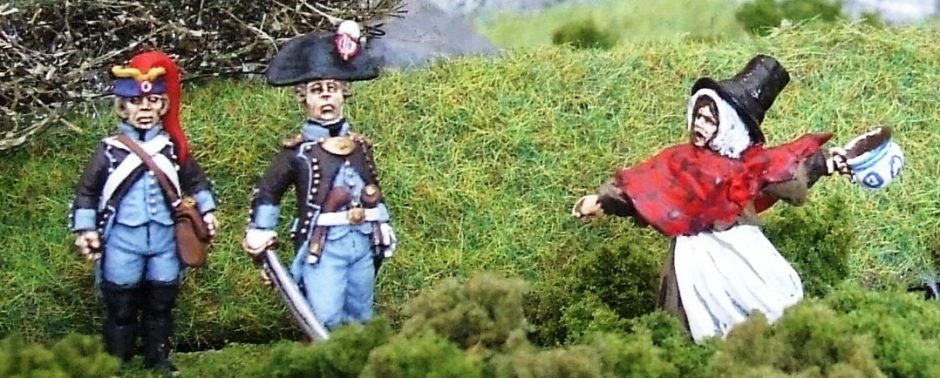
8. Brenier’s 2nd Brigade also included a very small detachment from the 4ème Régiment d’Étranger (also known as the Régiment de Prusse), the majority of whom had been given a drubbing by Daddy Hill at Almaraz. The strength of this tiny detachment is absorbed into that of the 22ème de Ligne. As it happens, I actually painted these when we re-fought Salamanca ‘In The Grand Manner’ at our second Général de Brigade Wargames Weekend at the National Army Museum in 2003, so here they are (not my best… I seem to remember that they were painted in a spare hour or so before the game):

 Terrain Notes
1. The Arapiles were each topped by a sheer rocky escarpment on the sides facing each other, making them excellent defensive positions, while they sloped away slightly more gently on the opposite sides. The lower contours provide the defender with a +1 defensive modifier and do not affect movement. However, the rocky upper contour of each Arapile counts as 2 inches of rough terrain to enter or exit and each has the following restrictions:
2. The Greater Arapile: The French eventually managed to mass forty guns on top of this feature, so I therefore suggest that it may accommodate up to five batteries and a single infantry brigade. The north, west and east slopes give the defender a +4 defensive modifier and are impassable to artillery and cavalry. The southern slope gives the defender a +2 defensive modifier and is passable to all troop types as 2 inches of rough terrain. Horse Artillery may not evade either to or from the Greater Arapile.
3. The Lesser Arapile may accommodate up to three batteries and a single infantry brigade. The south, west and east slopes give the defender a +4 defensive modifier and are impassable to artillery and cavalry. The northern slope gives the defender a +2 defensive modifier and is passable to all troop types as 2 inches of rough terrain. Horse Artillery may not evade either to or from the Lesser Arapile.
4. Other Hills give the defender a +1 defensive modifier and do not cause any movement penalty.
5. Woods count as rough going for all troop types.
6. Villages provide the defender with a -1 cover modifier and a +2 combat modifier. Most may only accommodate a single brigade, but Los Arapiles village may accommodate two brigades.
7. Streams were probably simply dried-up gullies at this time of year and are therefore passable to all troop types as 1 inch of rough terrain. They provide a defender with a +1 combat modifier. Units in Column, March Column or Limbered formation may cross at fords/bridges with no movement penalty.


 Unit Labels

 Well as Mrs Fawr always says; that was a big one!

 Then I moved on to the last of the Hessian cavalry with these two regiments of heavy horse; the Prinz Wilhelm and Leib Regiments:
 The Hessian cavalry were finally finished off with the Leibdragoner Regiment:
 Then it was on to the last of the Hanoverian heavy horse, starting with the Hammerstein and Leib Regiments:
 The Hanoverian heavy cavalry were finished off with the two guard cavalry squadrons; the Garde du Corps and the Grenadiers à Cheval. That only leaves three dragoon regiments and the ‘Luckner’ Hussars left to paint and then I can call the Hanoverian cavalry properly finished:
 I also had some French cavalry to complete. I’d painted the first half of the Royal-Carabiniers late in 2024 and finally got around to finishing off the regiment in mid-2025:
 Then it was all-change as I suddenly got the urge to do some Napoleonic games and needed to paint some more troops to go in them, starting with this Italian general:
 With the flurry of 1809 games in 2025, I got the urge to make a renewed effort to complete the order of battle for Aspern-Essling and then to play the battle. The Great Plan has slipped back down the calendar somewhat, but I did manage to clear out a whole wing of the Lead Dungeon, painting eight Austrian infantry regiments (the 14th, 15th, 18th, 21st, 25th, 28th, 54th & 57th Regiments) and a load of new casualty figures to use as game markers. Although I had originally planned to play the battle in late 2025, Aspern-Essling is now tantalisingly close, with only three dragoon regiments, a hussar regiment, two Hungarian infantry regiments and a slack handful of generals and gunners left to paint:
 One of the primary reasons for losing focus on Aspern-Essling was that we wanted to play other battles from the 1809 Danube Campaign first, before moving on to Aspern-Essling. In order to play the Battle of Eggmühl, I therefore needed to paint a few more Bavarians for my collection (the 1st, 5th & 9th Infantry Regiments, 1st Dragoons, a standard bearer for the 1st Light Infantry, some generals, some artillery and some casualty markers). This resulted in the clearing out of another wing of the Lead Dungeon!
 Eggmühl also required the addition of some Württembergers to my collection, so in August I painted up the 2nd Leib-Chevaulégers and a couple of generals for the game. I haven’t profiled these yet, so expect some Württemberg articles in the new year:
 Thanks to my above-mentioned trainees (grrr!), that sadly was it for for almost the rest of the year. However, I managed to be trainee-free for the last fortnight before Christmas and managed to paint three small Württemberg infantry regiments (3rd, 4th and 9th), some French Gardes-Nationale and a Württemberg 12-pounder for the Christmas Game. I’ve not had time to take some decent photos of these troops yet, so I’ll profile them in the New Year:
 So to the Scores on the Doors… For my 15mm SYW collection, this year I managed to paint 12x Foot and 64x Horse. For my 15mm Napoleonic collection, I painted 375x Foot, 45x Horse and 2x Guns. That’s a total of 387x Foot, 109x Horse and 2x Guns. At current prices, that works out as £501.68 worth of stuff.
 We kicked off February with a refight of the First Battle of Bull Run 1861 in 10mm. This was a nail-biting game that could have gone either way and a great start to the wargaming year. I absolutely love Fire & Fury rules, so I must do more ACW in 2026:
 Then in March I put on a club-night SYW Tricorn game based on Frederick the Great’s victory at Soor in 1745, but scaled down by half. Instead of the Austrians and Prussians, I employed the French in lieu of the Austrians and the British-Allied army in lieu of the Prussians. It was a fun game resulting in an Allied victory, though for some reason I never got around to writing it up here:
 In April we played a 6mm ACW battle using Volley & Bayonet rules and Al Broughton’s superb collection, though I foolishly forgot to take photos! In May we got back into Napoleonics and Napoleon’s Battles rules with a return to the Battle of Raab 1809, pitting Prince Eugène’s French Army of Italy against Archduke John’s Austrian Army of Inner Austria:
 The Napoleonic and 1809 theme continued in June with another return to one of my old scenarios; the Battle of Neumarkt. Sadly however, we had to break this off and never managed to return for the Part 2 due to player-availability (or rather the lack of it!) in the following months. Nevertheless, it was a great game and definitely one we’ll have to return to once again:
 In July, our intended Part 2 of Neumarkt had to be binned due to a family tragedy, so I quickly knocked up a scenario for another 1809 battle; the Battle of Teugn-Hausen. This actually proved to be enormously good fun:
 There was a gap for the rest of the summer and then we had once again planned to re-convene for Part 2 of Neumarkt, but fate once again played a hand and instead we had to play a different 1809 scenario. This time I converted my old General de Brigade scenario for the Battle of Eggmühl to Napoleon’s Battles rules and it was another epic game; the biggest of the year, played over two days:
 That then, was pretty much it for the rest of the year. Work and various other commitments kept us from wargaming until this week, when we got together for our annual Christmas Game; the Battle of La Souffel 1815, the report for which will be posted in the coming weeks:
 So while wargaming was relatively rare through the year, it was in my opinion, of very high quality, with some very memorable games in excellent company.
 I still need to write this up properly, but the campaign ended with a titanic clash outside the walls of Metz and the Emperor of the French seeking terms. Here’s my situation map of the end of the campaign and a photo of the Battle of Metz as it appeared on Barrie’s table:
 As for the blogging side of things, I started the year with a scenario and game-report for our 2024 Christmas game; the semi-fictitious Battle of Wanneminden 1759 (a scaled-down version of the Battle of Minden):
 In February I did a couple of articles on the first of my SYW Saxon infantry, which I painted at the end of 2024.
 March was a sparse month on the blog, with only the above-mentioned game-report for the First Battle of Bull Run 1861.
 April proved to be another sparse blogging month, with only an article on the above-mentioned final batch of SYW Hessian cavalry, including a parade of all the Hessian cavalry regiments.
 In June I finally posted a belated game-report for a refight of Cornwallis’ flank-attack at the Battle of the Brandywine 1777, which we’d played in 2023. I also posted the game report for the above-mentioned refight of the Battle of Neumarkt 1809.
 July was another very quiet blogging month, but I managed to start catching up with some SYW units I painted in 2024, starting with the Mighty Army of Schaumburg-Lippe-Bückeburg:
 Then I had a look at the heap of Napoleonic Austrian infantry regiments I’d painted during the summer.


 I then finished off October with a scenario for the last great battle of the Napoleonic Wars… No, not that one… The Battle of La Souffel 1815:


 In the short term on the painting front, I’ve got quite a few ‘interesting’ units lined up, as well as the above-mentioned Austrians for Aspern-Essling; namely the Italian Guards of Honour and Guard Dragoons, the Vistula Legion and a couple of batteries of Don Cossack horse artillery. In the longer term, I’d also like to finish a lot more cossacks and generally replace the shabbier parts of my Napoleonic Russian Army. I also need to get some Russian casualty packs and increase my Russian game-markers, as nothing pleases me more than dead Russians. On the SYW front, I’d like to get back to finishing off the orbats for Minden; I’ve still got the Brunswickers to finish and the 15th Light Horse for the British, as well as a load of Hanoverian infantry and a pile of Frenchmen.
 I’m afraid that once again this year, I neglected to send a Christmas card to my surviving reader. So by way of apology, here’s a short article and hoping that you and your family have a very Merry Christmas.
 As previously mentioned, in 2024 I finally got around to buying myself the start of a 17th/18th/19th Century bastion-fortress from
  If you don’t know who Ian Weekley was (shame on you), he was a very well-known terrain-modeler and frequent contributor to all the modelling and wargame magazines of the 1970s and 80s, producing incredible bespoke models for people all over the world, including royal palaces and museums, as well as wargamers. His magazine articles showing the model-building process were a constant source of inspiration and ideas, though there was no way that we mere mortals could ever afford to buy his wonderful creations! However, for the benefit of us plebs, he then released a range of wonderful resin building models, cast in a very nice lightweight foam-resin that held the detail, didn’t weigh a ton and unlike ‘traditional’ resin, didn’t chip or shatter when dropped. I still have a couple of his Spanish buildings and a Middle Eastern fort here somewhere that I bought during the 80s.
 As soon as I saw the model, I knew I had to have one as well, but Ian Weekley has long shuffled off this mortal coil and searches of eBay drew a blank. However, from asking around I soon discovered that TSS Models had picked up part of Ian Weekley’s old resin range, including the ‘Vaubanesque’ modular fortress in both 15mm and 25mm scales. I bought a couple of pieces to test the water and found that TSS have cast them using ‘traditional’ hard resin, instead of the foamed stuff. They’ve lost a degree of detail when compared to the original model (presumably due to the age of the masters), though they’re still more than good enough for my needs, so I ordered a few more pieces. In total this now amounts to two bastions, a large ravelin, three sections of curtain wall (one with a gateway) and a right-angled wall that can act as a redan or smaller ravelin.
 As TSS are using ‘traditional’ hard resin, this could made the fortress VERY heavy. However, TSS have inserted polystyrene foam cores inside each piece, which serves to reduce a lot of the weight and also stiffens up the structure, making them a lot stronger than they would be if they’d simply made them hollow in order to reduce weight. I still prefer Ian Weekley’s foamed resin, but there’s probably a good business reason (cost or elf’n’safety) for using traditional ‘hard’ resin in preference to the foamed stuff. Nevertheless, I’ve glued them to cardboard bases to act as ‘bumpers’, to help prevent chipping.
 I must confess however, that the gateway wall section didn’t do it for me, being very uninspiring (just a rectangular hole in the wall) and quite badly cast. I therefore cut out the gateway using a hacksaw and used the resultant two short wall sections to flank a lovely fortress gateway by TBM. I really do like this gateway model and the two gates can be slipped out to make an open arch if you prefer.


 Anyway, I hope that Wargame Santa brought you plenty of goodies and that you have Christmas games lined up? We’ll be refighting the
 As discussed
  Above: The Mestre-de-Camp-Général Cavalry Brigade at the Battle of Minden 1759. This actually consisted of four regiments; Mestre-de-Camp-Général, Poly-St. Thiébault, d’Espinchal and Fumel, but I haven’t yet got around to painting the Fumel Regiment. French brigades were always known by the name of the senior regiment in the brigade. These weren’t permanent groupings and regiments were often swapped around, so at Rossbach for example there was a Poly-St Thiébault Brigade, where that regiment was the most-senior in the brigade, but here they were junior to the Mestre-de-Camp-Général Regiment.
 Above:
  Above: The Mestre-de-Camp-Général Cavalry Regiment. While ‘everybody knows’ that the overwhelming majority of French regiments during this period wore ‘grey’ coats, the shade of grey (which could also be various shades of cream, buff, beige, etc) was actually simply that of unbleached wool. However, the Mestre-de-Camp-Général Regiment was most unusual in that it actually wore coats that had been dyed ‘iron grey’. These coats had black cuffs and ‘full’ black lapels that extended the whole length of the coat, from neck to hem. Tail-turnbacks were the same shade of grey as the coat and there was no collar. Buttons were of yellow metal and were arranged in pairs on the lapels and in fours on the cuffs and pockets. A ‘golden’ aiguillette was worn on the right shoulder, while the left shoulder had a strap of the regimental lace (parallel stripes of red, black, blue and aurore), ending in a ‘golden’ fringe.
 Above:
  Above: The Poly-Saint-Thiébault Cavalry Regiment. This regiment wore much the same uniform as that worn by the overwhelming majority of French heavy cavalry regiments; namely a coat of ‘grey-white’ (unbleached) wool with red lapels, cuffs and coat-linings, with white metal buttons. Buttons were grouped in pairs on the lapels and in fours on the cuffs and tail-pockets. On the left shoulder was a strap of regimental lace (which was yellow with a black central stripe), ending in a yellow fringe. Hats were edged in ‘false silver’ lace and decorated with a black cockade and button. Smallclothes, gloves and belts were buff and the waistcoat was edged with regimental lace. The cartridge pouch was red leather. Horse furniture was blue, edged in regimental lace.
 Above:
 Above:
  Above: The Royal-Cravate Cavalry Regiment. This regiment wore blue coats with red cuffs, lapels and linings. Buttons were white metal and were grouped in pairs on the lapels and in fours on the cuffs and pockets. The left shoulder had a red fringed epaulette, with a strip of the regimental lace, which was aurore, punctuated with pairs of dots in red, white and blue. Smallclothes and gloves were buff, with the waistcoat being edged in regimental lace. Belts were white, as was the cartridge pouch (the white pouch was unique in the French army). Horse furniture was blue, edged in the regimental lace. As a Royal regiment, trumpeters wore standard Royal Livery.
 Above:
  Above:
 I did promise that there would be some tricorns among the recent wave of shakos, so here are some more French cavalry that I painted late last year and early this year.
 Above:


 Above: The Royal-Carabiniers. The regiment wore a blue coat with red cuffs and linings, silver lace edging to the cuffs and a white & silver fringed epaulette on the left shoulder. Some sources show the addition of red lapels from 1760, but it seems that these were not actually added until after the reorganisation of 1763. Buttons were silver and were evenly-spaced down each side of the breast, with three buttons on each cuff, three on each tail-pocket and one either side of the rear waist.
 Above: The Royal-Carabiniers. According to David Morfitt’s
 Ask anyone to name the last battle of the Napoleonic Wars and the answer in 99% of cases will be ‘Waterloo’. However, the war continued for some time after Napoleon’s catastrophic defeat. The remainder of the war for the most part consisted of sieges, assaults on forts, small actions and clashes of outposts, but before the war finally ended there was one more large battle fought between two armies in the open field. This battle occurred ten days after Waterloo on 28th June 1815, along the River La Souffel (or ‘Suffel’), just outside the fortress-city of Strasbourg. It resulted in a victory for the French Army of the Rhine, commanded by General Rapp.
 Historical Background: The Hundred Days on the Rhine
 Following Napoleon’s sudden return to power in 1815 he rapidly built up France’s armies to face the inevitable military response by his enemies. By the end of May, he had rebuilt the army from 56,000 to 198,000 men. The I, II, III, IV & VI Corps, the Imperial Guard Corps and the Cavalry Reserve, stationed along France’s northern borders and Paris, would become the Army of the North and would march north with the Emperor. The rest of France was very sparsely defended by a number of ‘armies’, each being at most only the strength of a weak corps. However, Napoleon hoped that with the advantage of interior lines, he could quickly knock out the Allied armies individually as they appeared before turning to face the next one, much as he had tried (and ultimately failed) to do in Germany in 1813 and France in 1814.


 The Battle of La Souffel


 Victory Conditions
 III Austrian-Allied Corps Order of Battle


 Deployment
 Unit Labels

 In
In  Above: 1. Dragoner-Regiment ‘Minucci’. The lineage of Bavarian cavalry regiments through this period is ludicrously complicated and I soon lost the will to live while trying to work it out. Suffice to say; at the start of the French Revolutionary Wars there were three classes of Bavarian cavalry; cuirassiers (2 regts, without cuirass), dragoons (2 regts) and chevaulégers (3 regts). However, with various conversions and disbandments, by the time Napoleon became Emperor of France in 1804 the cuirassier regiments had disappeared and number of chevauléger regiments had increased to four. The number of dragoon regiments remained the same, though the original 1st Dragoons had been disbanded, being replaced by the converted 1st Cuirassiers, who now became the new 1st Dragoons.
 In 1811 the two dragoon regiments were converted to chevaulégers and just to confuse future historians and wargamers, all the regiments were then re-numbered according to seniority. The army’s cavalry arm therefore now consisted solely of six chevauléger regiments.
 Above: 1. Dragoner-Regiment ‘Minucci’. So as you might have worked out, this dragoon regiment I’ve just painted is only really useful for the 1809 campaign and will probably only ever appear in the
  I should also perhaps confess at this point that the AB Figures Bavarian Chevauléger figures aren’t QUITE perfect for dragoons, due to the horse furniture. As can be seen in the Knötel print above, the dragoons had a smaller square shabraque, with a red-edged white fleece over the front of the saddle and a square valise behind the saddle. These figures have the larger chevauléger-style, pointed shabraque which also covers the front of the saddle and which has a round valise.
 Above: 1. Dragoner-Regiment ‘Minucci’. Following the 1799 uniform changes, Bavarian dragoon and cuirassier regiments wore white coats, while the chevauléger regiments wore the same pattern in light green (as shown in the header banner to this article), changing in 1809 to dark green. As the cuirassier regiments at this time didn’t wear cuirasses, the uniform remained apparently unchanged when the 1st ‘Minucci’ Cuirassiers became the 1st ‘Minucci’ Dragoons in 1804. This consisted of a white coat, very similar in style to the ‘Spencer’ coat worn by the infantry, with red collar, cuffs and square lapels, red tape edging to the tail-turnbacks and red-piping to the cuff-flaps. Buttons were white metal. The shoulders were protected/decorated by white metal shoulder-scales on red cloth backing.
 I must ALSO confess here that I had originally intended to paint the 2nd ‘Taxis’ Dragoons (above), who in 1804 changed from black to red facings, matching the 1st ‘Minucci’ Dragoons. However, I didn’t notice that the 2nd Dragoons had yellow metal buttons, so painted them with white metal, thereby accidentally painting them as the 1st Dragoons…
 Above: 1. Dragoner-Regiment ‘Minucci’. The junior ranks of both dragoon regiments officially wore a broad red cummerbund or waist-sash, tied with an elaborate bow at the left hip, but lacking the loose tails of officers’ sashes. The chevaulégers wore the same item, but in grey. However, these don’t always appear in paintings (I’ve only seen one picture of a chevauléger with a grey cummerbund) and their use seems to have quickly died out. Perhaps they were only worn for parade? In any case, the AB Chevauléger figures don’t have them (nor do the chevaulégers in the painting at the top of this article) and I haven’t bothered painting them in.
 As for the rest of the uniform; breeches were white, worn with knee-length boots. These were covered on campaign with grey overalls, decorated with a red stripe and buttons down the outer seam. Belts were white with brass fittings, the cartridge-pouch was black and the scabbard was initially black leather with white metal fittings, though soon changing to an all-steel scabbard. Note that the dragoons carried curved sabres, like the chevaulégers. Sword knots were white. The 1799 Pattern raupenhelm was very much like that of the infantry, except with the addition of brass chin-scales and additional brass reinforcement over the crown and around the brim. A white plume was worn by all ranks (I’ve seen pictures of senior officers with a light blue base to the plume, so I’ve included this here).
 Above: 1. Dragoner-Regiment ‘Minucci’. Officers wore a sash of mixed silver and light blue threads, as well as a silver cross-belt with two light blue stripes, gold fittings and a white or silver cartridge pouch, decorated with the royal cypher in gold. They also had a bushier fur raupe (crest) and plume than the junior ranks. As mentioned above, their horse furniture was edged with button-coloured lace and some officers seem to have had a light blue base to their plume. Rank was identified by lace on the collar, as described for the infantry in Part 1. On the right is a Rittmeister (i.e. Captain of cavalry) of the 1st Dragoons, identified by the three bars of silver lace. Senior officers also had lace edging to the collar and much wider waist-sashes. Note that he also has one lapel buttoned across, leaving the top corners of the lapels unbuttoned and hanging loose on both sides. This was a popular affectation among fashionable officers.
 Above: Bavarian Light Artillery. I think I’ve mentioned it here before, but in the mid-1990s we lost a dear friend all too soon to leukaemia. Richard Boulton, or ‘Dusty’ as we knew him had beaten the bastard disease off once, but as so often happens it came back and finished him off, aged only 28. Dusty had been a major player in our club Big Games (Lützen, Bautzen, Wachau and Waterloo being among the biggest), typically providing a good 50% of the French and all of the Bavarians. However, following his death, his dad understandably wanted to keep his collection as a keepsake, so we were back to playing relatively small battles until we could backfill the capability-gap.
 However, some time after we lost him, his wife rang me to say that she’d found a packet of figures and asked if I wanted them. Of course I said ‘Yes’ and the packet contained a load of unpainted Battle Honours Bavarian artillery (sculpted by Tony B before he started AB Figures). While they’re very slightly smaller than AB Figures, the sculpting style is the same and they fit really well with my collection, so they’ll never be replaced by ‘new & improved’ ABs. It’s also nice to know that Dusty lives on with us in a very small way.
 Above: Bavarian Light Artillery. Like Austria, the Bavarian artillery arm didn’t include ‘proper’ horse artillery and instead had light mounted batteries, where the gunners rode a padded leather wurst (‘sausage’) atop the ammunition caissons. They were therefore often referred jokingly to as ‘wurst-artillerie‘ (the Austrians rode the trail of the guns themselves).
 The observant may have noticed that my figures don’t match the description above, as I’ve done them with black collar and cuffs, piped scarlet… Well in my defence m’lud, I got a bit confused by various sources showing black collars (Osprey) and black cuffs (the picture above) and instead of checking, I just painted them according to my faulty memory… You’d think that I’d have learned by now… It’s also worth noting that the two pictures above show blue turnbacks with red edging, so that’s another possible variation.


 Above: Bavarian Generals. As to uniforms, Bavarian generals wore cornflower blue coats with scarlet lapels, collar, cuffs and turnbacks. The lapels, collar and cuffs heavily decorated with silver lace edging and a very elaborate ‘foliate’ border and lace buttonholes. Horse furniture was scarlet with heavily-laced silver edging.


 Above: Maréchal François Joseph Lefebvre, Duc de Danzig. In terms of uniform, each of these French officers wore their own national uniform (which I won’t describe here) and their headquarters staff would undoubtedly have also included French officers and aides de camp wearing their own uniforms, but in order to maintain the national ‘flavour’ here, I’ve only included Bavarian staff officers. I’ve therefore painted the saluting cavalry ADC as an officer of the 1st Dragoons (as described above) and I had a few spare mounted infantry officers, so I’ve included one here wearing a fairly anonymous grey greatcoat.
 For our recent refight of the
  Above: 1. Linien-Infanterie-Leib-Regiment. At the start of the Napoleonic Wars, this regiment was Bavaria’s premier infantry regiment, as it had been since the 17th Century. In 1811 the Leib-Regiment was re-titled as the ‘König’ Regiment, but it maintained its status as the top dog in the army. However, in 1814 the top-slot was taken by the newly-raised Garde-Grenadier-Regiment.
 Above: 1. Linien-Infanterie-Leib-Regiment. Bavarian Line Infantry Regiments initially fielded two battalions apiece. Each battalion would take to the field with four companies; a grenadier company and three fusilier companies. From 1803 a fourth fusilier company was added to each battalion, though this would remain at home as a depot. Each company included a detachment of schützen (sharpshooters), who would often be grouped together in battle to form a de facto fifth (light) company. In 1809 each company numbered 185 men, including 20 schützen. The schützen element was increased in March 1809 to 36 (7 of whom were rifle-armed). It’s not clear to me if these additional 16 schützen were taken from or were in addition to the company total of 185.


 Above: 5. Linien-Infanterie-Regiment ‘Preysing’. This regiment was mainly distinguished by its rose-pink facings, being the only Bavarian regiment to wear this colour. The facings were edged with red piping, though after painting the piping on a couple of figures, I quickly realised that the colour-contrast was so poor that the red piping was essentially invisible, so on the remainder I only painted the red piping on the edge of the cuff-flaps, as that’s the only place where it’s actually visible. Tail-turnbacks were red for all regiments. Buttons were white metal.
 Above: 5. Linien-Infanterie-Regiment ‘Preysing’. All Bavarian regiments wore the same pattern of tall, crested leather helmet or raupenhelm. This always had brass ornamentation, regardless of the regimental button-colour. Note that officers and SNCOs had extra brass edging around the visor and often had additional brass strips running over the crown (all ranks in the dragoon and chevauléger regiments had the extra brass decoration). Unlike the Austrians, Württembergers and Badeners, the Bavarians kept the raupenhelm right through the Napoleonic Wars and didn’t convert to the much cheaper and more comfortable shako, making them possibly unique as the only army whose basic uniform remained largely unchanged throughout the entire period.
 Above: The crest or raupe was a woollen sausage for junior ranks with SNCOs having a larger, bushier example and officers having theirs made of high-quality fur. However, the raupe seem to have become steadily bigger and bushier for all ranks as time went on, as shown in this sketch from 1816. Note that Tony Barton seems to have modelled his lovely AB Figures Bavarian infantry on these chaps. The little details, such as the mixture of breeches and campaign trousers, the frying-pan, the drawstring-bag for the greatcoat and the helmet-badge actually being in front of the raupe, are all captured in Tony’s sculpting.
 Above: 5. Linien-Infanterie-Regiment ‘Preysing’. The raupenhelm was additionally decorated with a circular national cockade in white and cornflower blue on the left side. From this sprouted a red plume for grenadiers and a green plume for schützen (note that the schützen seem to have worn the green plume as a mark of their status long before the creation of schützen companies in 1811, though not all sources agree). The grenadier and schützen companies of 2nd Battalions had a white base to the plume.
 The fusilier companies were identified by a small coloured woollen tuft secured behind the left-hand brass boss for the chin-strap, just below the cockade. After 1811 the fusilier company tuft colours were 1st – white, 2nd – white-over-yellow, 3rd – green, 4th – green-over-yellow, 5th – red, 6th – red-over-yellow, 7th – blue and 8th – blue-over-yellow (the 5th to 8th fusilier companies were in the 2nd Battalion).
 Above: 9. Linien-Infanterie-Regiment ‘Graf von Ysenburg’. This regiment initially had scarlet facings with yellow buttons, but by 1806 the colourings had changed to a red collar with yellow cuffs and lapels, piped red, with red tail-turnbacks. Buttons were yellow metal. The 4th Regiment also had yellow facings from the outset (with white metal buttons and a yellow collar) and also added red piping at some point, while the 10th Regiment (initially with crimson facings) also adopted the same uniform as the 9th, though with white metal buttons (it’s probably the 10th who are depicted in the picture below).

 Above: 9. Linien-Infanterie-Regiment ‘Graf von Ysenburg’. Drummers for all regiments wore the same uniform as the rank-and-file, with the addition of facing-coloured shoulder-wings, decorated with the electoral/royal arms. The collar and lapels and wings were then edged with broad yellow or white lace, according to the button colour. The sleeves were also edged in lace and were decorated with four upward-pointing chevrons. Drums were brass, edged with white and light blue diagonal stripes.
 Above: 1. Leichte-Infanterie-Bataillon ‘Habermann’. This unit was created in 1801, being initially titled ‘Metzen’. In 1807 the title changed to ‘Habermann’, changing in 1809 (following the conclusion of the war) to ‘Gedoni’. In 1811 the unit changed title twice; first to ‘Hertling’ and then to ‘Fick’, which remained the title until 1815, when it changed again to ‘Fortis’. Unlike the line infantry regiments, who were named for an inhaber, the light infantry battalions were named after their commanding officer (as were artillery batteries), hence the rapid turnover of names.
 Light infantry battalions were organised exactly the same as the line infantry battalions, with the only real differences being in terminology. The elite company was called carabiniers instead of grenadiers and instead of fusiliers, the battalions had four ‘ordinary’ companies, one of which would act as the depot. Again, the companies each had a schützen detachment, a small number of whom were armed with rifles. From 1811 the light infantry battalions were also reorganised and would take to the field with the carabinier company, four ordinary companies and a schützen company.
 Above: 1. Leichte-Infanterie-Bataillon ‘Habermann’. The light infantry wore the same basic pattern of uniform as the line infantry, except with light green coats and grey breeches or campaign trousers. The coats changed to dark green in 1809. Sources are slightly confused re the colour of plumes and company tufts, with the carabinier company probably having green plumes at first. However, by 1811 they seem to have changed to much the same pattern as the line infantry (please not however, that the AB firing poses all have elite company plumes, so I’ve done the carabiniers with red plumes and everyone else with green plumes – this is not correct). Lapels and cuffs were black with red piping for all units and tail-turnbacks were again always red. Battalions were therefore identified by the colour of collar and buttons. This unit had red collars and yellow metal buttons.
 As promised, here’s the game report from our recent Eggmühl refight. If you missed it,
 Above: For once, I actually remembered to get an overview shot of the battlefield at the start of the game, orientated the same as the map! I’m getting good at this…
 Above: The left wing of Rosenberg’s IV. Korps. On the left of the photo stands GM Stutterheim’s cavalry brigade (the 4th ‘Vincent’ Chevauxlegers and 10th ‘Stipsicz’ Hussars) atop the hill known as the Vorberg, along with the two 12pdr reserve batteries and a 6pdr cavalry battery. On the right, FML Sommariva (who commands the three infantry regiments of the left wing) has brought the 9th ‘Czartoryski’ Infantry Regiment to occupy the Bettelberg. To the rear stands FML Vukassovich’s 3rd ‘Erzherzog Ferdinand’ Hussars from III. Korps. Vukassovich also commands the 9th ‘Peterwardeiner’ Grenze Infantry Regiment, which is deployed forward, defending Eggmühl itself, supported by another 6pdr cavalry battery.
 Above: On the extreme left flank, atop the steep Einsiedelberg hill, stands GM Bieber’s brigade from III. Korps. The 38th ‘Württemberg’ Infantry Regiment are deployed as the forward line, along the edge of the escarpment, along with a 6pdr position battery. To their rear, in reserve along the tree-line, is the 20th ‘Kaunitz’ Infantry Regiment.
 Above: The two villages at the corner of the IV. Korps position (Oberlaiching and Unterlaiching) are occupied by Sommariva’s two remaining infantry regiments; here we see Oberlaiching, defended by the 55th ‘Reuss-Greitz’ Infantry Regiment and an attached corps reserve 6pdr cavalry battery. Out of shot to the right is Unterlaiching, defended by the 44th ‘Bellegarde’ Infantry Regiment. Also present are two regiments from FML Hohenlohe’s centre division; in the foreground is the 8th ‘Erzherzog Ludwig’ Infantry Regiment and in reserve on the Vorberg is the 46th ‘Chasteler’ Infantry Regiment.
 Above: Guarding the right flank of IV. Korps are FML Dedovich’s 12th ‘Deutsch-Banát’ Grenze Infantry Regiment (just visible in the woods) and a 3pdr Grenze Battery. Also under Dedovich’s command are the 3rd ‘Erzherzog Karl’ Infantry Regiment, who are occupying Obersanding in the foreground. In support to the rear of the Grenze are the 22nd ‘Koburg’ Infantry Regiment of Hohenlohe’s Division.
 Above: As mentioned above, in this playtest version of the scenario, we started with the Austrian reserves on table; namely FML Hessen-Homburgs’ Cuirassier Division (Lederer’s and Schneller’s Brigades, plus two 6pdr cavalry batteries) and GM Rohan’s Grenadier Division (Melgum’s and Steyrer’s Brigades).
 Above: Deploying on the high ground opposite Unterlaiching is Deroi’s 3rd Bavarian Division of Marshal Lebevre’s VII Corps. This is a very strong division, consisting of two very strong infantry brigades (Sieben’s and Vincenti’s) Seydewitz’s Cavalry Brigade, a 12pdr foot battery and two 6pdr light mounted batteries. As the two infantry brigades are so strong, I’ve massed the light battalions on the right flank as a separate unit.
 Above: On the Bavarians’s left is GD Saint-Hilaire’s 4th Division of Marshal Davout’s III Corps. This consists of two strong infantry brigades; Lorencez’s and Destabenrath’s, plus a 4pdr horse battery. Destabenrath’s brigade is so strong that I’ve split off the 10e Légère as a separate unit. In the foreground is Davout’s headquarters and GB Piré’s III Corps Cavalry Brigade. Davout also initially had the services of Saint-Germain’s Cuirassier Brigade, but they rode off through Schierling during the morning, to rejoin their parent division as part of the Emperor’s approaching column.
 Above: The first elements of that approaching column have just appeared to the south of Eggmühl. GM von Hügel has already reached the bridge with the Württemberg Light Infantry and is already coming under fire from Vukassovich’s 6pdr cavalry battery. Following close behind are GD Vandamme (commanding VIII Corps) and the Württemberg Jäger and 6pdr horse artillery.
 Above: On the extreme right flank are the leading elements of GD Gudin’s 3rd Division of Marshal Lannes’ Provisional Corps, consisting of Petit’s Brigade (which is so large that I’ve split it into two separate units). The weir at the Stanglmühl water-mill is only passable by infantry with some difficulty and Gudin is uncharacteristically cautious about making the crossing right under the noses of Bieber’s whitecoats.
 Above: Keen to capture Unterlaiching as quickly as possible, Deroy throws Sieben’s Brigade straight into the assault, while Saint-Hilaire launches a supporting assault on the left with the 10e Légère. The rest of Deroi’s division provides supporting fire in an attempt to keep Austrian heads down.
 Above: However, the 44th ‘Bellegarde’ Regiment is made of sterner stuff and throws the attackers back over the stream. Austrian celebrations are short-lived however, as the French and Bavarian artillery continue their bombardment of the village.
 Above: Not fancying his chances in a direct assault across the weir at Stanglmühl, Gudin decides instead to join the direct assault across the Eggmühl Bridge!
 Above: Davout observes closely as the main body of Saint-Hilaire’s Division advances on Oberlaiching. Lorencez’s Brigade (3e & 57e de Ligne) moves up through the copse on the right, while Destabenrath’s Brigade (72e & 105e de Ligne) crosses the open ground on the left, supported by Piré’s cavalry. On the left, Friant’s Division advances through the woods.
 Above: At Eggmühl, Hügel’s initial assault with the Light Infantry has been comprehensively beaten off by the Grenze and falls back to lick its wounds. As Hügel’s Jäger and horse artillery deploy to provide covering fire, Gudin moves forward with his leading regiment. General Vandamme arrives and demands to know why Hügel hasn’t already taken Eggmühl!
 Above: In the meantime, Wöllwarth arrives with his Württemberg cavalry. While the horsemen wait for the crossing to become available, Wöllwarth intervenes in the command dispute and manages to dissuade the seething Hügel from challenging Vandamme to a duel.
 Above: Saint-Hilaire’s first assault on Oberlaiching is spearheaded by Lorencez’s Brigade using the cover provided by the small wood. However, this doesn’t help very much as the French infantry are beaten off and forced to withdraw, though with only relatively light casualties.
 Above: On the far northern flank, a sharp firefight has developed in the woods between the ‘Erzherzog Karl’ Regiment and Gautier’s Brigade (108e & 111e de Ligne) of Friant’s Division. Friant also inserts Gilly’s small brigade (consisting of just the 15e Légère) between Gautier’s left flank and the stream.
 Above: The Emperor has arrived!
 Above: Following close behind the Emperor is Saint-Sulpice’s 2nd Cuirassier Division. Seeing the chaos still ongoing at Eggmühl Bridge, Napoleon instead directs Saint-Sulpice to take his division over the river at Schierling and to place themselves on the Bavarian right flank.
 Above: At Unterlaiching, Marshal Lefebvre has launched a massive general attack (after some considerable artillery preparation) against the village, this time throwing in the entirety of Deroi’s 3rd Bavarian Division and Demont’s (French) Reserve Division. The defending 44th ‘Bellegarde’ Regiment are simply overwhelmed and having already taken considerable casualties from artillery fire, completely disintegrate and flee through the woods to safety as Sieben’s Bavarians mercilessly hunt down the survivors in the village.
 Above: However, Stutterheim has anticipated such a move and sweeps down off the Vorberg with his two cavalry regiments, to take Demont in the flank!
 Above: Demont’s 3rd Brigade, on the extreme right flank, fails to form square and is ridden down by the 4th ‘Vincent’ Chevauxlegers! The survivors flee past Demont for the safety of Schierling. The disciplined Austrian troopers manage to maintain control and line up their next target; Seydewitz’s Bavarian Cavalry Brigade.
 Above: Demont is forced to flee as the Austrian chevauxlegers charge across the stream! However, to Stutterheim’s disappointment, the Bavarian cavalry manage to stand their ground and both sides fall back to reconsider their options.
 Above: The Austrian 10th ‘Stipsicz’ Hussars meanwhile, tried to exploit their comrades’ success by launching their own charge on Demont’s remaining brigade. However, the inexperienced young Frenchmen managed to form square and the hussars were rebuffed!
 Above: Saint-Hilaire meanwhile, makes a second attempt on Oberlaiching. This time he personally leads Lorencez’s Brigade forward through the woods, while Davout himself decides to re-live his glory days as a Général de Brigade, in leading Destabenrath’s Brigade forward in the assault! However, as Saint-Hilaire leads his men in with the bayonet, Davout pauses, fumbling in his pockets for his spectacles…
 Above: Despite Davout’s hesitancy, Saint-Hilaire’s assault is a complete success and the 55th ‘Reuss-Greitz’ Regiment abandons its positions as Lorencez’s Brigade storms into Oberlaiching! However, the best moment to counter-attack is always while the enemy is in some disorder, occupying their newly-captured position and anticipating this moment, Hohenlohe already has two regiments (22nd ‘Koburg’ and 46th ‘Chasteler’) in position to the rear of the village, ready to mount an immediate counter-attack.
 Above: On the northern flank, the 3rd ‘Erzherzog Karl’ Regiment is holding its ground and repulses the first assault by Gautier’s Brigade.
 Above: An overhead view from the north of the battlefield.
 Above: As Hohenlohe’s counter-attack goes in, the 22nd ‘Koburg’ Regiment, on the right of the attack, receive an enormous volume of fire from Destabenrath’s Brigade and French horse artillery. The regiment is unable to press home the attack and is routed, fleeing for the safety of the woods to their rear.
 Above: However, the 46th ‘Chasteler’ Regiment, charging from the far side of Oberlaiching and hidden from enemy artillery, successfully manages to eject Saint-Hilaire from the village and re-occupies the position! Saint-Hilaire is forced to flee along with Lorencez’s infantry, though they eventually manage to rally at the bottom of the valley and prepare to go back up the hill.
 Above: On the northern flank, the situation suddenly deteriorates rather sharply for Friant, as Kayser’s Brigade (consisting of two regiments; 7th ‘Schröder’ and 56th ‘Wenzel Colloredo’) of III. Korps suddenly appears on Gilly’s left flank!
 Above: Over on the opposite flank, Morand’s Division has arrived at the Stanglmühl. Despite Gudin’s initial hesitancy in assaulting across the mill-weir, things continue to go badly at Eggmühl Bridge, so Morand will have to gird his loins and press on! However, he has to contend with Petit’s Brigade who, having been left by Gudin to guard the mill, are very much in everyone’s way (doubly so when they keep becoming disordered by Bieber’s artillery)!
 Above: Gudin meanwhile, has just launched the 21e de Ligne over Eggmühl Bridge and this assault, like the Württembergers before them, ends in dismal, bloody failure.
 Above: A view of the main Austrian position at the Bettelberg and Vorberg, with Hessen-Homburg’s Cuirassier Reserve in the foreground and Vukassovich with the 3rd ‘Erzherzog Ferdinand’ Hussars still in reserve on the high ground.
 Above: With the Austrian 46th ‘Chasteler’ Regiment now disordered as it re-occupies Oberlaiching, there is the perfect opportunity for Davout, still attached to Destabenrath’s Brigade, to repay the compliment and launch his own counter-attack! However, he’s still looking for his glasses and as ADCs are dispatched to ride back to his headquarters for his spare pair, the opportunity passes.
 Above: General Piré however, suffers from no such indecision and, seeing the 8th ‘Erzherzog Ludwig’ Regiment looking vulnerable, decides to launch his cavalry up the hill! The Austrians fail to form square, but by some miracle manage to deliver a devastating volley into the French cavalry which disorders them as they charge up the slope. The resultant impact is therefore negligible and the French horsemen are forced to withdraw with heavy losses. A lucky hit from the Grenze 3pdr battery then sees Piré’s men flee the field completely!
 Above: With his first assault across Eggmühl Bridge having failed, Gudin now brings up the 85e de Ligne and this time leads the assault himself. However, despite initial promise, this charge also fails and the French infantry flee back across the bridge in front of their furious Emperor.
 Above: With Unterlaiching secured, Deroi pushes his Bavarian infantry up through the wood, aiming to silence or at least force back the two Austrian 12pdr position batteries atop the Vorberg.
 Above: On the Vorberg, Sommariva has returned to rally his 55th ‘Reuss-Greitz’ Regiment, who had earlier been ejected from Oberlaiching. However, he can’t stay for long, as his 9th ‘Czartoryski’ Regiment is the tactical reserve for the Eggmühl garrison and he daren’t stay away from that critical sector for too long.
 Above: At Schierling, Saint-Sulpice’s 2nd Cuirassier Division crosses over the Grosse-Laaber and passes through the town.
 Above: South of Eggmühl, a truly monumental traffic jam is building up as Nansouty’s colossal 1st Cuirassier Division arrives.
 Above: On the far northern flank, the battle has stagnated as Kayser seems remarkably reluctant to exploit his advantageous position on the left flank of Gilly’s Brigade. Gilly is therefore able to fall back, thus refusing the left flank and engaging in a firefight across the stream. Friant meanwhile, has managed to rally Gautier’s Brigade in his centre and is at last pushing forward with Grandeau’s Brigade on his right, against the 12th ‘2nd Deutsch-Banát’ Grenze in the woods.
 Above: Morand meanwhile, is slowly making progress in establishing a bridgehead across the Grosse-Laaber, despite some disorder caused by Bieber’s artillery. Morand’s own 4pdr horse artillery simply lacks the range to reply effectively from beyond the marsh.
 Above: “If you want a job doing properly, do it yourself…” Vandamme, frustrated at Hügel and Gudin’s lack of progress in securing Eggmühl, personally leads the Württemberg Light Infantry forward in their second charge of the day! However, the Württembergers are badly shot up by the Grenze and their supporting cavalry battery and the charge ends in yet another disaster. Vandamme’s horse is shot from under him, but after a tot of brandy to steady his nerves, the grizzled veteran general acquires a remount and carries on.
 Above: With Vandamme’s assault having failed, Hügel orders the Württemberg Jäger to prepare themselves to make the next assault. However, the unthinkable then happens! The supporting Württemberg artillery first manage to silence the extremely destructive Austrian cavalry battery covering the bridge and with their next shot, manage to demoralise the Grenze so much that their nerve finally breaks and they run for the hills, leaving Eggmühl completely unoccupied! The Austrian 9th ‘Czartoryski’ Regiment is already in position for just such an eventually, but with Sommariva presently absent, they dither in indecision…
 Above: Marshal Lannes, watching from the opposite bank, immediately identifies the astonishing opportunity that has suddenly presented itself. “Now, Hügel! Now is your time! Up, Jäger and at them!” Sure enough, General von Hügel and his Jäger storm across the bridge and quickly secure their prize before the whitecoats can react. Now at last, the Emperor’s heavy cavalry can cross over to take the fight to the Kaiserlicks!
 Above: Things are also proceeding well at Stanglmühl, as Morand successfully crosses over with the third regiment of Lacour’s Brigade (13e Légère, 17e de Ligne & 30e de Ligne). Bieber isn’t inclined to come down off the Einsidelberg, so satisfies himself with bombarding them as the infantry wait nervously along the crest.
 Above: At long last, Saint-Sulpice’s leading cuirassier brigade (Clément’s) emerges from Schierling and passes the Bavarian cavalry, aiming directly for Stutterhim’s Austrian horsemen.
 Above: At Eggmühl, Nansouty wastes no time in following up Hügel’s success and throws Defrance’s Carabinier Brigade across the bridge. Vukassovich’s cavalry battery, which has previously done so much damage to enemy units crossing the bridge, is this time unable to reply, thanks to Württemberg counter-battery efforts. On the left, Sommariva has finally returned, but is too late to prevent the enemy capture of Eggmühl. The Austrians now have only one chance to recapture the village with its bridge…
 Above: West of Eggmühl, another surprising event has taken place. Wöllwarth’s cavalry, scouting along the river bank, have discovered a mill-weir at Schnitzlmühl. Having opened the sluice-gate, the water-level behind the weir has dropped sufficiently that cavalry are now able to cross the river with some difficulty. Wöllwarth wastes no time in ordering his brigades to cross over and deploy onto the water-meadows along the north bank.
 Above: Stutterheim, realising that he is about to be crushed between three massive cavalry formations, pulls his cavalry back onto the high ground, hoping against hope that the scant advantage of the slope will save them.
 Above: As Clément’s Cuirassier Brigade shakes out into line near Unterlaiching, Guiton’s Brigade forms up close behind him, while their divisional horse artillery struggles through the traffic-jam at the rear.
 Above: Vincenti’s Bavarian Brigade finally emerges from the wood to capture an isolated position battery of Austrian 12pdrs atop the Vorberg! However, the assault quickly grinds to a bloody halt as the Bavarians are subjected to a colossal storm of shot from the 55th ‘Reuss-Greitz’ Regiment, their supporting 6pdr cavalry battery and the surviving 12pdr position battery.
 Above: To the rear of Saint-Hilare’s Division, Crown Prince Ludwig’s 1st Bavarian Division has now arrived. Consisting of two large infantry brigades (Rechberg’s and Stengel’s) and a 12pdr position battery (his cavalry brigade and light mounted battery are both absent), he marches to fill the vulnerable gap that has opened up between Saint-Hilaire and Friant.
 Above: Realising that there will never be a better opportunity to meet the French heavy cavalry than when they are still massed in column while crossing the bridge, Vukassovich reluctantly launches the 3rd ‘Erzherzog Ferdinand’ Hussars down the hill to meet Defrance’s Carabiniers. By some miracle, the hussars manage to rout the Carabiniers, who flee back over the bridge to the jeers of the infantry watching on both sides!
 Above: However, Vukassovich’s luck doesn’t hold, as his hussars immediately go berserk and throw themselves at the Jäger lurking among the houses and gardens of Eggmühl. The hussars are easily beaten off and retire to reform behind the Bettelberg.
 Above: In the meantime, Sommariva has launched his own assault on Eggmühl with the 9th ‘Czartosyski’ Regiment, which immediately gets off to a bad start as the expert marksmen of the Jäger inflict heavy casualties on the attackers, disrupting the cohesion of their assault. Things then go from bad to worse for the Austrians as they are comprehensively defeated. Sommariva himself is mortally wounded. His men carry him back with them as they flee and inspired by his sacrifice they manage to rally, though Sommariva later dies on the surgeon’s table.
 Above: The Emperor, now joined by his escort from the Baden Light Dragoons, looks on with increasing disgruntlement at the situation before him. The day is now starting to come to a close and while progress has been made, he had hoped to be already attacking Archduke Charles’ main body by now, but here he is, still struggling to deal with the flank-guard!
 Above: With his right flank now secured by Saint-Sulpice’s cuirassers, Lefebvre throws Deroi’s 3rd Bavarian Division and Demont’s Reserve Division up the slope of the Vorberg, to clear away the Austrian artillery once and for all! However, the Austrians aren’t willing to give up their guns, or possession of the high ground, without a fight!
 Above: Having found a replacement horse, Vandamme joins Stettner’s Cavalry Brigade as they deploy beyond the Grosse-Laaber and at last prepare to take on the Austrian cavalry.
 Above: With his last brigade (l’Huillier’s, consisting of just the 60e de Ligne) finally across the Grosse-Laaber, Morand launches two regiments of Lacour’s Brigade (13e Légère and 30e de Ligne) up the steep Einsiedelberg, where they are met by a storm of fire from Bieber’s 38th ‘Württemberg’ Regiment.
 Above: Despite some light casualties from the defensive fire, the assault is completely successful and the 38th ‘Württemberg’ Regiment are routed, along with the supporting gunners.
 Above: At Eggmühl, Nansouty throws another brigade across the bridge; this time it’s Doumerc’s Cuirassier Brigade who have the honour of sabering the depleted cavalry battery. Bravely standing their ground (they could have limbered up and evaded the charge), the brave Austrian gunners manage to empty a few saddles, but are soon overwhelmed by the cuirassiers and are destroyed.
 Above: However, Doumerc’s blood-crazed troopers now lose control and launch a ragged charge up the slopes of the Bettelberg, where the 10th ‘Stipsicz’ Hussars are waiting. The Austrian hussars, having the advantages of the slope and good order, contemptuously throw the cuirassiers back down the slope, whereupon the rout back over Eggmühl Bridge, causing yet more traffic problems!
 Above: However, like the cuirassiers before them, the 10th ‘Stipsicz’ Hussars now go berserk and launch a disordered charge at the first enemy unit they see, which is Clément’s Cuirassier Brigade… This is highly unlikely to end well… However, by some miracle, the hussars, having got themselves into trouble, actually manage to fight their way back out of it and both brigades fall back to lick their wounds. The Austrian hussars really do seem to have the luck of the Gods today.
 Above: Saint-Hilaire meanwhile, is leading his third assault of the day on Oberlaiching. To recap, he started the day by being beaten off, but then succeeded in capturing the village with his second assault, only to be thrown out again by an Austrian counter-attack. However, he has rallied Lorencez’s Brigade and once again leads them up the hill, using the cover of the woods to reduce the effectiveness of any defensive fire.
 Above: However, it’s all for naught, as the defending 46th ‘Chasteler’ Regiment throw the Frenchmen back down the hill yet again. Saint-Hilaire once again rallies his men at the bottom of the valley and prepares for the next assault. This time however, Crown Prince Ludwig, having observed Saint-Hilaire’s dilemma, orders Major Leiningen to deploy his 12pdr battery to support the next French assault.
 Above: With the 38th ‘Württemberg’ Regiment having broken and fled in the face of Morand’s assault, Bieber held out hope that the 20th ‘Kaunitz’ Regiment, holding the second line along the tree-line, would be able to hold the Einsiedelberg, but alas it was not to be. Overwhelmed by firepower, the 20th Regiment too, broke and fled through the woods. With all positions along the Grosse-Laaber now firmly in French hands, Austrian defeat is now guaranteed. All that remains is to decide the severity of that defeat.
 Above: As Crown Prince Ludwig’s 1st Bavarian Division attempts to break through north of Oberlaiching, Leiningen’s 12pdr battery softens up the village in preparation for Saint-Hilaire’s next assault.
 Above: At Unterlaiching, Deroi’s and Saint-Hilaire’s artillery falls silence as the enemy is masked by friendlies or is pushed out of range. However, beyond the woods, Deroi’s Bavarian infantry, shredded by close-range Austrian fire as they clear the treeline, have finally had enough and flee the field en masse!
 Above: Having recovered from their earlier clash, Saint-Sulpice’s cuirassiers re-order their lines and prepare to charge. The Bavarians might be breaking and running on their left, but Demont’s youngsters are still in the fight as they successfully overrun another Austrian battery.
 Above: On the Bettelberg, the Austrian horse are as ready as they’ll ever be.
 Above: While Nansouty rallies his two routed brigades in the marsh, Gudin causes absolute traffic-havoc as he marches his division back to Stanglmühl, leaving Eggmühl Bridge open for the cavalry.
 Above: At last, the tidal wave of cuirassiers breaks over the Vorberg as Clément’s Brigade leads Saint-Sulpice’s Division over the crest to clash with the 3rd ‘Erzherzog Ferdinand’ Hussars and the 4th ‘Vincent’ Chevauxlegers. Guiton’s Brigade follows very close behind, leaving no margin for error, should it all go wrong for Clément. “Are you sure that’s wise, Sir…?”
 Above: Once again, the Austrian hussars prove that the Gods [or at least Dear Departed Deutchmeister Doug’s Dreaded Dastardly Purple Dice of Doom…] are definitely on their side this day, as Clément’s charge fails to break them. As Clément’s cuirassiers fall back, they inevitably disorder Guiton’s Brigade, created an irresistible target for the Austrian cavalry.
 Above: Whittled down by the Bavarian artillery, the 46th ‘Chasteler’ Regiment in Oberlaiching is starting to waver. At that moment, Saint-Hilaire leads Lorencez’s Brigade in yet another charge through the woods!
 Above: The 46th ‘Chasteler’ Regiment can finally take no more and breaks and runs as Lorencez’s Brigade captures Oberlaiching for the second and final time! However, just beyond the village is Steyrer’s Austrian Grenadier Brigade, ideally positioned to mount an immediate counter-attack. However, their divisional commander Rohan is elsewhere and the Grenadiers remain in place as the opportunity passes.
 Above: A short distance to the north, Crown Prince Ludwig’s 1st Bavarian Division launches its assault on the ridge.
 Above: Stengel’s Bavarian Brigade [comprising veteran Battle Honours Bavarians] makes short work of the Austrian 8th ‘Erzherzog Ludwig’ Regiment, which disintegrates and flees the field. The supporting Grenze gunners meanwhile, make good their escape up the road to Regensburg. The Bavarians break through into the ‘green fields beyond’!
 Above: At last, Hessen-Homburg’s Kürassier Reserve strikes! Schneller’s Brigade on the right, charges over the Bettelberg to contact Guiton’s disordered Cuirassiers, while Lederer’s Brigade on the left charges directly across the low ground to hit Stettner’s Württemberg Cavalry Brigade (with Vandamme attached).
 Above: The view from the top of the hill as Stutterheim also leads the 4th ‘Vincent’ Chevauxlegers forward to join the counter-attack against Guiton’s Cuirassiers.
 Above: The outcome is a disaster for the French, as Guiton’s Brigade is crushed and routs through both Demont’s 3rd Brigade and Clément’s Cuirassier Brigade, disordering both! Worse is to come as Saint-Sulpice is mortally wounded by the rampaging kürassiere. He survives long enough to ride back and rally Guiton’s men, but soon succumbs to his wounds. Lederer’s charge is nowhere near as decisive however, and following an inconclusive clash, both sides fall back to rally.
 Above: With Guiton routed, Schneller unforunately loses control of his men, who launch a ragged charge into Demont’s 3rd Brigade. The inexperienced French infantry, already disordered by the rout of the cuirassiers, fail to form square and are immediately ridden down, with the survivors fleeing to the relative safety of Unterlaiching. With the Austrian kürassiere now milling about in disorder, Vandamme is quick to take advantage of the situation and leads Röder’s Württemberg Cavalry Brigade in yet another charge.
 Above: However, the combat is again indecisive and while the Württembergers hurt Schneller’s kürassiere, they are unable to break them and both sides withdraw to redress their ranks and reconsider their next move.
 Above: At Oberlaiching, Hohenlohe demonstrates that he still has some fight left, as he orders the 22nd ‘Koburg’ Regiment to charge Rechberg’s disordered Bavarian Brigade. The attack is successful and Rechberg’s men are routed, fleeing back to the stream!
 Above: However, before Hohenlohe has a chance to exploit his success, Saint-Hilaire strikes back with Destabenrath’s Brigade, who completely shatter the 22nd ‘Koburg’ Regiment.
 Above: As Crown Prince Ludwig rallies Rechberg’s Brigade, he can now see that with the destruction of Hohenlohe, there is now a yawning hole in the heart of the Austrian position.
 Above: On the northern flank, near Obersanding, the fight in the woods between the 3rd ‘Erzherzog Karl’ Regiment and Gautier’s Brigade continues to go back and forth, with attack followed by counter-attack and neither side gaining a particular advantage over the other. The Austrians could easily tip the balance if only Kayser could be persuaded to attack, but he seems content to remain on the bank of the stream and engage in a desultory firefight with Gilly’s 15e Légère.
 Above: Deep in the woods, Friant has finally managed to destroy the 12th ‘Deutsch-Banát’ Grenze Regiment, though Rohan mounts a spirited counter-attack at the head of Melgum’s Grenadier Brigade!
 Above: Grandeau’s Brigade suffer the worst of the combat and are routed, though are quickly rallied by Friant.
 Above: On Friant’s left, Gautier’s Brigade finally manage to rout the persistent 3rd ‘Erzherzog Karl’ Regiment. Gautier however, has suffered heavy losses and could easily be destroyed if Kayser attacks, but true to form, Kayser remains where he is on the far side of the stream.
 Above: Having participated in the rout of Guiton’s cuirassiers, Stutterheim managed to halt the 4th ‘Vincent’ Chevauxlegers and then waited to see what developed. Seeing Demont’s 1st Brigade isolated and in line amid the wreckage of the Austrian batteries, he orders his troopers to charge once again! However, Demont’s raw recruits have defeated Stutterheim once before and once again, they manage to form square like veterans.
 Above: Stutterheim’s troopers fall back once again to the rear slope of the Bettelberg, where the wreckage of several infantry regiments are also rallying. The two hussar regiments and Schneller’s Kürassier Brigade however, are still in pretty good shape and ready to fend off another French charge. Lederer’s Kürassier Brigade though, is suffering casualties from Morand’s French infantry lurking along the edge of the woods and is forced to fall back.
 Above: Crown Prince Ludwig and Saint-Hilaire push forward into the massive gap now opened in the Austrian lines between Oberlaiching and the northern woods.
 Above: Despite his brief success against Friant, Rohan realises that with the Austrian infantry regiments collapsing on either side, his grenadier brigades are in serious danger of being surrounded and overrun. He orders the grenadiers to pull back and to assist the cavalry in covering the retreat of the army.
 Above: Dedovich attempts to rally the wreckage of the 3rd ‘Erzherzog Karl’ Regiment, though without success.
 Above: As his voltigeurs snipe at the massed Austrian cavalry, Morand pushes forward from the Einsiedelberg.
 Above: His cuirassiers and carabiniers having rallied, Nansouty pushes forward once again over Eggmühl Bridge, along with Hügel and his rallied Light Infantry.
 Above: As night draws in, the Austrians are able to cleanly disengage, as the nearest French and Württemberg cavalry are busy rallying and in the cuirassiers’ case are temporarily without leadership, following the death of Saint-Sulpice.
 Above: As the Austrians make good their escape, both sides take stock of their respective situation. The Austrians have lost five of their eleven infantry regiments outright, as well as both of the Grenze regiments, almost all of their artillery, including all of the 12pdr position guns and FML Sommariva has been killed. The remaining infantry regiments have mostly suffered heavy losses, though one of Kayser’s regiments has only suffered moderate losses, while Kayser’s other regiment and Rohan’s Grenadier Brigades are still intact, having only suffered light losses. The cavalry have suffered surprisingly light losses, considering their heavy engagement. However, all the key positions have been lost and Rosenberg’s force is now in full retreat. Nevertheless, the cavalry and reserves retain sufficient strength with which to mount a reasonably potent rearguard.

 Following our recent refights of
 The Aftermath of the Battle of Teugn-Hausen


 The Battle of Eggmühl, Day 2 – 22nd April 1809


 Scenario Outline
 Orders of Battle
 Austrian Order of Battle Notes
 French Army Of Germany
 French Order of Battle Notes
 Reinforcement Schedule
 Terrain Effects


 Anyway, that’s it for now! Tune in next time for the thrilling game-report! Please try to control your excitement.